







read also
 Fines for Illegal Rentals in Spain Reach €800,000
 Australia’s Spring Auctions Rise but Remain Well Below 2025
 Number of Foreigners Holding Turkish Residence Permits Exceeds 1.27 Million
 Demand from Russian Tourists for Holidays in Georgia Rises by 20–25%
 Montenegro Property Buying Costs in 2026
 Four in Ten Companies Would Not Choose Slovakia
Temporary Protection for Ukrainian Citizens in Europe in 2026: What Has Changed
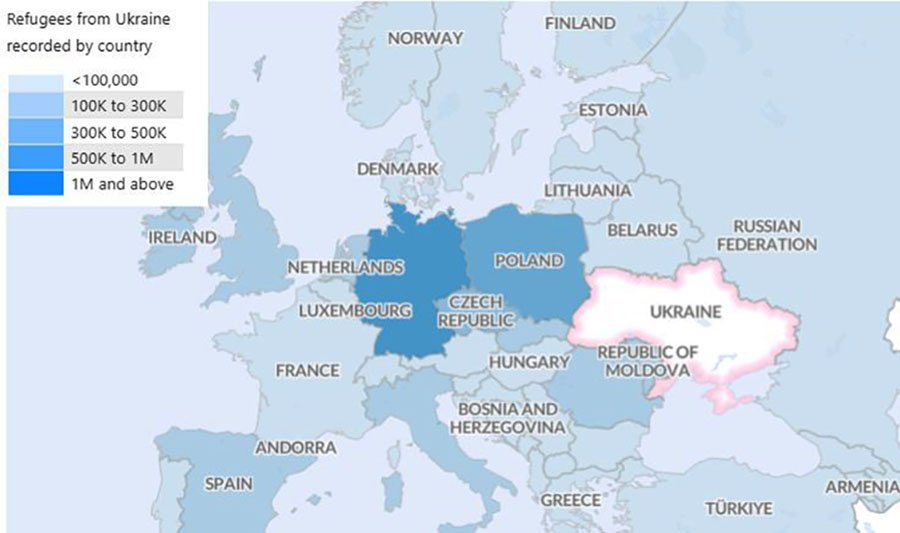
Photo: UNHCR
Across Europe, the rules governing temporary protection for Ukrainian citizens are being updated, while the single EU directive continues to be implemented differently at the national level. The Fragomen overview presents the latest decisions on the duration of the status, renewal procedures, and country-specific requirements, including non-EU states that have introduced their own protection mechanisms.
General conditions
The temporary protection regime in Europe is based on a directive adopted in 2022. Most EU Member States have launched national programmes that differ in a number of respects. Similar frameworks also apply outside the Union, notably in Albania, Norway, Switzerland, and the United Kingdom.
The directive applies to Ukrainian citizens, foreign nationals who were permanently residing in the country before February 24, 2022, as well as their family members — spouses or partners, minor children, and dependent relatives who were living together. At the same time, EU Member States retain significant discretion in defining the categories of persons covered and the conditions of protection, resulting in noticeable differences between countries.
In June 2025, the European Council agreed to extend the temporary protection regime until March 4, 2027. However, if the situation in Ukraine improves significantly, the regime may be terminated earlier, and residence permits issued under it may lose their validity.
In most countries, extending the status requires a photo identification document, proof of protection or permanent residence status issued in Ukraine, and any available evidence of residence in the country prior to February 24, 2022. Family members must additionally provide documents confirming family ties.
National requirements
Albania maintains one of the simplest protection regimes, with no documents required for renewal. In Austria, a standard document package is required, but renewal takes place automatically and no application to migration authorities is needed. Ukrainian citizens covered by this regime may work without a separate work permit, and previously issued work documents remain valid.
To retain status in Belgium, individuals must apply in person at the local municipality and complete the renewal; otherwise, the status may be lost. Proof of actual residence address is also required. Temporary protection holders are exempt from obtaining work permits both for employment and self-employment.
In Bulgaria, individuals must apply in person to the State Agency for Refugees and obtain a new temporary protection card. In Croatia, no separate renewal application is required, but the identity card must be updated at the Ministry of the Interior office at the place of residence. In Cyprus, renewal is automatic.
In the Czech Republic, renewal involves two stages: online registration via the Information Portal for Foreigners, followed by an in-person visit to the Department for Asylum and Migration Policy to obtain a new visa sticker. Authorities have also introduced a new five-year residence permit with work rights for certain temporary protection beneficiaries. It is available to individuals who have held this status for at least two years and are economically self-sufficient. Eligible applicants are notified by state authorities.
A further rule applies whereby temporary protection status may be revoked if the applicant has previously sought similar protection in another country. Any change of address in the Czech Republic must be reported to the authorities within three days.
Denmark does not apply the EU Temporary Protection Directive, having exercised its opt-out from the relevant legislation. Instead, a national regime operates under a special act, which in substance is close to the EU-wide model. Status holders are not required to submit applications or undergo additional procedures.
In Estonia, retaining status requires submitting an application via the Police and Border Guard Board’s electronic self-service portal — no earlier than three months and no later than one month before the current residence permit expires. Applicants receive electronic confirmation and a notification when the document is ready for collection at the nearest office. If the permit has already expired, renewal is only possible in person.
In Finland, existing permits are extended automatically. However, new temporary protection residence permits are now issued for three years instead of the previous four. Finland no longer grants status to foreign nationals who had been residing in Ukraine on the basis of a temporary residence permit. This restriction does not affect those who were granted protection earlier — their permits continue to be extended.
In France, maintaining status requires submitting a renewal application through the prefecture at the place of residence. Authorities recommend applying three weeks in advance, but no later than three days before the temporary residence permit expires. Document requirements and procedures may vary by region, as prefectures apply the rules independently.
In Germany, renewal is automatic and no action is required. An additional condition has been introduced: eligibility for temporary protection is retained by those who entered Germany no later than December 4, 2025. In Greece, no action is required to extend the status, and similar rules apply in Hungary.
In Iceland, the status is extended without an application, but a new residence permit card must be obtained. Authorities send an SMS notification specifying the place and time for collection. Issuance of the card requires a photo appointment within prescribed timeframes, typically close to the expiry date of the current permit.
In Ireland, holders of an Irish Residence Permit with Stamp 4 must renew via the online system. Others do not need to obtain a new certificate. Proof of status can be printed from the immigration service website if required. Authorities also conduct phased address verification to issue and update residence cards.
In Italy, maintaining status requires submitting an application to the authorities. Since 2024, temporary protection holders have been able to switch to standard work-based residence permits, subject to meeting the usual requirements, including a local employment contract and payment of the applicable fee.
In Latvia, the temporary protection regime has been converted to an open-ended framework, with the programme extended without a fixed end date and previous deadlines no longer applying. Status holders receive three-year residence permits. Authorities emphasise that failure to submit an application may lead to cancellation, and processing can take up to three months. Latvia also allows an in-country change of status to another residence permit without leaving the country.
In Lithuania, no additional steps are required for renewal. Residence permits are issued digitally through the MIGRIS system and can be downloaded and used in printed form. The country also allows a switch from temporary protection to other residence or work permits without departure.
Luxembourg has introduced biometric cards for status holders. Failure to comply with renewal requirements may result in loss of the right to reside, work, and receive state support. A transition from temporary protection to a national residence permit is also available, in which case the original status is withdrawn.
In Malta, maintaining status requires submitting a request to the International Protection Agency. Without contacting the agency, the permit is not extended even under the EU-wide temporary protection regime.
In the Netherlands, the status is retained for Ukrainian citizens and foreign nationals who previously held permanent residence in Ukraine. After registering with the municipality, individuals must undergo a review by the Immigration and Naturalisation Service (IND) within four weeks. Upon approval, a sticker or O-document is issued confirming the right to reside and work. For those who had been residing in Ukraine on the basis of a temporary residence permit, protection ended on September 4, 2025.
Norway is not an EU member and applies its own national scheme of temporary collective protection. Extensions are automatic, with no application required. However, the country has introduced territorial and personal restrictions. Since autumn 2024, residents of certain regions of Ukraine no longer qualify for collective protection and their applications are assessed individually under stricter criteria. Exceptions apply to previously submitted applications, current beneficiaries, their family members, and medically evacuated persons. In addition, following rule changes, Ukrainians with dual citizenship may lose eligibility if their second nationality is from a country deemed safe by Norwegian authorities.
In Poland, temporary protection is extended automatically and requires no action from beneficiaries. The extension is закреплён by a separate law adopted after a presidential veto of an earlier reform, again amending the so-called “Ukrainian Special Act”. National rules remain more detailed than in most EU countries. In recent years, Poland has repeatedly adjusted requirements for registration, employer notifications, and the issuance of the PESEL identification number, while also expanding options for switching from temporary protection to other residence and work permits.
In Portugal, renewal is automatic. In Romania, a national Direct Employment programme is in place, allowing Ukrainian citizens to take up employment based on proof of qualifications and a clean criminal record, and then regularise residence in-country without a work permit or long-stay visa from abroad. The status is granted for nine months and can be renewed if employment continues, even if the situation in Ukraine stabilises.
In Slovakia, a three-year residence card is available. Those granted status before mid-December 2024 may obtain it on a voluntary basis, while it is mandatory for new applicants and becomes invalid if temporary protection ends. In Slovenia, applications can be made either at the border through border police or at a local police station. Residence permits are issued immediately upon approval, no government fees apply, and renewal is automatic.
In Spain, legal stay remains valid even if the residence card has expired. A switch from temporary protection to residence permits under the “Entrepreneurs Act” is allowed without leaving the country. Status holders may apply directly in Spain for an EU Blue Card, a Highly Qualified Professional permit, an intra-company transfer permit, or a digital nomad visa. These permits are issued for up to three years with the possibility of renewal.
In Sweden, renewal requires submitting an application. Overall, the rules have been eased: eligibility now extends not only to those who resided in Ukraine before February 24, 2022, but also to individuals who were legally present in Sweden before December 22, 2023.
In Switzerland, a special protection status S applies, and since late 2025 the rules have been significantly relaxed. A work authorisation is no longer required; it is sufficient to notify authorities of the start, end, or change of employment. Travel restrictions imposed on other migrant categories do not apply to S-status holders.
At the same time, the approach to new applications has tightened. Federal authorities have designated certain regions of Ukraine as “safe for return”, and new applicants arriving from those areas may be denied protection. The permitted duration of stays in Ukraine for S-status holders has also been reduced to no more than 15 days per six-month period.
In the United Kingdom, the Ukraine Permission Extension Scheme was launched in February 2025, allowing Ukrainians and their family members to extend their right to stay by a further 18 months. The scheme replaced the previous Ukraine Extension Scheme, while the Homes for Ukraine and Ukraine Family Scheme remain in place for approved participants. Time spent in the UK under any Ukraine scheme does not count towards eligibility for long-term residence.
Some rules have been tightened in parallel. Participation in the Homes for Ukraine programme now requires an approved sponsor, the range of eligible relatives has been narrowed, and the possibility of submitting in-country applications without entry clearance is being gradually phased out. The Ukraine Family Scheme is closed to new applications, but existing beneficiaries retain their rights.
UN statistics
According to the UN, as of December 11, 2025, 5.86
million Ukrainian refugees were registered. Of these, 5.31 million are located in European countries, with a further approximately 549,000 outside the European region.
The largest host countries remain Germany (1.31 million), Poland (976,740), and the Czech Republic (397,240), as well as neighbouring states such as Moldova (137,630) and Romania (197,800). UNHCR emphasises that these figures reflect registered presence and may differ from the actual number of people in each country due to secondary movements and differences in national registration systems.
Analysts at International Investment note that the number of refugees holding temporary protection status is gradually declining, while the requirements for retaining it are becoming stricter. European countries initially viewed this mechanism as a short-term measure, but the prolonged nature of the crisis is forcing authorities to reassess their approaches, tighten procedures, and adapt migration systems to growing economic pressure and budget constraints.