







read also
 Vietnam Mortgage Surge Pushes Homes Out of Reach
 Lithuanian Apartment Prices Accelerate Across Major Cities
 London Flats Lose Value Ahead of Leasehold Reform
 Construction of the Batumi–Sarpi Highway Begins in Georgia
 Baltic Property Investment Accelerates in 2026
 Hong Kong and Singapore Renew Their Expat Rivalry
Georgia Recognised as One of the World’s Safest Countries in the Global Terrorism Index (GTI)
Georgia remains among the world’s safest countries in the ranking compiled by the Institute for Economics and Peace. It ranked 100th with a zero score for the number of terrorist attacks. At the same time, the situation has deteriorated in many countries across Europe, the Middle East, Africa, and South Asia. The Global Terrorism Index 2025 notes that terrorism remains a persistent global threat and that its geographic spread continues to widen.
Long-term dynamics
The study analysed data from 163 countries, with only 25 of them having avoided terrorism since 2007. The number of fatalities fluctuated from a peak of 10,882 in 2015 to a low of 6,824 in 2022. In 2024, the number of countries experiencing at least one incident increased from 58 to 66, the highest level since 2018. For the first time in seven years, more countries deteriorated than improved: terrorist activity increased in 45 countries, while a decline was recorded in 34.
The total number of deaths resulting from attacks fell to 7,555, a 13% decrease compared with 2023. The report links this to the high base effect of the previous year, influenced by the Hamas attack on October 7. Without this factor, the figure would have been close to the 2023 level. The number of attacks in 2024 also declined by 3%, to 3,492, largely due to a sharp drop in activity in Myanmar. Excluding Myanmar, the number of attacks would have increased by 8%.
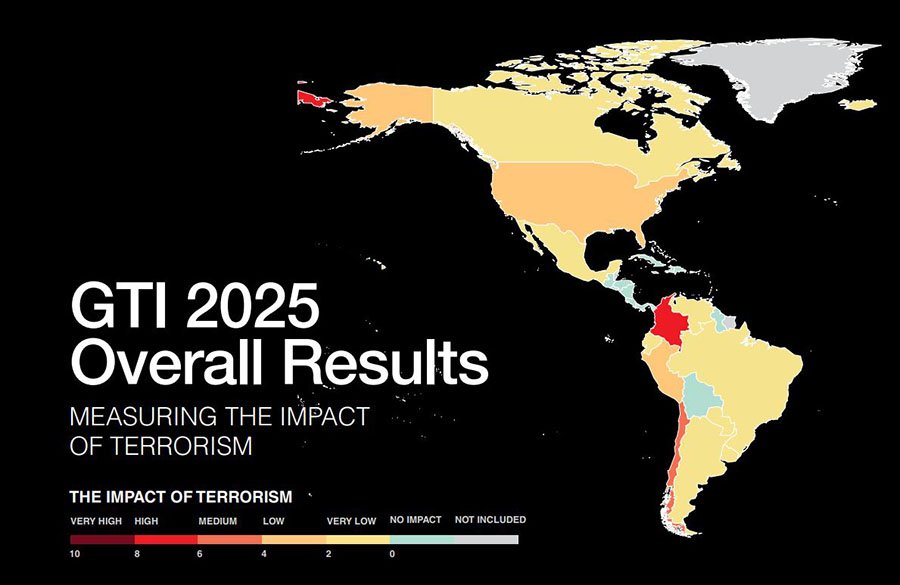
The most dangerous countries
Over several years, the epicentre of terrorism has shifted from the Middle East and North Africa to the Sahel region, where the number of fatalities has increased almost tenfold since 2019. In 2024, the Sahel accounted for 51% of all terrorism-related deaths worldwide, while total conflict-related fatalities exceeded 25,000 — the highest level on record. Five of the ten countries most affected by terrorism are located in this region.
Experts emphasise that changes in the geopolitical balance — the Sahel countries moving away from cooperation with the West and strengthening ties with Russia and China — are creating new opportunities for radical groups to expand their activities, including into coastal areas of West Africa. Competition over natural resources, including uranium and gold, further exacerbates instability.
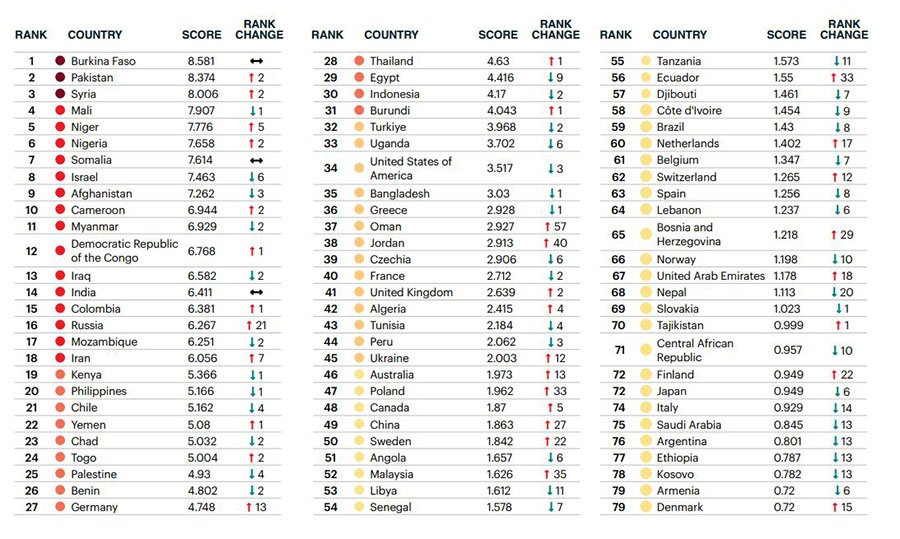
Burkina Faso remains at the top of the negative ranking: despite some improvement, the country still accounts for nearly one fifth of all terrorism-related deaths globally. A significant rise in fatalities was recorded in Niger and Pakistan — by 94% and 45% respectively — underscoring the fragility of positive trends.
Israel ranked 8th, while Afghanistan placed 9th. The report also notes a deterioration in Russia, where 197 terrorism-related deaths were recorded in 2024, placing the country 16th in the ranking. Iran ranked 18th with a figure of 163. Relatively high risks were also recorded in Thailand, Egypt, and Indonesia, which occupy positions 28 to 30 in the index.
Transnational groups
Large transnational groups continue to pose the greatest threat. In 2024, the main sources of violence remained the Islamic State (IS), Jamaat Nusrat Al-Islam wal Muslimeen (JNIM), Tehrik-e-Taliban Pakistan (TTP), and al-Shabaab. The combined number of deaths attributed to attacks by these groups rose by 11% to 4,204. IS and its affiliated structures retained their status as the world’s deadliest terrorist network, operating in 22 countries, although the number of deaths linked to the group declined by 10%, to 1,805.
Assessing the true scale of the threat remains challenging. More than one third of attacks in 2024 were not officially claimed by any organisation. Using a machine-learning model, IEP analysts concluded that reallocating such incidents would increase the number of deaths attributed to IS by 58%, and to JNIM by 176%.
New trends in Europe
In Western countries, the number of lone-actor attacks increased in 2024 from 32 to 52, while in Europe the total number of terrorist incidents doubled to 67. Such attacks are most often carried out by young people, including teenagers, who have no formal ties to organisations. Radicalisation occurs online — through social media, gaming communities, closed messaging platforms, and the dark web — making these threats particularly difficult to detect.
In Europe, one in five individuals detained on terrorism-related charges is legally classified as a child. Incidents were also recorded in countries traditionally considered relatively safe, including Sweden, Finland, the Netherlands, Denmark, and Switzerland. Germany ranked worst among Western countries, placing 27th in the index. Seven Western states are now among the top 50 countries with the highest terrorist impact.
Medium risk level and countries without attacks
The category of medium risk begins with Turkey, ranked 32nd. It is followed by Uganda, the United States, and Greece. France and the United Kingdom are also included in this group. Ukraine ranks 45th, Poland 47th. Canada, China, and Sweden appear further down the list. Switzerland is ranked 62nd, Spain 63rd, and the UAE 67th.
Lower scores are recorded for Finland, Japan, Italy, and Argentina, although they remain within the same category, along with Armenia, Denmark, and Cyprus. Azerbaijan and Belarus share 90th place, while New Zealand ranks 94th. Eswatini, Paraguay, and Uruguay close this group.
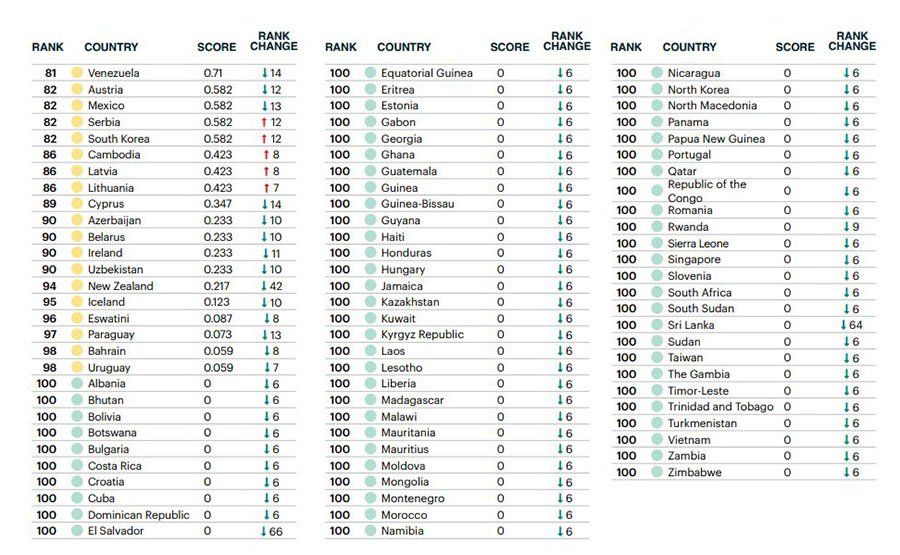
The group of countries with a zero index score occupies 100th place in the GTI 2025 table, shared by 65 states. These include Albania, Bulgaria, Croatia, Estonia, and Georgia. Hungary, Kazakhstan, Moldova, Montenegro, Taiwan, and Vietnam are also in this category. Analysts note, however, that a low index value does not mean a complete absence of threats: in a number of countries, risks related to lone-actor attacks and hate crimes persist, increasingly outside the framework of organised terrorist structures.
Conclusion
Regional analysis shows that almost 95% of all terrorism-related deaths in 2024 occurred in three regions — sub-Saharan Africa, the Middle East and North Africa, and South Asia. In North America, politically motivated attacks have predominated since 2007, with a significant share linked to far-right views.
The report also notes a rise in antisemitic violence and hate crimes: in the United States, the number of such incidents increased by more than 200% over the year, while in the first two months after the start of the Gaza war the increase reached 270%.
Technology is emerging as a separate factor. Artificial intelligence and digital platforms are being used by both radical groups and security services. The former employ AI to produce propaganda, deepfakes, and personalised content, while the latter use it to detect radicalisation and counter extremism. The authors of the report emphasise that over the next decade, the application of AI will largely shape the evolution of the terrorist threat.
Overall, GTI 2025 shows that terrorism is becoming less concentrated but more widespread, shifting into new regions and increasingly manifesting in non-traditional forms. Analysts at International Investment emphasise that security is becoming an independent criterion for evaluating countries. Against the backdrop of the expanding geography of terrorism, a zero index score, as recorded in Georgia and a number of other states, points to a consistently low level of risk rather than a one-off statistical outcome. Countries with this profile tend to offer a more predictable environment — both for internal stability and for long-term decisions in tourism, business, and investment.
Read more:
World Bank Recognizes Georgia as One of the Best Countries for Doing Business
TOP 10 Most Dangerous and Safest Countries and Cities in the World in 2026
Ranking of national leadership: where governments are closest to their populations
TOP-10 Richest Countries in the World
Country Safety Ranking in 2025: Global Safety Index