







read also
 Australia’s Spring Auctions Rise but Remain Well Below 2025
 Number of Foreigners Holding Turkish Residence Permits Exceeds 1.27 Million
 Demand from Russian Tourists for Holidays in Georgia Rises by 20–25%
 Montenegro Property Buying Costs in 2026
 Four in Ten Companies Would Not Choose Slovakia
 Gulf Countries Prepare Unified Tourist Visa
All-Inclusive Redefines Modern Luxury
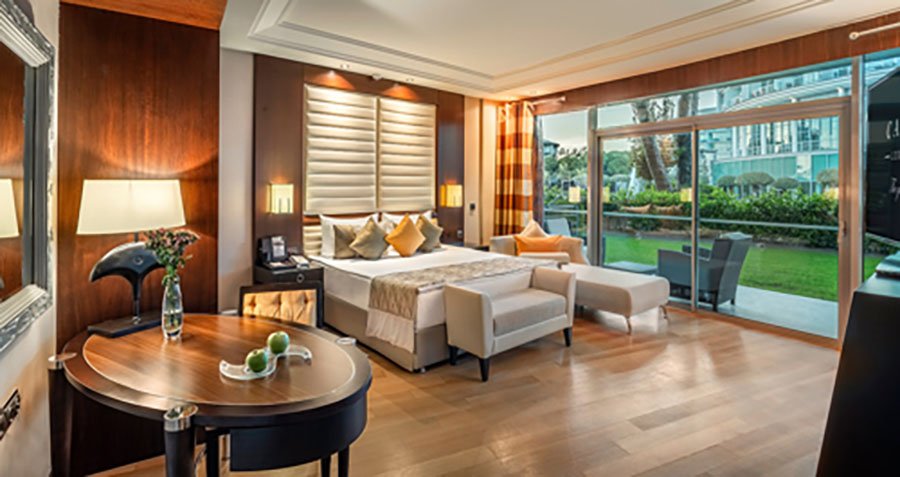
Photo: Calista.com.tr
All-inclusive is undergoing a clear repositioning: what used to be framed as a “value-first” vacation is increasingly sold as controlled luxury—budget certainty, high service density, and fewer friction points for guests. Industry trend reporting supports the shift. Expedia Group’s Unpack ’25 coverage notes that 42% of Gen Z travelers say an all-inclusive resort would be their preferred hotel type, and one-third say their perception of all-inclusive hotels has improved over the past year.
Why “everything included” no longer feels like a trade-off
The definition of value has changed. Travelers aren’t only optimizing for price; they are optimizing for predictability and simplicity. All-inclusive delivers cost control, reduces decision fatigue on property, and bundles food, drinks, and activities into a single, comprehensible promise. The winning products increasingly sell a narrative rather than a checklist—an intentional, curated vacation flow that feels effortless without feeling generic.
From mass leisure to a modern product standard
The roots of packaged leisure in Europe run deep, but the “modern” commercial reference point for the all-inclusive concept is often linked to Club Med’s early model starting in 1950 in Mallorca, Spain—an approach built around simplicity, community, and an integrated holiday experience that later scaled into a global blueprint.
Over time, the category evolved from standardized holiday camps into a segmented market where inclusivity can be paired with design, premium dining, and locally anchored experiences.
Where the model is heading: service, dining, and place
The competitive edge is no longer the sheer number of outlets or activities—it’s the quality of what’s included and how convincingly it matches the brand promise. Dining is a key battleground: many resorts are attempting to rival city dining standards and turn restaurants into destination features rather than functional cafeterias. At the same time, authenticity is becoming non-negotiable. Guests increasingly want a sense of place—local ingredients, regional culture, and partnerships beyond the resort boundaries—because a beautiful, interchangeable experience is no longer enough.
The trust killers: where all-inclusive still fails
The model typically loses credibility in three places. First, when “local culture” is staged rather than felt. Second, when the boundaries of inclusion are blurry and the guest experiences constant add-ons for what seems essential. Third, when properties chase “premium” positioning but fail to balance mass scale with individual expectations across different traveler types.
What it means for the industry and for travelers
For travelers, all-inclusive increasingly represents the purchase of calm—financial clarity and fewer decisions—especially in periods of volatile prices and peak-season stress. For the industry, it’s a race toward “quality inclusion”: transparency, consistency, and authenticity determine who can price higher without triggering skepticism.
This format is taking shape differently across individual markets. In mature resort destinations, it is evolving through the modernization of existing models, while in emerging markets all-inclusive is being designed from the outset as part of a higher-end segment — without the legacy of mass tour packages and with a focus on controlled quality.
New destinations for investors
One of the emerging and increasingly attractive destinations for investors is Georgia, where the all-inclusive format is only beginning to be institutionalized as a premium product. Here, it is developing as a tool for creating a resort environment with predictable service standards, dense infrastructure, and a clearly defined level of guest experience.
Among the largest projects following this logic is the Wyndham Grand Batumi Gonio hotel complex. The global portfolio of the international Wyndham network includes around 85 Wyndham Grand hotels in the luxury segment, and only three of them operate in All Inclusive and Ultra All Inclusive formats. The complex, located in one of Batumi’s most prestigious areas, will become the third such project worldwide and will be launched under the Premium All Inclusive concept.
International Investment expert conclusion
As International Investment experts report, the all-inclusive comeback is not a short-lived trend but a response to a new traveler baseline: people will pay for lower stress and budget certainty, but they now demand that “included” is validated by real quality—service standards, food and beverage credibility, cultural grounding, and a pricing structure that doesn’t feel like hidden fees.