












Construction in Georgia: Record Housing Completions Expected in 2026 — Galt & Taggart Forecast

Georgia’s residential construction market is set to reach peak levels in 2026. Analysts at Galt & Taggart attribute this to the completion of numerous projects and a large volume of issued permits. The sharpest growth is expected in Tbilisi and Batumi, where projects launched during the period of surging demand are being completed simultaneously. Going forward, the focus may shift from development to the furnishing and fit-out stage, along with a potential decline in prices and rental yields.
Scale of Construction in Georgia
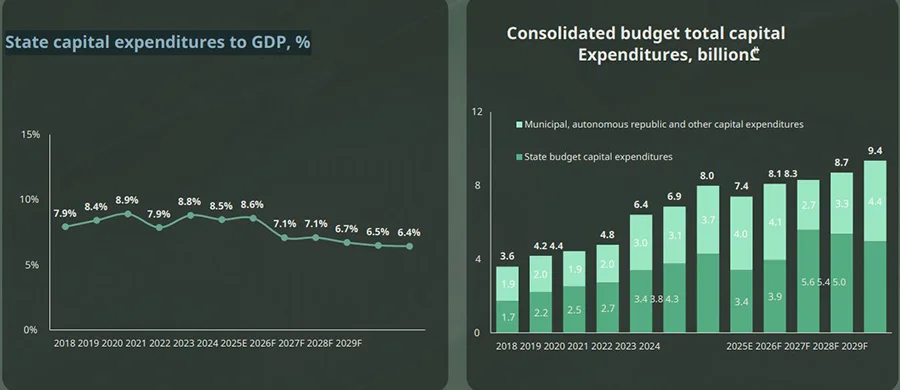
Rising prices and record demand from both the public and private sectors have driven the growth of the construction industry, which remains one of the key engines of Georgia’s economy. From 2015 to 2025, its volume increased from $2.5 billion to $7.3 billion. The most rapid growth was recorded in 2022–2024.
The sector’s share of GDP fluctuates between 7.3% and 10.2%. In 2025, it is estimated at around 8.0%, placing Georgia among countries where construction plays a significant role in the economy. In Armenia and Azerbaijan, the figures are lower — 7.6% and 7.4%, respectively. In Turkey, it is only 6.6%. For comparison, the study also cites other countries: 5.1% in Portugal, 8% in Croatia, and 10.1% in Kyrgyzstan.
Construction Permits in Georgia
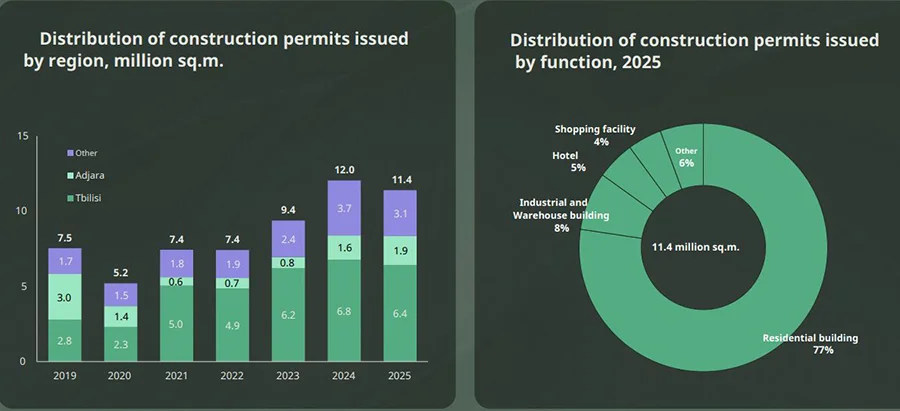
The total area of issued construction permits in Georgia remains at a high level, driven primarily by the residential real estate market. A record 12 million sq. m was registered in 2024, followed by a slight decline to 11.4 million sq. m in 2025. Tbilisi continues to lead with peak figures of 6.8 million sq. m and 6.4 million sq. m, respectively.
Adjara shows steady growth, increasing from 1.6 million to 1.9 million sq. m. Other regions accounted for 3.1 million sq. m. Overall, there is a clear trend toward concentration of activity in the country’s largest urban centers, while regional shares remain stable.
Residential buildings dominate the structure of construction permits in Georgia, accounting for 77%. All other segments lag significantly behind: industrial and warehouse buildings — 8%, hotels — 5%, and retail properties — 4%.
Housing Construction Outlook in Georgia
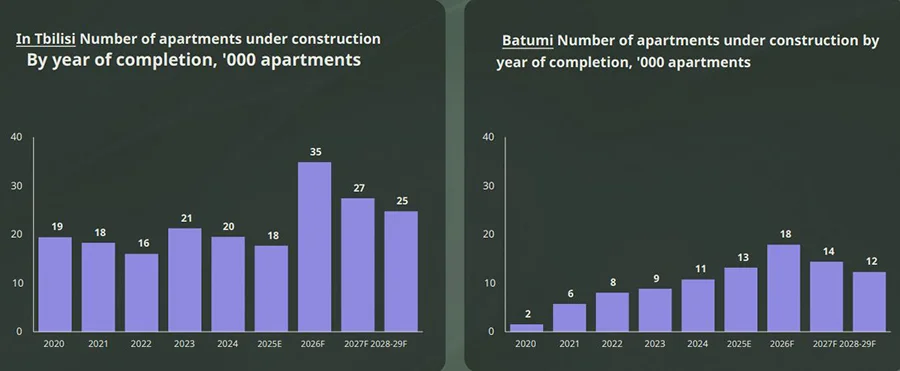
In 2026, a record number of residential units is expected to be completed. In Tbilisi, 35,000 units are projected for delivery. Over the next three years, volumes will remain high: 27,000 in 2027 and an average of 25,000 annually in 2028–2029. For comparison, between 2020 and 2025, the figure ranged from 16,000 to 21,000 units.
In Batumi, completed volumes increased from 2,000 units in 2020 to 13,000 in 2025. The peak is also expected in 2026, reaching up to 18,000 units. In 2027, around 14,000 units are projected, followed by approximately 12,000 annually in 2028–2029.
Thus, 2026 will mark the peak in housing completions in Georgia’s largest cities, after which the market is expected to shift toward a gradual slowdown in delivery volumes while maintaining a relatively high level of activity. This may lead to a further shift in focus toward furnishing and home improvement.
Construction Costs in Georgia
The cost structure in 2025 highlights a strong dependence on materials, which accounted for around 50% of total expenses. This is followed by labor costs (31%), machinery and equipment (10%), and transportation (4%). In 2026, construction costs are expected to rise again by about 8% due to external factors, including the war involving Iran. Wages are also projected to grow by approximately 9%.
Revenue in the construction and renovation materials market has nearly doubled in recent years, reaching $5.9 billion in 2025. It is expected to increase further to $6.3 billion in 2026, albeit with a slight slowdown in growth rates.
The market structure is shifting toward the home improvement segment, which already accounts for about 65% of total revenue, compared to 35% for basic construction materials. The sector also remains heavily import-dependent, with around 65% of products sourced from abroad. The most localized segment is basic construction materials.
Investment Outlook in Georgia’s Real Estate Market
Housing: Declining Returns
A significant share of residential property in Georgia is built and purchased for rental income. However, active construction and rising completion volumes are creating oversupply, which is gradually reducing profitability.
In Batumi, the most attractive market for investors, gross rental yields for apartments declined from 10% in 2023 to 7.4% in 2025. Galt & Taggart forecasts a further drop to 5.1–3.4%. Analysts at International Investment note that nominal yields do not reflect the real picture.
After accounting for management, cleaning, commissions, utilities, maintenance, and vacancy, net yields typically fall to 3–4%, and often lower when vacancy rates are high. If the apartment stock doubles, as projected, net returns could decline to 1.5–2% or approach zero.
Hotel Sector: A More устойчивый Model
The hotel segment demonstrates a more stable investment model. The key difference lies in centralized management, where costs are distributed across the entire property rather than borne by individual owners. This reduces income volatility and provides more predictable returns.
The gap between the two models is substantial. With an average nightly rate of $34 for apartments versus $286 for hotels, and occupancy rates of 31% versus 68.6%, gross income differs by nearly 19 times. Hotel room yields are estimated at 10–17% net, compared to 2.8–3% for apartments.
At the same time, Batumi’s hotel market remains limited in terms of high-quality supply: it is dominated by city hotels and a small number of international chains. New projects in the luxury and all-inclusive segments are shaping the next phase of market development and are considered the most promising for investment, in line with global trends.
FAQ
What are the current housing construction volumes in Georgia?
After a record 12 million sq. m of permits in 2024, the market remains at a high level: 11.4 million sq. m in 2025, with completions expected to peak in 2026.
How much housing will be completed in 2026?
Around 35,000 units in Tbilisi and up to 18,000 in Batumi, marking the highest level on record.
How does construction growth affect the market?
Rising volumes create an oversupply, intensify competition, and put pressure on prices and rental rates.
What is the current housing yield in Georgia?
Net yields for apartments typically stand at 3–4% after expenses and continue to decline.
Which is more profitable: apartments or hotels?
Hotels offer a more stable model, with yields of 10–17% compared to 2.8–3% for apartments.