







 Covivio Hotels Revenue Grows 4.7% as European Markets Split
 Lithuanian Apartment Prices Accelerate Across Major Cities
 Georgia's Tourism Revenue Hits Record High
 Norway's Sovereign Fund Commits €1.5bn to European Warehouses
 Market Rout of October 2026: Can Branded Hotels Protect Capital?
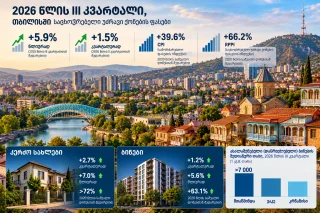 Residential Property Prices in Tbilisi Rise by 5.9% Year-on-Year
Mass cancellations of new-build home deals in southern Israel

Globes
Buyers in southern Israel are increasingly cancelling new-build home deals, Globes reports. By the end of the second quarter, 669 contracts signed between 2022 and 2025 had been terminated. Developers now have to resell these apartments, adding to supply in a region where demand is already weakening.
New-build market trends in southern Israel
Back in the first quarter of 2022, demand in southern Israel exceeded new supply: the number of homes where construction had started for sale on the open market was about 1,200 lower than the number sold. By the end of the second quarter of 2026, the situation had reversed. The gap between housing starts and sales reached around 11,000 units.
At the same time, the stock of unsold housing is growing. By the end of June, there were 10,788 unsold units in the Southern District, according to Israel’s Central Bureau of Statistics. Another 669 had previously been counted as sold, but buyers later cancelled their contracts. Including these cases, the actual supply could reach 11,457 units — around 6% above the official figure.
Galit Ben Naim, Deputy Chief Economist at Israel’s Ministry of Finance, notes that after a deal is cancelled, the property is not always returned to the statistics on unsold housing. A significant share of these units is already under construction. As a result, official figures may not fully reflect the amount of housing that remains available on the region’s primary market.
As an example, Ben Naim cites a participant in the “Price for the Newcomer” program. After becoming eligible to take part in a housing lottery, it emerged that he had purchased a home on the open market twice and later cancelled both deals. He currently owns no property but has to prove this because records held by the Israel Tax Authority still contain information about the previous purchases.
New home sales in Israel are declining
Demand in Israel’s primary housing market remains weak, although some periods show a temporary recovery. Around 7,600 residential transactions were completed nationwide in July, 13.7% fewer than in June. New-build sales fell by about 20% to 2,930 units, while excluding government programs, developers sold around 1,820 homes — 26% fewer than in the previous month.
Activity was stronger overall in May–July, when around 25,160 homes were sold nationwide, including 10,470 new units. The three-month result exceeded both the February–April figure and the level recorded in the same period of 2025. Government subsidy programs accounted for 33.7% of primary-market sales.
The stock of unsold housing remains high. By the end of July, nearly 85,000 new homes were available on the market — enough for 26.9 months of sales at the current pace. The situation has changed little since the beginning of 2026.
Israeli developers rent out unsold homes
Israeli developers are reluctant to cut prices on unsold apartments and are instead temporarily offering some properties for rent. Tal Kopel, CEO of real estate platform Madlan, explains that substantial discounts can affect the perception of a project, upset previous buyers and reduce the bank valuation of the remaining units.
Temporary rentals are already being used in Modiin and Bat Yam. Dona Engineering is renting out around 20 apartments for one or two years before planning to offer them for sale again. At the Panorama North development, around 78 of the 113 units are intended to be rented for ten years, allowing the project to benefit from tax incentives.
Rental payments help reduce the cost of maintaining vacant properties and partly offset financing expenses. However, postponing sales is mainly an option for companies with sufficient financial resources. Another alternative is to sell large portfolios to investment funds, although such buyers typically expect a substantial discount.
Israel reduces land supply for new housing
In 2024, the Israel Land Authority offered sites for the construction of 113,197 homes. The figure fell to 91,993 in 2025 and reached 35,143 in January–September 2026. There is currently no housing shortage, however: by the end of June, 217,200 residential units were under construction nationwide, 8% more than in the same period of 2025.
Developers’ interest in new sites has weakened because of sluggish sales and high financing costs. Military events and political uncertainty in Israel have also affected activity. Further delays arise at the municipal level, as local authorities need to plan roads, schools, kindergartens and other infrastructure for new residential districts.
The number of new sites could still increase before the end of the year, as the Israel Land Authority traditionally steps up tenders in the final months. However, the current decline may affect the market later. The pipeline of projects remains large for now, but in several years a shortage of prepared land could limit the launch of new residential developments.
What this means for investors
International Investment analysts note that conditions in Israel’s housing market have become less favorable for investors, primarily because of weak sales and the accumulated stock of new homes. This makes properties harder to resell and reduces the potential to profit from capital appreciation, particularly over a short investment horizon.
Average gross rental yields in Israel stand at around 3.05% nationwide and 2.94% in Tel Aviv, according to Global Property Guide. Given the traditionally high entry costs, such returns make buy-to-let investment less attractive once ongoing expenses are taken into account.
Further uncertainty comes from deal cancellations, cautious buyer sentiment and continuing tensions in the region. Together, these factors weaken the risk-return profile of Israeli residential property. Even local investors often consider overseas markets where investment conditions may be more attractive.