











International capital returns to German housing
Why funds are buying again while homes remain expensive for private buyers
Germany's investment market is still far from its previous levels of activity, but residential real estate has shown a clear shift. Transactions reached almost €5.9 billion in the first nine months of 2026. The third quarter was the strongest of the year at around €2.3 billion, up 17% from the second quarter. The nine-month total was still 4% below the same period of 2025, so this is not a new boom. The change is being driven by large portfolio transactions and international capital. Meanwhile, Destatis reports rising residential building permits, even as the number of completed dwellings remains weak.
Market at a glance
|
9M 2026 residential investment |
€5.9bn |
|
Q3 2026 investment |
€2.3bn (+17% q/q) |
|
Portfolio deals in Q3 |
~75% |
|
Foreign buyers in Q3 |
~75% |
|
Prime multifamily yield, Top 7 |
3.59% |
|
2026 outlook |
~€8bn |
Funds are moving before private buyers
For private buyers, Germany remains a difficult market. Financing is expensive and limited supply supports rents in major cities. Institutional investors look at a different equation: portfolio pricing, long-term rental cash flow and the potential to improve returns through active asset management.
Germany's Federal Statistical Office reported that residential property prices rose only 0.6% year on year in the second quarter of 2026 and 0.3% from the previous quarter. Apartment prices in the seven largest cities fell 0.4% year on year. The figures do not point to a new price boom, but they suggest the broad decline has stopped. Destatis also recorded a wide regional gap, with apartment prices in large cities outside the Top 7 up 2% year on year.
The housing shortage persists despite more permits
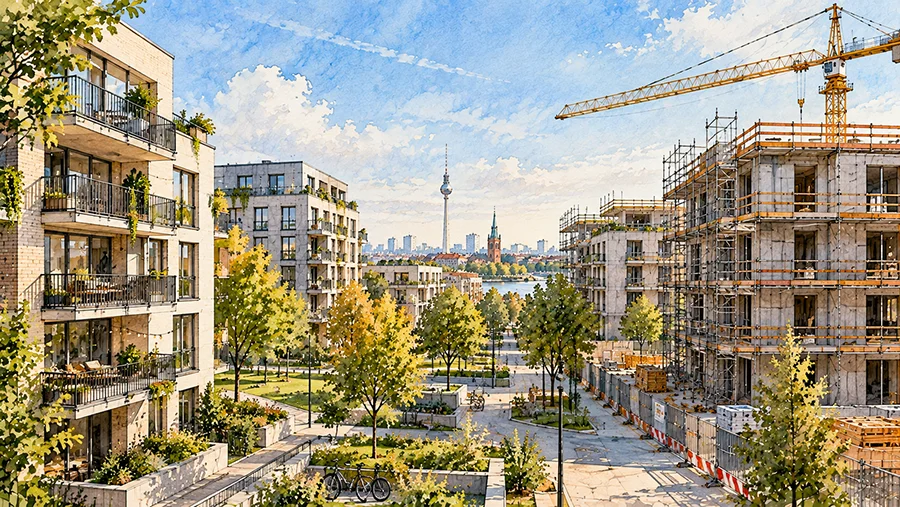
Supply remains the central argument for residential investment. Germany completed 206,600 dwellings in 2025, 18% fewer than a year earlier and the lowest total since 2012. At the end of the year, 760,700 approved dwellings were still unfinished. The backlog shows how different a building permit is from actual new supply.
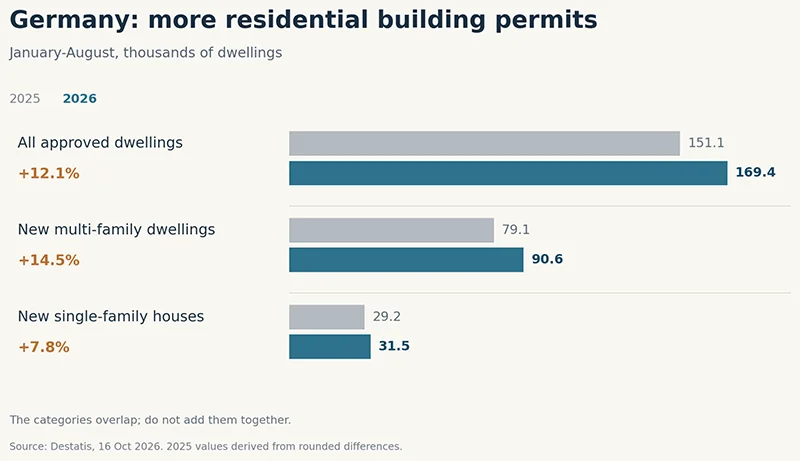
The latest Destatis release, published on 16 October, confirms stronger permitting. In August 2026, authorities approved 20,600 dwellings, 6.8% more than a year earlier. Across January–August, permits covered 169,400 dwellings in new and existing buildings (+12.1%), including 90,600 apartments in new multifamily buildings (+14.5%). A building permit is not proof that construction has started or homes have been completed.
Of the 169,400 approved dwellings, 137,500 were in newly planned residential buildings (+12.7%). New multifamily buildings accounted for 90,600 apartments (+14.5%), while new single-family houses represented 31,500 (+7.8%). Another 29,100 dwellings were approved through alterations of existing residential and non-residential buildings (+10.1%). Some categories are subsets of the overall total and should not be added together.
A permit marks the beginning of a longer construction cycle. At the end of 2025, Germany still had 760,700 approved but unfinished dwellings, including 307,200 already under construction. During the same year, 35,700 dwelling permits expired. Destatis calculated that residential buildings completed in 2025 had taken an average of 27 months from permit to completion. The monthly permit series can also be revised as authorities submit information after the reporting deadline.
The July forecast from ifo and EUROCONSTRUCT projected approximately 185,000 completed dwellings in Germany in 2026 and 195,000 in 2027. Even the 2027 projection is below the 206,600 homes actually completed in 2025. The projection predates October's new permit figures and has not been recalculated in response to that release. It illustrates the delay between early-stage project activity and housing becoming available.
This matters directly to investors. CBRE reported that existing properties accounted for approximately 89% of German residential investment in the third quarter: completed homes can earn rent now, while new developments still carry construction-cost and timing risk. International Investment has examined proposed EU changes to housing construction rules and growth in European prefabricated housing, but neither reform nor industrial building methods can turn a permit into a completed dwelling immediately.
Rents keep rising
Limited supply continues to support rental growth. Median rents across Germany's 20 largest residential markets rose by about 4% year on year in the first quarter of 2026. Average service charges reached €2.49 per square metre per month nationwide and €2.94 in the Top 7 cities. CBRE does not expect meaningful near-term relief for tenants.
For institutional investors, resilient rental demand matters more than short-term movements in owner-occupied prices. Yet returns also depend on borrowing costs, property maintenance and planned upgrades. Renewed interest in operating portfolios therefore does not necessarily mean that funding new construction has become equally attractive.
Large portfolio deals are driving the market
The shift is clearest in the structure of transactions. Portfolio deals accounted for around 75% of third-quarter investment volume and existing assets for 89%. A handful of large transactions generated more than half of the quarterly total, while the number of deals fell from 51 to 44.
The market has therefore not become broadly more active. Large buyers with discretionary capital and active asset-management strategies are doing most of the work. Value-add and opportunistic strategies represented about 58% of volume, compared with roughly 42% for core and core-plus capital.
The wider German real estate investment market remains more cautious. Total transaction volume across asset classes reached €23.2 billion in the first nine months, only slightly above the previous year. Decision-making is slower and higher financing costs continue to push investors to reassess pricing.
What is happening to yields
Average prime yields for multifamily housing in Germany's seven largest cities rose by 0.2 percentage points to 3.59% in the third quarter. That puts pressure on valuations for some owners but creates a more attractive entry point for buyers. CBRE expects a further moderate increase in yields by year-end.
CBRE also considers a full-year residential investment volume of around €8 billion achievable if several larger portfolio transactions close in the fourth quarter. This would not mark a return to the cheap-money era, but it would confirm that capital is becoming more willing to move.
Why Germany is attracting international funds again
German housing now offers investors a combination of three factors: prices have stopped falling rapidly, rents are still rising and construction is not keeping pace with demand. For an international fund, this creates an opportunity to enter after repricing and manage an asset over the medium term. International Investment has also examined how a shortage of new homes may sustain prices in other European markets.
Private buyers face a different reality. Mortgage costs remain high and supply is limited in the most sought-after cities. Institutional capital can therefore return before mass-market buyers do.
International Investment covered the earlier phase of Germany's housing slowdown in spring 2026, when uncertainty and expensive financing were still holding back demand. The third quarter now adds a new layer: large investors are moving before the mass market.
Buyers of operating portfolios and housing developers are assessing the German market on different terms. The former can acquire existing rental income after repricing, while the latter still need financing, permits and construction budgets that work. More approvals suggest a possible recovery in future supply, but do not mean Germany's shortage of homes will disappear in the next few years.
FAQ
Are German house prices rising in 2026?
Yes, but only slightly overall. Residential prices rose 0.6% year on year in the second quarter, while apartment prices in the seven largest cities fell 0.4%.
Why are international funds returning?
They are attracted by resilient rental demand, limited housing supply and the ability to buy large existing portfolios after the repricing of real estate.
What is happening to rents?
Median rents in the 20 largest residential markets rose about 4% year on year in the first quarter of 2026, while service charges also increased.
What are residential yields in Germany?
Average prime multifamily yields in the seven largest cities reached 3.59% in the third quarter. CBRE expects a further moderate rise.
How many dwelling permits did Germany issue in January–August 2026?
Destatis recorded 169,400 approved dwellings, up 12.1% year on year. The August total was 20,600, an increase of 6.8%.
Why will more permits not end Germany's housing shortage immediately?
Permits precede construction and completion. At the end of 2025, 760,700 approved dwellings remained unfinished, and some permits had expired without the homes being delivered.
How many homes are expected to be completed in Germany in 2026 and 2027?
An ifo forecast published in July projected 185,000 completions in 2026 and 195,000 in 2027. These are projections, not final building statistics.