







 European Hotels Gain 5% RevPAR as Investment Reaches €15.7bn
 Georgia Accommodation Producer Prices Rise 5.2%
 DXB Passenger Traffic Falls 28.1% in Nine Months
 InterContinental Plans Its First Montenegro Resort in Tivat
 Portugal Reconsiders Its 10% Rental Income Tax Relief
 Scotland Proposes Higher Council Tax for Million-Pound Homes
The world's most expensive shopping streets in 2026
Retail rents on the world's leading shopping streets continue to rise, although growth has slowed for the second consecutive year. New York has returned to the top of Cushman & Wakefield's global ranking, overtaking London and Milan. Meanwhile, competition for commercial real estate is gradually spreading beyond traditional luxury retail destinations.
Global shopping street rankings by rental cost
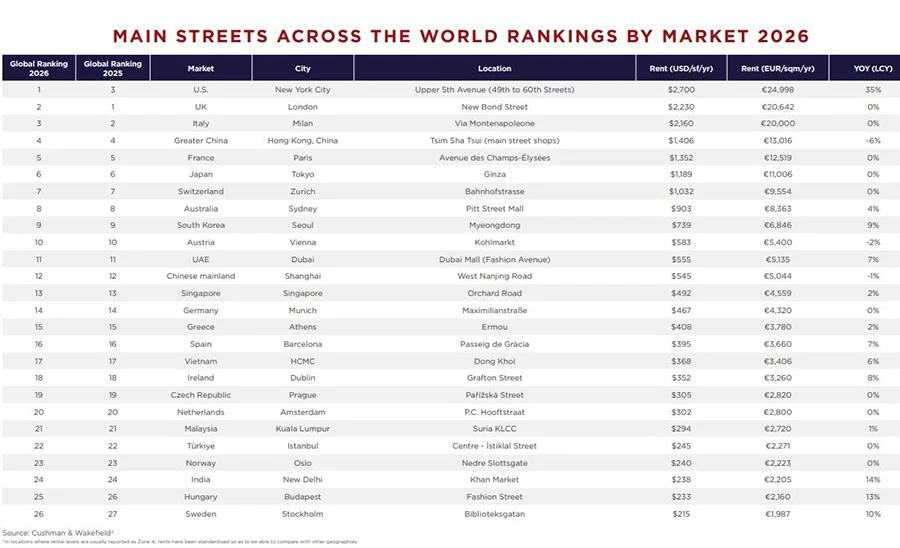
The global shopping street ranking is based on an analysis of rental rates across 147 locations. The final list comprises 50 entries, one from each market represented. All figures are expressed in euros per square metre per year.
New York's Upper Fifth Avenue reclaimed the top spot, rising from third place. Rents increased by 35% year on year to €24,998. London's New Bond Street (€20,642) and Milan's Via Montenapoleone (€20,000) each slipped one position, with rental rates unchanged.
Hong Kong’s Tsim Sha Tsui (€13,016) and the Champs-Élysées in Paris (€12,519) round out the top five. They are followed by Ginza in Tokyo (€11,006), Bahnhofstrasse in Zurich (€9,554) and Pitt Street Mall in Sydney (€8,363). Myeongdong in Seoul (€6,846) and Kohlmarkt in Vienna (€5,400) occupy ninth and tenth place, respectively.
Among the top ten, apart from the US leader, rents increased only in the South Korean capital (+9%) and Sydney (+4%). Rental rates fell by 6% in Hong Kong and 2% in Vienna, while the remaining streets saw no change from 2025.
Regional retail property rankings
The regional rankings also include other prestigious streets in each market. Rome's Via Condotti ranks third in Europe, with annual rents of €16,000 per square metre, ahead of the Champs-Élysées. US locations occupy all of the top 17 positions in the Americas. In Asia Pacific, Hong Kong and Tokyo account for four of the top five entries.
Prague has one of the highest rental rates in Central and Eastern Europe. Rents increased by 13% in Budapest and 2% in Warsaw. Retail space in Belgrade costs roughly the same as in Bucharest, but rates in the Serbian capital remained unchanged over the year.
Retail rents on leading shopping streets in selected European markets and Cyprus
|
City |
Shopping street |
€/sq m/year |
YoY |
|
Prague |
Pařížská |
2,820 |
0% |
|
Istanbul |
Istiklal |
2,271 |
0% |
|
Budapest |
Fashion Street |
2,160 |
+13% |
|
Warsaw |
Nowy Świat |
1,128 |
+2% |
|
Bucharest |
Calea Victoriei |
1,080 |
+29% |
|
Belgrade |
Kneza Mihaila |
1,080 |
0% |
|
Zagreb |
Ilica |
840 |
0% |
|
Sofia |
Vitosha Blvd |
756 |
+4% |
|
Ljubljana |
Čopova |
720 |
0% |
|
Limassol |
Anexartisias Ave |
600 |
+6% |
|
Bratislava |
Obchodna |
540 |
0% |
|
Vilnius |
Gedimino / Pilies / Didžioji |
468 |
0% |
|
Riga |
Central streets |
420 |
0% |
|
Tallinn |
Central business district |
420 |
0% |
Where retail rents are rising fastest
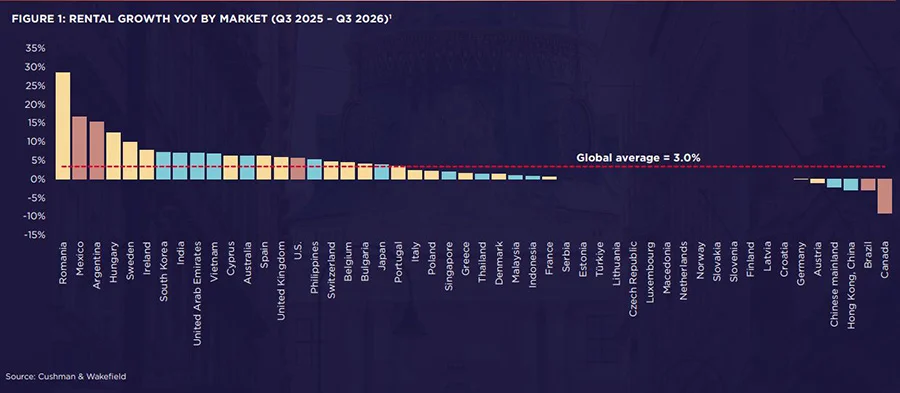
In 2026, retail rents across the locations surveyed increased by an average of 3% in local currency terms. Growth stood at 4.3% in 2025 and 5% in 2024. Rents increased on 49% of streets, remained unchanged on 32% and declined on 19%.
In Asia Pacific, rental growth accelerated from 2.3% in 2025 to 3.1% in 2026. India recorded particularly strong increases: rents on Mumbai's Linking Road rose by 28% year on year.
Growth in the Americas slowed from 7.9% to 3.1%, but accelerated in the US from 2.4% to 5.8%. Miami recorded the sharpest increase, with rents on the Brickell Boulevard Corridor rising by 43%. Austin's South Congress saw a 20% increase. Annual rents reached €2,778 per square metre in both locations.
The picture was more mixed in Canada and Brazil. Rents on Toronto's Bloor Street fell by 17%, causing the street to drop five places in the global ranking. In São Paulo, Oscar Freire Jardins recorded a 26% decline, while rents on Avenida Paulista increased by 8%.
Average rental growth in Europe reached 2.9%. Bucharest's Calea Victoriei led the region with a 29% increase, lifting the Romanian capital three places in the global ranking. In London, rents on Regent Street and in Covent Garden rose by 13%.
Rental growth in local currencies
|
Region |
2025 |
2026 |
|
Asia Pacific |
+2.3% |
+3.1% |
|
Americas |
+7.9% |
+3.1% |
|
Europe |
+4.0% |
+2.9% |
|
US |
+2.4% |
+5.8% |
|
World |
+4.3% |
+3.0% |
International brands drive demand
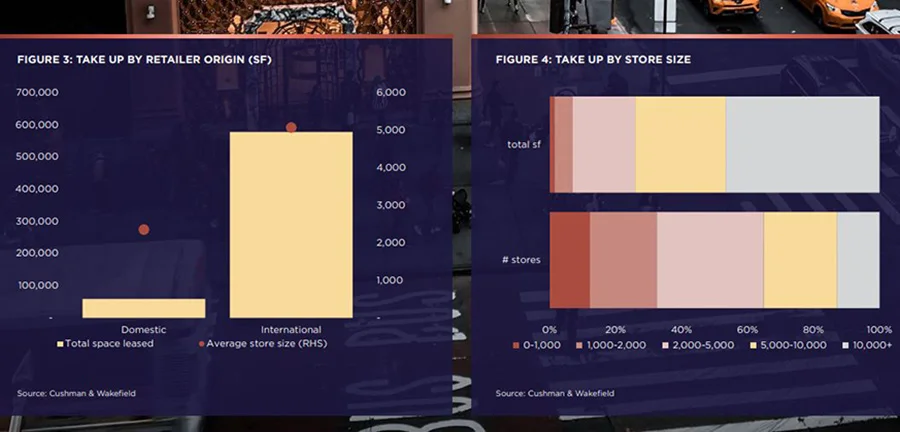
Across 30 leading shopping streets, 153 leasing deals and store openings were recorded over the year, covering more than 75,700 square metres. Cushman & Wakefield estimates that the combined annual rent for these properties exceeds $647 million at prevailing market rates. More than 80% of deals involved companies not previously represented on the respective streets.
International chains accounted for approximately 90% of leased space. Their stores averaged around 465 square metres, more than twice the size of those operated by domestic retailers. Units exceeding 929 square metres represented just 13% of transactions but 47% of total space leased.
Fashion and apparel retailers accounted for half of all deals and 57% of leased space. Health and beauty ranked second by floor area (15%), partly driven by the expansion of South Korean and Japanese cosmetics brands. In prestigious districts of Paris, Milan and London, European companies are competing for limited space with new entrants from Asia and North America.
Retail take-up by tenant category across 30 leading shopping streets
|
Segment |
Share of space |
Share of stores |
|
Fashion and apparel |
57% |
50% |
|
Health and beauty |
15% |
11% |
|
Personal goods |
9% |
15% |
|
Food and beverage |
8% |
10% |
|
Home and DIY |
3% |
3% |
|
Jewellery and watches |
1% |
1% |
|
Leisure |
1% |
1% |
|
Other |
6% |
9% |
Retailers expand into new districts
High occupancy costs on the best-known shopping streets are encouraging retailers to seek alternative addresses. Mixed-use neighbourhoods are attracting interest, as housing, offices, hotels and restaurants generate footfall throughout the day. Beyond the traditional global retail centres, analysts highlight Miami, Palm Beach and Austin, which attract affluent shoppers.
In London, annual rents reached €8,294 per square metre in Covent Garden and €6,756 on Regent Street. In Milan, rents on Corso Vittorio Emanuele rose by 7% to €8,000, just 40% of the rate on Via Montenapoleone. Tokyo's Shibuya district recorded a 20% increase to €6,003.
However, neighbouring districts can have markedly different prospects. In Miami, for example, annual rents in Wynwood fell by 17% to €1,157 per square metre, despite the sharp rise in property rents in Brickell. This demonstrates that even in rapidly developing cities, demand is concentrated in particular locations.
In Asia, analysts highlight Singapore and Mumbai, where limited supply constrains retailers' expansion. Bangkok presents a different picture: around 500,000 square metres of retail space are expected to come onto the market by the end of 2027. Madrid, Barcelona and Prague are identified as promising destinations in Europe.
Cushman & Wakefield expects space on the most sought-after shopping streets to remain scarce in 2027. The company believes the development of artificial intelligence in retail will not diminish the importance of physical stores. New technologies will be used to personalise customer service, manage inventories and attract shoppers.
FAQ
What is the world's most expensive shopping street in 2026?
Upper Fifth Avenue in New York, at €24,998 per square metre per year.
Where are retail rents rising fastest?
Miami's Brickell Boulevard Corridor leads the streets surveyed, with a 43% increase. Rents rose by 29% on Bucharest's Calea Victoriei and 28% on Mumbai's Linking Road.
How much does it cost to rent a shop in Central and Eastern Europe?
Annual rents on leading shopping streets reach €2,820 per square metre in Prague, €2,160 in Budapest, €1,128 in Warsaw and €1,080 in both Bucharest and Belgrade.
Which cities offer promising retail property investment opportunities?
Cushman & Wakefield highlights Miami, Palm Beach and Austin in the US, and Madrid, Barcelona and Prague in Europe. Investors should consider demand in the specific neighbourhood when selecting a property.