







 Egypt Prepares New Law for Property Developers
 Young Japanese Buyers Turn to 50-Year Mortgages
 Argentina Narrows Tourism Gap as Arrivals Rise
 Seattle Luxury Housing Loses Its Former Momentum
 The World’s Strongest Passports for Travel, Living and Investment
 Russian Developers’ Debt Nearly Doubled in a Year
China Moves to Reduce $148 Billion Property Land Risk
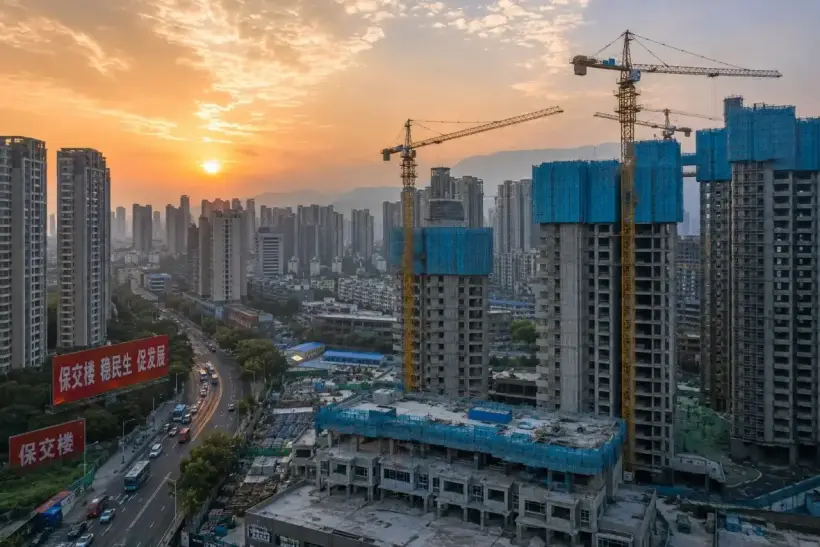
The estimate is a market calculation rather than an official government tally. Bloomberg reported that Andrew Chan, head of valuation and advisory services for Greater China at Cushman & Wakefield, estimates that more than 1 trillion yuan of non-residential real estate has 20 years or less remaining on its land tenure. The issue has already complicated attempted asset sales involving Parkview Group and New World Development. Office values in some major Chinese cities are more than 40% below their peaks, while developers have defaulted on about $130 billion of debt across the broader property crisis.
The distinction is critical. The $148 billion figure should not be described literally as a new debt bomb.
It is the estimated value of properties carrying an additional legal and valuation risk.
For institutional investors, that risk emerges years before a tenure expires because buyers and lenders must estimate both future cash flow and residual asset value.
Buildings and urban land are legally different assets
Urban land in China is state-owned, while investors obtain time-limited rights to use it.
National rules establish maximum terms of 70 years for residential land, 50 years for industrial land and land used for education, science, culture, health and sports, 40 years for commercial, tourism and entertainment uses, and 50 years for comprehensive or other uses.
When a land-use right is transferred, the buyer receives the remaining portion of the original term rather than a new full tenure.
One correction is important here.
China's national regulation does not create a separate universal category stating that every office site has a 50-year tenure. The applicable term depends on the official land-use classification and the specific land-grant contract.
It is therefore safer to assess the registered tenure of each office asset rather than assume that every office building carries the same 50-year right.
Residential property has clearer renewal protection
China's Civil Code provides that residential construction land-use rights renew automatically when their term expires.
Non-residential land is treated differently. Its renewal is governed by law, while ownership arrangements for buildings and other real estate after expiry depend on contractual provisions and applicable laws and administrative regulations.
That distinction explains why commercial tenure has remained a significant valuation issue.
Much of China's modern institutional commercial property stock was developed after the land market took shape in the early 1990s.
As those first-generation projects age, renewal is shifting from a distant legal question into a present investment problem.
Guangzhou has established detailed renewal rules
Guangzhou introduced one of the clearest local frameworks in 2026.
Its pilot establishes standard applications before expiry, early applications and a transitional route for rights that had already expired or were approaching expiry when the new rules took effect.
A normal application can be filed during the year before expiry. Certain owners can apply earlier once more than half of the original tenure has elapsed and more than one year remains.
Approval depends on compliance with spatial planning, contractual obligations, land-use requirements and other regulatory conditions.
For qualifying commercial and service projects, the renewal charge incorporates a 70% factor applied to the relevant officially determined land value, adjusted for renewal period and building area. A single extension can last as long as 20 years.
Projects that fail the relevant investment-performance test do not receive the same discount and can receive a maximum extension of 10 years. Separate formulas apply to industrial land and underground space.
The policy turns an open-ended future obligation into a cost investors can potentially model.
Early renewal can improve investment planning
The ability to seek renewal before the final year is particularly important for institutional owners.
A shopping-center operator considering a major refurbishment needs sufficient tenure to recover the investment.
A lender financing that redevelopment wants to know whether the land right will outlast the loan.
An investor preparing an asset sale needs enough visibility to allow the next owner to value the building.
Guangzhou's framework provides that visibility without turning a time-limited land right into perpetual ownership.
Projects required for public purposes, inconsistent with planning rules or carrying unresolved violations can still be denied renewal.
Shanghai is developing its own framework
The previous version overstated the link between Shanghai's benchmark land prices and renewal costs.
A general benchmark land-price schedule should not automatically be treated as the formula for extending every existing commercial land right.
Shanghai's officially published 15th Five-Year land-management plan instead provides the firmer basis for analysis. It explicitly calls for the establishment of a renewal system for industrial and commercial project land and for the issuance of relevant policies.
The plan also says the city will adapt renewal periods to the needs of real estate investment trust projects, reduce renewal and issuance costs and support the valuation and activation of commercial assets with shorter remaining land tenure. Shanghai is also targeting an increase in the share of existing developed land in total supply to around 70% by 2030.
That establishes the policy direction but does not mean every Shanghai commercial asset already faces identical renewal terms.
Investors still need to examine the specific land contract and the rules applicable to the asset when a transaction occurs.
Exposure will increase toward 2030
CBRE estimated in 2021 that by 2030 about 30 million square meters of office and retail space across 18 major Chinese cities would have less than 20 years remaining on land-use rights.
The calculation covered properties under single ownership, meaning the true stock exposed to shorter tenures could be larger.
CBRE also found that shorter remaining tenure has a progressively negative effect on transaction pricing.
That explains why the market responds long before the legal expiry date.
Two buildings with similar rents and occupancy can have materially different values if one has 15 years remaining on its underlying land right and the other has 35.
Parkview Green demonstrates the transaction problem
The impact is already visible in major asset sales.
Parkview Group has attempted to sell a Beijing shopping property linked to Parkview Green, where one affected land parcel has less than a decade remaining.
The owner has considered alternatives including the sale of a partial stake.
New World Development has encountered a similar tenure issue while attempting to sell an office tower above Shanghai K11 Art Mall.
In both cases, shortening land tenure compounds the broader weakness of China's commercial property market. Buyers must price rental income, future capital values and the uncertain cost of extending the underlying land right.
That uncertainty is reflected in the price a buyer is willing to pay today.
CapitaLand's exposure is more nuanced than outright ownership
Another correction concerns CapitaLand Investment.
The accurate formulation is that the company manages or owns stakes in more than 2 million square meters of Chinese property with remaining tenures of 20 years or less.
That does not mean CapitaLand is the sole owner of all of those assets.
Bloomberg identified Raffles City Shanghai, where the tenure runs to 2045, as one potential extension case. The mall is majority-owned by the life-insurance arm of Ping An, while CapitaLand has an investment and management role.
Brookfield Asset Management has also discussed property land-tenure issues and possible extensions with local officials.
Ownership, fund management and minority investment therefore need to be distinguished when assessing the exposure of international real estate groups.
China's property downturn remains severe
The renewal reforms are taking place against a weak national backdrop.
Real estate development investment fell 18% year on year to 3.8074 trillion yuan in the first half of 2026.
New construction starts dropped 23.4% to 232.39 million square meters and completed floor area declined 23.7%.
New commercial-property sales fell 11.6% by floor area and 13.6% by value.
Funds available to developers dropped 20.2% to 4.0233 trillion yuan, including a 31.7% fall in domestic bank lending.
Office investment declined 20.4%, while investment in premises for commercial business fell 23.1%, according to China's National Bureau of Statistics.
That backdrop makes tenure clarity more valuable.
When property values are rising, investors can more easily absorb uncertainty over a future land payment. In a falling market, the same uncertainty produces a larger valuation discount.
Renewal rules could unlock transactions and refinancing
The biggest potential benefit is predictability rather than necessarily cheap renewal.
If an investor knows the likely duration of a new land right and can estimate the fee, that expense can be incorporated into discounted cash-flow models.
Banks can calculate collateral values further into the future.
Sellers can negotiate with buyers without both sides assuming the most adverse possible outcome.
Clear rules could therefore improve both transaction liquidity and refinancing.
But legal certainty does not guarantee economic viability.
If renewal fees are too high relative to the income generated by an older property, the asset will still trade at a discount.
China does not yet have one uniform national system
China still lacks a fully standardized nationwide framework applying identical renewal conditions to all non-residential land.
Guangzhou has established a detailed local mechanism.
Shanghai has formally committed to building its own renewal system.
Other cities may use different procedures, pricing methods and approval requirements.
That flexibility allows local governments to reflect regional conditions, but it complicates valuation for institutional investors holding assets across several Chinese cities.
The same remaining land tenure can therefore carry different economic risks depending on the jurisdiction.
Land reform will not solve the wider property crisis
Clearer renewal rules can remove an important barrier to transactions, but they do not change the basic state of China's property sector.
Development investment, construction starts and financing are still contracting.
Commercial property also depends on office demand, vacancy, retail spending, rental income and capital costs.
The renewal initiative should therefore be viewed as a way to remove one valuation discount rather than as a rescue programme for the entire market.
FAQ: China's land-use rights and property market
What does the $148 billion figure represent?
It is an estimate of the value of more than 1 trillion yuan of non-residential property with 20 years or less remaining on underlying land-use rights. It is not a new estimate of developer debt.
Who produced the $148 billion estimate?
The figure cited in the reporting comes from Andrew Chan, Greater China head of valuation and advisory services at Cushman & Wakefield.
Can investors own urban land in China indefinitely?
No. Urban land is state-owned and private investors receive time-limited land-use rights.
How long can commercial land rights last?
Land legally classified for commercial, tourism and entertainment use can generally be granted for up to 40 years. Industrial and several other categories have maximum terms of 50 years.
Does every office building have a 50-year tenure?
Not necessarily. Office land is not a separate universal category in the national list, so investors need to check the registered use and original land-grant contract.
What happens when a property is sold?
The buyer generally receives the remaining portion of the existing land-use term rather than a fresh full tenure.
Do residential land rights automatically renew?
China's Civil Code provides for automatic renewal of residential construction land-use rights.
Do commercial rights renew automatically?
No equivalent automatic-renewal provision applies to non-residential land. Renewal is handled through the applicable legal and local regulatory framework.
What has Guangzhou changed?
Guangzhou has set out application procedures, eligibility criteria, renewal periods and pricing formulas for industrial and commercial land-use rights.
What is Shanghai doing?
Shanghai has formally committed to establishing a renewal regime for industrial and commercial project land and to supporting shorter-tenure assets, including those intended for real estate investment trusts.
Why does a 20-year remaining tenure matter?
Institutional investors, insurers and banks value property over long periods. Uncertain renewal conditions can reduce future liquidity and collateral value years before actual expiry.
Can the reforms restore China's property market?
They can improve liquidity and valuation for some commercial assets, but they do not reverse the wider contraction in property investment, construction and developer financing.
As International Investment experts report, the most important correction is that China is not trying to defuse a new $148 billion debt bomb. It is trying to remove uncertainty affecting commercial assets of roughly that value. That is a more manageable systemic problem because much of the risk can be reduced through regulation. Clearer tenure rules, however, should not be confused with a recovery of China's real estate sector. Investment fell 18% in the first half of 2026, new construction starts dropped by more than 23% and domestic bank lending to developers fell by almost a third. If cities make renewal costs predictable and economically viable, part of the discount on mature commercial assets can disappear. If costs remain discretionary or differ sharply between jurisdictions, legal uncertainty will decline but the pricing penalty will remain.