







 Airbnb Limits Checkout Chores for Guests
 Foreign Visitors Spent GEL 5.7 Billion in Georgia in Q3 2026
 Russia May End Its IT Mortgage Program Early
 Dublin Warehouse Leasing Jumps 65% in Q3
 Batumi Real Estate Market: Sales Rise as Growth Dynamics Shift — Galt & Taggart
 Wizz Air Launches Domestic Flights in Spain
Best Citizenship by Investment Programs in 2026
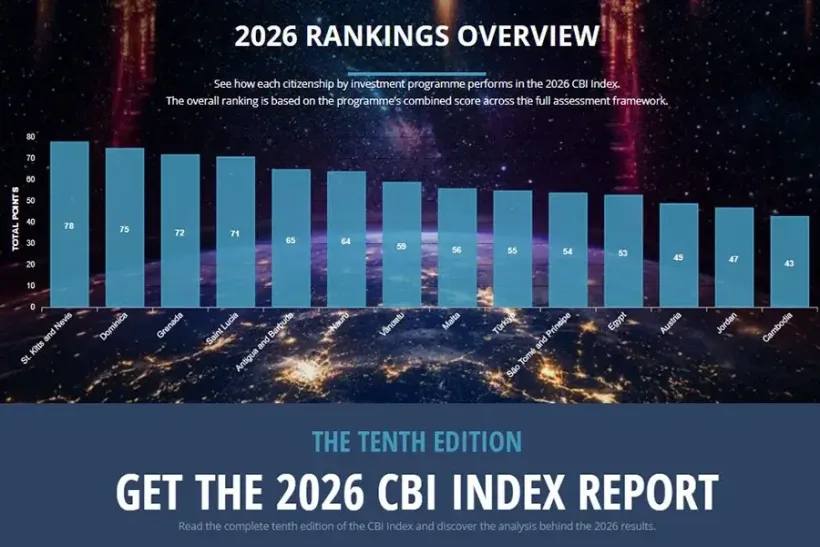
St Kitts and Nevis has topped the international ranking of citizenship by investment programs for the sixth consecutive year. Caribbean countries once again occupy all five leading positions, while Nauru ranks highest outside the region. However, a high score does not guarantee that an investor will be eligible to apply, according to CBI Index 2026.
How the top programs were selected
The tenth-anniversary edition of the CBI Index covers 14 jurisdictions. Each is assessed across nine criteria, including standard of living, freedom of movement, investment conditions, and travel or residence requirements.
The remaining criteria are the time required to obtain citizenship, ease of processing, due diligence, family eligibility, and the program's reliability. Each criterion carries a maximum of 10 points, giving a total possible score of 90. Further details are available in the CBI Index methodology.
The authors assess rules that have formally entered into force, rather than changes merely announced by governments. All 14 jurisdictions retained their positions from 2025, although 11 of them received different scores. These shifts reveal developments that the final ranking positions alone do not capture.
Citizenship by investment rankings for 2026
Overall CBI Index 2026 results, out of a possible 90 points:
|
Rank |
Country |
Score out of 90 |
|
1 |
St Kitts and Nevis |
78 |
|
2 |
Dominica |
75 |
|
3 |
Grenada |
72 |
|
4 |
Saint Lucia |
71 |
|
5 |
Antigua and Barbuda |
65 |
|
6 |
Nauru |
64 |
|
7 |
Vanuatu |
59 |
|
8 |
Malta |
56 |
|
9 |
Turkey |
55 |
|
10 |
São Tomé and Príncipe |
54 |
|
11 |
Egypt |
53 |
|
12 |
Austria |
49 |
|
13 |
Jordan |
47 |
|
14 |
Cambodia |
43 |
Why Caribbean countries remain at the top
St Kitts and Nevis scored 78 points, the same result as in 2025. It received maximum marks for due diligence, program reliability, ease of processing, and minimal residence requirements. According to the St Kitts and Nevis Citizenship by Investment Unit, the country has led the citizenship by investment rankings for six consecutive years.
Dominica gained two points to reach 75, while Grenada also improved by two points to 72. Saint Lucia posted the largest increase of any participant, adding three points to reach 71. Antigua and Barbuda completed the top five with 65 points, down by one. The improvements largely reflect application processing times, family provisions, and regulatory stability. Since March 2026, however, Saint Lucian citizens have needed a visa to enter the United Kingdom, illustrating how passport advantages can be affected by changes to immigration rules.
Rules across the Caribbean continue to become stricter. In an October statement on Dominica's citizenship by investment program, the government said that the European Union had linked the continuation of visa-free travel to the termination of investment citizenship programs by June 2028. This is a negotiating position, not a decision to close the programs that has already taken effect. One element of the regional reforms is stronger joint oversight and more rigorous checks on the source of applicants' funds.
Nauru and Vanuatu: strong positions outside the Caribbean
Nauru gained two points, bringing its score to 64 and placing it sixth. The new program, first included in the ranking in 2025, directs proceeds toward economic development and climate resilience projects. Analysts awarded 9–10 points for processing speed and family eligibility, but only 3 for program reliability. The official Nauru citizenship by investment program website sets out mandatory identity and source-of-funds checks; the typical processing period is three to four months.
Vanuatu ranks seventh with 59 points. Its advantages include rapid processing, flexible residence requirements, and a relatively straightforward procedure. The country received 9 points for the time needed to obtain citizenship but only 2 for freedom of movement. Visa-free access to Europe, which previously made its passport more attractive, is no longer available. The authorities are working to strengthen applicant screening, but these measures have not yet restored the earlier travel privileges.
Turkey: real estate and financial investments
Turkey placed ninth with 55 points, one fewer than in 2025. It scored 8 points each for processing time and ease of procedure, and 3 for freedom of movement. Investors may find the option to purchase an asset that can potentially be sold after the mandatory holding period particularly attractive.
To qualify for Turkish citizenship by investment through real estate, a property must cost at least $400,000 and cannot be sold for at least three years. Other options include deposits in Turkish banks, government bonds, and certain investment funds, with a minimum commitment of $500,000 and a three-year holding period. The ability to sell an asset or recover invested capital later does not guarantee a profit: currency, market, and transaction risks remain.
São Tomé and Príncipe and Egypt: speed versus mobility
São Tomé and Príncipe received 54 points and ranked tenth. The researchers awarded it the maximum 10 points for the time taken to grant citizenship, but only 2 for program reliability. The relatively new scheme attracts applicants with investments that are modest compared with those required by some competitors, although its practical implementation is still developing. It also scored 2 points for freedom of movement: obtaining a second passport does not necessarily resolve the issue of visa-free travel.
Egypt ranked eleventh with 53 points and the lowest freedom-of-movement score, just 1 out of 10. The country nevertheless offers several investment routes. The official Egyptian citizenship by investment portal lists a non-refundable contribution starting at $250,000, real estate worth at least $300,000, participation in a business project, and a $500,000 deposit held for three years. The deposit is returned in Egyptian pounds without interest, creating exchange-rate risk. These figures exclude associated fees and application expenses.
Why Malta and Austria remain in the rankings
Malta's eighth-place finish, with 56 points, needs clarification. Following a Court of Justice of the European Union ruling on April 29, 2025, the country's previous citizenship-by-investment scheme was abolished. In February 2026, the Community Malta agency explicitly stated that citizenship by merit is neither a continuation of the former scheme nor an alternative to it. Decisions are made on a case-by-case basis. Malta's inclusion in the table should therefore not be interpreted as an opportunity to obtain a passport for a fixed payment.
Austria ranked twelfth with 49 points. As the CBI Index itself notes, the country has no standard citizenship program with a fixed entry price: citizenship may be granted in exceptional cases for special contributions in the national interest. Such mechanisms differ substantially from widely available investment programs. Including them in the same table may be useful for comparison, but the distinction must be made clear.
What the citizenship program rankings reveal
International Investment analysts note that competition among investment citizenship programs is increasingly about more than the cost of a passport and the speed of issuance. Their overall attractiveness depends on legal predictability, confidence in applicant vetting, and access to international travel, which may change even after citizenship is granted. For investors seeking to preserve their capital, the nature of the investment is equally important: non-refundable contributions, real estate, and refundable deposits entail very different risks.
Certain eligibility restrictions must also be considered. For example, the five Caribbean jurisdictions at the top of the ranking are effectively closed to Russian and Belarusian nationals. These restrictions are explicitly set out in the St Kitts and Nevis citizenship eligibility rules and Dominica's list of excluded nationalities.
The CBI Index allows investors to compare the broad characteristics of different jurisdictions, but it cannot replace a review of current legislation and individual eligibility. In 2026, the gap between the formal leaders of the ranking and the programs available in practice to certain groups of applicants is particularly evident.
FAQ: Questions and Answers
What is citizenship by investment?
Citizenship by investment is granted under a government program in exchange for qualifying investments. Applicants must meet the investment conditions and pass due diligence checks; transferring the money alone does not guarantee approval.
Which is the best citizenship by investment program in 2026?
According to the 2026 CBI Index, St Kitts and Nevis ranks first with 78 out of 90 points. The country has led the ranking for six consecutive years.
Which countries make up the top five?
St Kitts and Nevis, Dominica, Grenada, Saint Lucia, and Antigua and Barbuda. All five are located in the Caribbean.
Which program ranks highest outside the Caribbean?
Nauru ranks sixth overall with 64 points, followed by Vanuatu in seventh place with 59.
How much must an investor spend on property to obtain Turkish citizenship?
The minimum property value is $400,000, and the property cannot be sold for three years. Certain financial investment routes have a minimum threshold of $500,000.
Can citizenship-by-investment applicants recover their capital?
It depends on the program and type of investment. Property can be sold after the required holding period if the program permits it, but neither capital preservation nor a return is guaranteed. Non-refundable contributions cannot be recovered.
Can Russian and Belarusian citizens apply to Caribbean programs?
The five top-ranked Caribbean programs impose restrictions on Russian and Belarusian citizens. Eligibility must be checked against each country's current rules, rather than inferred from its ranking.
Why does Malta appear in the ranking if its investment citizenship program has ended?
The CBI Index continues to include Malta in its comparison, although the former citizenship-by-investment scheme has been abolished. The current citizenship-by-merit mechanism is not a continuation of that scheme and does not allow applicants to obtain a passport for a fixed payment.