

ADB to Allocate $200M for Regional Infrastructure and Tourism in Georgia
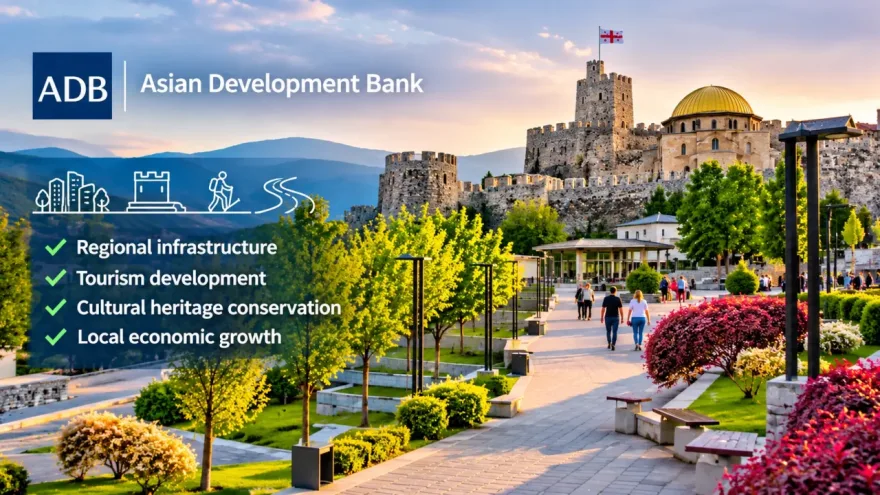
According to the Asian Development Bank (ADB), a loan of 200 million US dollars has been approved for the development of regional infrastructure and tourism in Georgia. The total estimated project cost stands at 253.85 million dollars, of which 53.85 million dollars represents co-financing from the Government of Georgia. The initiative encompasses the modernization of municipal infrastructure in small towns and villages, the preservation of cultural heritage, and the development of tourism facilities.
According to information released by the Asian Development Bank (ADB) on November 27, the bank approved a 200 million US dollar loan for Georgia. The financing is earmarked for the Developing Resilient Infrastructure for Vibrant Economies (DRIVE) project, which aims to improve urban and tourism infrastructure across the country's regions and expand local economic opportunities.
According to ADB estimates, the project will benefit approximately 400,000 residents of small towns and villages. Visitors traveling to project areas will also benefit.
The project combines the upgrading of municipal infrastructure, the development of public and recreational spaces, the rehabilitation of cultural heritage sites, and the unlocking of the tourism potential of natural assets.
Total Project Cost Reaches $253.85 Million
Financing for the project is not limited solely to the ADB loan. In the project profile published by the bank, the funding source is identified as a 200 million US dollar loan provided from the bank's Ordinary Capital Resources (OCR). Meanwhile, the published advance procurement notice indicates that its estimated total cost is 253.85 million dollars, comprising a 200 million dollar ADB loan and 53.85 million dollars in co-financing from the Government of Georgia.
Thus, the project's financial volume reaches 253.85 million dollars. However, this figure reflects the preliminary financial scope of the project rather than an already disbursed amount or the value of signed construction contracts.
Final details on the allocation of funds across specific project components and municipalities are not yet fully presented in publicly available documents.
Municipal Infrastructure and Tourism: Two Core Project Tracks
The DRIVE project encompasses two interrelated tracks.
The first track focuses on improving municipal infrastructure and creating green, healthy, and economically vibrant urban environments. Planned investments in this direction include the development of public spaces, parks, recreational areas, healthcare and youth facilities, as well as multifunctional sports infrastructure. To ensure the full functionality of these facilities, plans also include the upgrading of access roads, water supply, wastewater, stormwater drainage, and solid waste management systems.
The second track pertains to developing the tourism potential of natural assets and cultural heritage. Within this component, plans include the rehabilitation and conservation of cultural heritage sites taking climate risks into account, improving road networks and utility infrastructure, developing pedestrian and cultural trails, and expanding other targeted tourism infrastructure.
According to project documentation, the selection of subprojects must be grounded in integrated urban plans prepared by the relevant municipalities or the Spatial and Urban Development Agency. In the case of projects implemented within historically significant zones, cultural heritage impact assessment methodology will also be taken into account.
Where and Which Projects Are Planned for Implementation?
The Environmental Assessment and Review Framework (EARF) published by the Asian Development Bank in August 2026 contains an indicative list of civil works packages considered under the project.
According to the document, as of June 2026, the procurement plan featured ten main focus areas:
-
Development of Kutaisi Central Park — 80 hectares across the Kutaisi and Tskaltubo municipalities.
-
Construction of the Palace of Sports and Youth — Kutaisi.
-
Rehabilitation of Ganmukhuri — Zugdidi Municipality.
-
Rehabilitation of Maltakwa — Poti.
-
Rehabilitation of the Khada Gorge — Dusheti Municipality.
-
Construction of a multifunctional sports facility — Gurjaani.
-
Rehabilitation of Rabati Fortress — Akhaltsikhe.
-
Modernization of the Central Park and urban infrastructure in Akhaltsikhe.
-
Urban renewal of the village of Gebi.
-
Urban renewal of the settlement of Pasanauri.
This list reflects indicative construction packages prepared as of June 2026. Consequently, it should not be viewed as a finalized, approved full work plan or as amounts already allocated to each site.
It is worth noting that supplementary ADB documents have been published for individual subprojects. For example, in September 2026, the bank released draft environmental assessments for the Kutaisi Central Park, the Kutaisi Palace of Sports and Youth, and the rehabilitation of villages in the Khada Gorge. This indicates that technical and environmental documentation preparation is ongoing across selected areas, though it does not in itself confirm the commencement of civil works.
Who Will Implement the Project?
Several government agencies will participate in delivering the project.
Specifically, according to ADB documentation, the Ministry of Finance of Georgia acts as the borrower's representative and is responsible for negotiating and signing the loan agreement, as well as providing overall project oversight.
The role of executing agency is assigned to the Ministry of Infrastructure. Its responsibilities include project execution, inter-agency coordination, ensuring timely disbursement of state co-financing funds, and progress monitoring.
The direct implementing agency is the Municipal Development Fund of Georgia (MDF), which will oversee subproject appraisal, engineering design, procurement, financial management, construction supervision, and outcomes monitoring.
Environmental and Social Requirements
Project implementation will adhere to environmental and social safeguard standards.
In particular, according to ADB's Environmental Assessment and Review Framework, the project has been assigned Environmental Category B, meaning that anticipated adverse impacts are typically site-specific and can be managed through appropriate design and mitigation measures.
The project has also been classified as Category B for involuntary resettlement. Regarding indigenous peoples, it has been categorized as Category C, which, according to the bank's assessment, indicates no anticipated significant impacts on this group.
At the same time, the documentation calls for the preparation of environmental assessments, public consultations, land acquisition and resettlement reviews, civil works monitoring, and public disclosure of information.
Furthermore, special emphasis is placed on addressing climate risks, including floods, erosion, and shoreline dynamics. When planning infrastructure, the principles of universal accessibility and gender-responsive design must be observed.
What Economic Impact Can the Investments Deliver?
The significance of the project extends well beyond the modernization of municipal infrastructure alone. One of its primary objectives is expanding economic opportunities across the regions.
Upgrading tourism routes, cultural heritage sites, parks, and recreational zones can bolster the appeal of small towns and villages for both domestic and international visitors. This, in turn, will generate added demand for accommodation facilities, food services, transport, guiding services, and other tourism products.
Enhancing municipal infrastructure is also crucial for local business. Reliable roads, water supply, wastewater networks, and waste management diminish logistical barriers for commercial activities and foster a more favorable climate for private investments.
According to ADB's assessment, the project will unlock economic opportunities for local businesses, women, and youth. However, the details released by the bank do not cite specific targets for job creation, projected tourism receipts, or the volume of private investments expected to be mobilized as a result of the project.
Consequently, evaluating the economic outcomes of the project cannot rely on the financing amount alone. Success will largely hinge on how effectively subprojects are selected, the timeliness of execution, and whether local municipalities can maintain the upgraded infrastructure and integrate it into the economic landscape.
ADB Regional Development Strategy in Georgia
The DRIVE project is part of a long-standing partnership between Georgia and the Asian Development Bank. According to the bank, its collaboration with Georgia began in 2007 and continues actively today.
In this context, the project aligns with the ADB Country Partnership Strategy for Georgia 2024–2028, a major priority of which is bridging the development gap between urban and rural areas and strengthening regional connectivity.
The initiative also resonates with the bank's Strategy 2030 priorities, including climate change mitigation, resilience, and inclusive development.
For Georgia, an initiative with an estimated value of 253.85 million dollars represents substantial financial backing for advancing regional infrastructure and tourism potential. Nevertheless, its ultimate economic impact will depend not only on capital absorption, but on successfully translating infrastructure improvements into localized economic vitality and sustainable opportunities for the private sector.
Planning to buy property abroad?
Discuss the country, budget and goals with a consultant.