


England and Wales Move Towards Phasing Out Leasehold
The UK government introduced the Commonhold and Leasehold Reform Bill in Parliament on 19 November. It proposes a £250 annual ground-rent cap for existing leaseholders, an easier process for converting buildings to commonhold and a gradual restriction on leasehold for most new flats in England and Wales. The Bill is undergoing parliamentary scrutiny as of 25 November; the proposed changes are not yet law.
What a flat buyer actually owns
Many flat purchases in England and Wales involve a long lease. The buyer acquires rights for a defined term, while the freehold interest in the land and building may remain with another party. Lease terms govern obligations including payments, permissions and the process for extending the lease.
Freehold ownership is not limited by a lease term. Commonhold adapts indefinite ownership to blocks of flats, with unit owners collectively responsible for the building’s common areas through an association. The framework was introduced in 2002 but has barely been used: the housing ministry reports fewer than 20 developments containing fewer than 200 flats. The aim is to make commonhold workable for a much larger market.
Ground rent and building costs
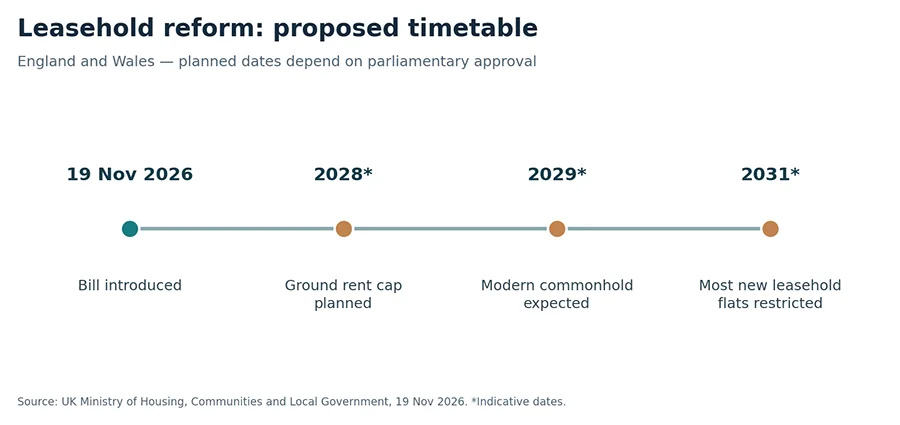
The government wants the £250 annual ground-rent cap to take effect six months after the Bill becomes law, currently expected in 2028. It estimates that up to one million leaseholders could benefit. Ground rent is distinct from the service charges that pay for the running and maintenance of the building.
Additional measures are intended to reduce the risk of unexpected major repair bills through building assessments, planned maintenance and advance funding. The ministry also proposes changes to administration charges, forfeiture, lease extensions and freehold purchases. Buyers should distinguish commitments in the Bill from provisions that will actually be in force at the time of a transaction.
A staged transition to commonhold
The modernised commonhold framework is expected around 2029. Existing blocks would have a route to conversion supported by 50% of the relevant leaseholders, rather than having to obtain unanimous agreement. Conversion would still require the legal and financial interests in the building to be resolved.
Restrictions on leasehold for most new flats are planned roughly two and a half years after the commonhold framework is introduced, around 2031. This is an indicative schedule designed to allow lenders, developers and building managers time to adapt. The final legislation and implementation rules will determine exemptions and precise commencement dates. The proposals apply to England and Wales, rather than automatically across the United Kingdom.
|
Stage |
Proposed measure |
Indicative timing |
|
19 Nov 2026 |
Bill introduced |
First reading |
|
Ground rent |
£250 annual cap |
2028; 6 months after law |
|
Commonhold |
Modernised model; 50% vote |
Around 2029 |
|
New flats |
Restriction on new leasehold |
Around 2031 |
The checks buyers still need to make
International Investment examined London flats ahead of leasehold reform in September. More recent official figures show London flat prices down 6.3% year on year to September and Inner London dwelling prices down 7.2%, as detailed in our London market report.
Tenure is one factor in a market also shaped by borrowing costs, demand and building condition. A buyer today needs to review the remaining term, ground-rent escalation provisions, historic service charges, planned major works, lease-extension costs and mortgage eligibility. The Bill points towards a different ownership model for future transactions, but the legal and financial assessment of an existing flat must still start with the lease and the law currently in force.
Frequently asked questions
Has leasehold been abolished in England and Wales? No. The Bill was introduced on 19 November 2026 and is not yet law.
When is the £250 ground-rent cap expected? Six months after the Bill becomes law, under the government's announced plan; 2028 is the current indicative year.
Will existing flats convert automatically? No. The Bill proposes an easier collective conversion route, subject to a separate process.
Does £250 include service charges? No. Ground rent and building service charges are separate obligations.
Sources: UK Parliament, Bill 189, 2026–27; MHCLG, announcement of 19 November 2026.
Planning to buy property abroad?
Discuss the country, budget and goals with a consultant.