

The branded residences market could grow by 133%
Branded residences are becoming one of the fastest-growing segments of the global real estate market. The number of such developments could approach 2,000 by the early 2030s, according to consultancy Global Branded Residences (GBR). The Middle East leads the construction pipeline, gradually reshaping the established geography of luxury housing supply.
Global market size and outlook to 2031
By the end of March 2026, there were 848 completed branded residential developments worldwide, with another 1,124 at various stages of planning and development, according to GBR’s annual report, The Brand Standard 2025–2026. Pipeline projects account for 57% of the combined portfolio. Analysts expect most of the new supply to come to market over the next six years.
The study covers 104 countries and 277 brands. Operators that provide information directly to the consultancy represent around 74% of the global branded residences market. GBR collects information on the remaining participants independently.
Other international consultancies confirm the long-term trend. Between 2015 and 2025, the number of completed developments rose from 354 to 903 and could approach 1,800 by 2031, according to Knight Frank analysts. In the luxury real estate segment, Savills forecasts a 24% increase in completed branded developments in 2026, following growth of 8% in 2025. Differences in the absolute figures reflect variations in research methodology and reporting periods.
The Middle East is catching up with North America
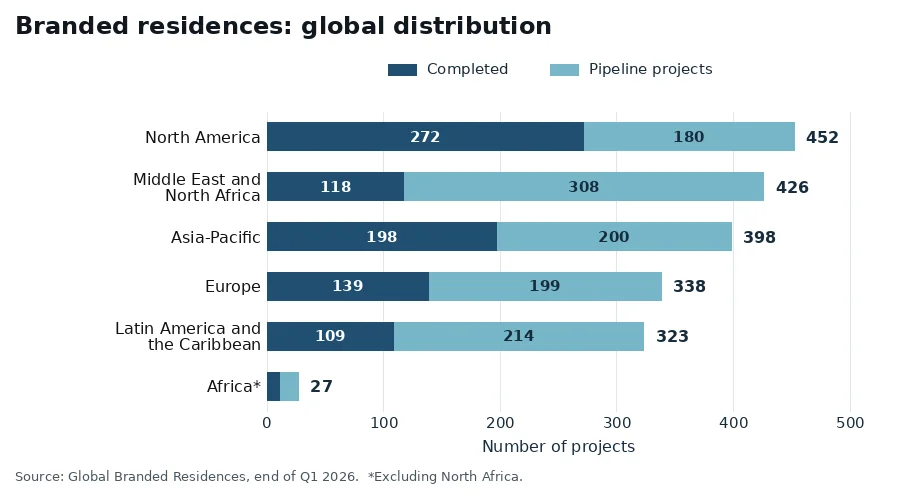
North America retains first place by number of completed developments, with 272, or 32% of the global stock. However, the region accounts for just 16% of pipeline projects. The Middle East and North Africa (MENA) lead in planned development, with 308 complexes, or 27% of the global pipeline.
The Asia-Pacific region has almost equal volumes of existing and prospective supply. The number of developments is expected to rise from 139 to 338 in Europe and from 109 to 323 in Latin America and the Caribbean. GBR highlights the contribution of Spain and Georgia to the European segment and expects supply in Turkey to double.
Branded residences by region
|
Region |
Completed |
Pipeline projects |
Total |
|
North America |
272 |
180 |
452 |
|
Middle East and North Africa |
118 |
308 |
426 |
|
Asia-Pacific |
198 |
200 |
398 |
|
Europe |
139 |
199 |
338 |
|
Latin America and the Caribbean |
109 |
214 |
323 |
|
Africa* |
12 |
15 |
27 |
Source: GBR, The Brand Standard, end of Q1 2026. Africa is listed separately from North Africa. The regional breakdown covers 1,964 projects, compared with 1,972 in the report’s overall total. The difference represents eight pipeline projects whose locations are unspecified.
The US and UAE top the country rankings
The United States remains the largest national market, with 250 completed developments and another 170 at various stages of development. The United Arab Emirates rank second by total portfolio but lead the US in pipeline projects, with 185 compared with 170. If all announced plans materialise, the number of developments in the UAE will reach roughly 3.5 times the existing stock.
Mexico ranks third, with a substantial share of construction concentrated in resort destinations. Brazil comes fourth: GBR identifies affluent domestic buyers as a key source of support for its developers. Thailand rounds out the top five, with almost equal numbers of completed and pipeline developments.
Five largest national markets
|
Country |
Completed |
Pipeline projects |
Total |
Potential growth |
|
US |
250 |
170 |
420 |
+68% |
|
UAE |
75 |
185 |
260 |
+247% |
|
Mexico |
33 |
77 |
110 |
+233% |
|
Brazil |
29 |
54 |
83 |
+186% |
|
Thailand |
36 |
37 |
73 |
+103% |
Source: GBR, The Brand Standard, end of Q1 2026. The ranking is based on the combined number of completed and pipeline projects; potential growth is calculated relative to completed developments.
From Dubai to Batumi: city rankings
The global top five
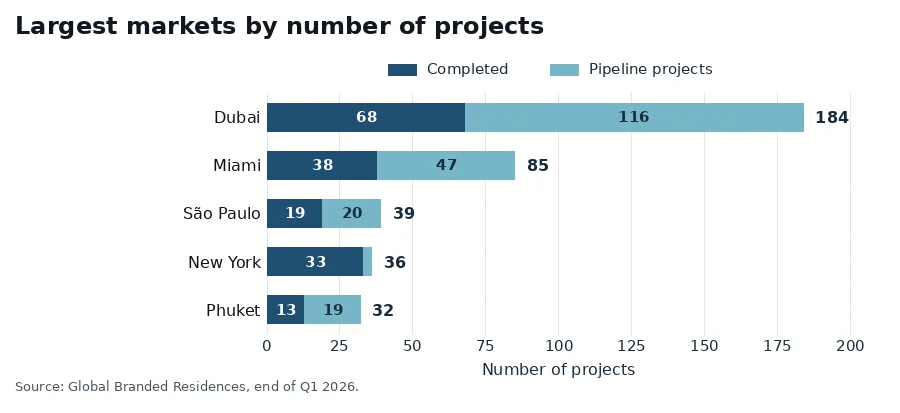
Dubai tops the global ranking by a wide margin, with 184 branded residential developments, of which 68 have been completed and 116 are in the pipeline. Miami ranks second with 85 projects. Even excluding future supply, the emirate has almost 1.8 times as many completed developments as the US city.
São Paulo has risen to third place, overtaking New York (39 projects versus 36). Brazil’s largest city has another 20 developments planned, compared with just three in the US financial centre. Phuket completes the top five, with 13 of its 32 projects already completed.
Five leading cities and resort destinations
|
City / resort |
Completed |
Pipeline projects |
Total |
|
Dubai |
68 |
116 |
184 |
|
Miami |
38 |
47 |
85 |
|
São Paulo |
19 |
20 |
39 |
|
New York |
33 |
3 |
36 |
|
Phuket |
13 |
19 |
32 |
Georgia: new projects and Batumi’s position
Georgia shares 16th place with Greece in the international country rankings. Batumi is joint 14th with the Turkish resort of Bodrum. Between January 2025 and March 2026, nine new agreements for projects involving established brands were signed in Georgia.
In Q4 2025, Georgia accounted for 30% of new branded residences projects in Europe, followed by Portugal at 15% and Spain and the United Kingdom at 10% each. In Q3 2024, Georgian and Spanish developers led in the number of agreements signed, with 19% of the regional total each. The figures reflect strong interest among international hotel operators in developing this segment on the Black Sea coast.
One of the country’s largest resort projects is Wyndham Grand Batumi Gonio, developed by European Village. The five-star complex brings together five hospitality properties and offers accommodation in apartments, townhouses and villas with all-inclusive service. Plans include more than 100 amenities and infrastructure facilities covering a total of 27,115 sq m. A residence management agreement has been signed with international operator Aimbridge Hospitality.
Premium development is also expanding in other parts of Adjara. In Tsikhisdziri, Petra Group is working with Accor on Pullman Living & Residences, which comprises plans for more than 250 investment apartments and over 300 residences. In central Batumi, near Heroes Alley, One Development is building Ramada Residences by Wyndham, scheduled for completion in Q4 2029.
Leaders in hospitality development
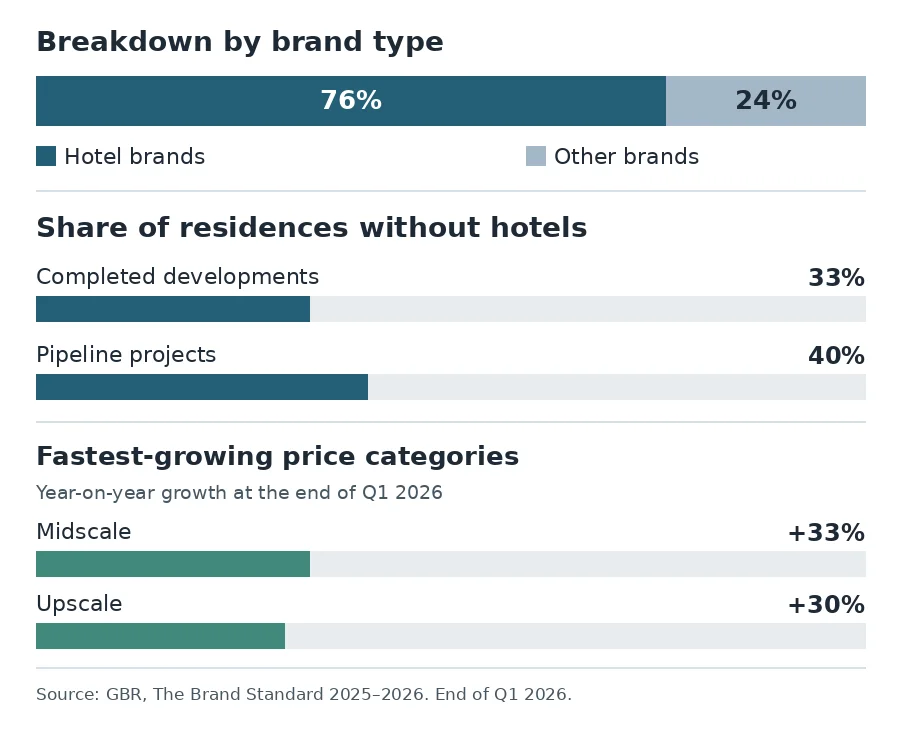
Hotel brands account for around 76% of the global portfolio, with other brands representing 24%. Marriott (336) and Accor (197) lead international groups by the combined number of completed and pipeline developments. Ritz-Carlton (103), Four Seasons (98) and St. Regis (54) top the rankings of individual hotel brands.
Wyndham Hotels & Resorts, one of the world’s largest hotel franchisors, is actively expanding its presence in the segment, with around 8,500 hotels across 100 countries as of November 2026. The group ranked third for new branded residences projects in Q4 2025 and fourth in Q1 2026, according to GBR. Savills estimates that the number of pipeline developments is almost five times the existing stock, with Ramada playing a significant role in this expansion.
Branded residential developments are increasingly being developed independently of hotels. Standalone developments account for 33% of completed projects and 40% of those in the pipeline. GBR founder Riyan Itani expects this model to spread further, as it allows developers to partner with international brands without having to build and operate a hotel.
The segment remains geared towards affluent buyers: around 88% of the portfolio falls into the Luxury and Upper Upscale categories. However, GBR recorded the fastest year-on-year growth at the end of Q1 2026 in the Midscale (+33%) and Upscale (+30%) categories, which still represent a small share of supply. This indicates a gradual diversification of the offering rather than a shift towards mass-market housing.
What this means for investors
Branded residences remain one of the most attractive segments of investment real estate, according to International Investment analysts. Their appeal lies in the combination of professional management, international service standards and the reputation of an established brand. Brand recognition helps attract tenants, sustain high occupancy and generate more stable income, particularly in popular tourist destinations.
For international buyers, this format is especially attractive because it offers the opportunity to earn passive income without directly managing the property. International hotel operators have their own booking channels, loyalty programmes and extensive customer bases. These resources create favourable conditions for higher rental rates and the preservation of property value over the long term.
The expansion of major hotel groups into emerging markets broadens the geography of investment and makes internationally branded assets available at more accessible prices than in traditional luxury housing centres. Georgia is particularly promising in this respect, combining the presence of well-known operators with a relatively low cost of entry. The development of branded residences in the Midscale and Upscale categories, which previously accounted for a small share of global supply, offers buyers additional opportunities.
FAQ
What are branded residences?
These are residential properties developed in partnership with a hotel operator, design company or another brand. Partnership arrangements may include design, service standards and management.
How many branded residences are there worldwide?
GBR counted 848 completed developments and 1,124 pipeline projects at the end of Q1 2026. These figures refer to developments, not individual apartments or villas.
Which countries lead in branded residences?
The United States ranks first by GBR’s combined portfolio, followed by the UAE and Mexico. The UAE has the largest national pipeline.
Which city leads the global market?
Dubai, with 184 completed and pipeline developments in GBR’s database at the end of March 2026.
How is the branded residences market developing in Georgia?
Georgia shares 16th place with Greece in GBR’s global rankings, while Batumi is joint 14th with Bodrum. Projects under international brands such as Wyndham Grand, Pullman and Ramada are being developed in the country. Professional management, expanding tourism infrastructure and relatively affordable property prices underpin the segment’s investment appeal.
Planning to buy property abroad?
Discuss the country, budget and goals with a consultant.