







read also
 Australia’s Spring Auctions Rise but Remain Well Below 2025
 Number of Foreigners Holding Turkish Residence Permits Exceeds 1.27 Million
 Demand from Russian Tourists for Holidays in Georgia Rises by 20–25%
 Montenegro Property Buying Costs in 2026
 Four in Ten Companies Would Not Choose Slovakia
 Gulf Countries Prepare Unified Tourist Visa
Earthquake Disrupts Travel in Japan. Strong tremor hits the Chugoku region
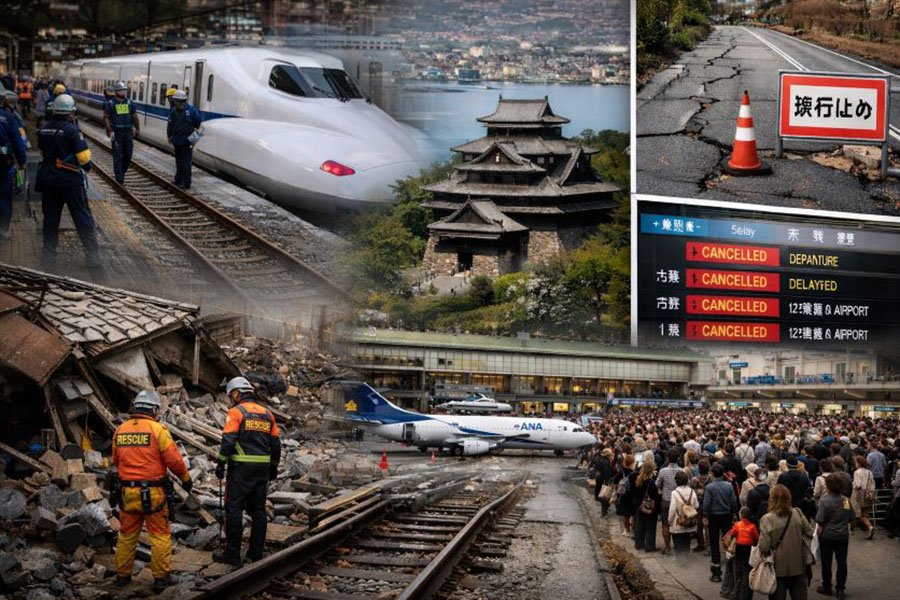
Photo: Travel and Tour World
On the morning of January 6, 2026, a 6.4-magnitude earthquake struck Japan’s western Chugoku region. The tremor occurred at 10:18 a.m. local time, with its epicenter located in eastern Shimane Prefecture. According to the Japan Meteorological Agency, the quake reached an Upper 5 intensity on the Shindo scale, causing strong shaking across Shimane, Tottori, Matsue, and Sakaiminato. While no major structural damage was immediately reported, the event triggered widespread disruption to transportation networks.
Rail services face major disruptions
JR West activated automatic safety systems following the quake, leading to power cuts and train suspensions across large parts of its network. By the evening of January 6, many services remained delayed or canceled as track inspections continued. The Sanyo Shinkansen between Shin-Osaka and Hakata resumed operations after safety checks, but trains continued to run with delays of up to an hour due to speed restrictions. Overnight sleeper services Sunrise Izumo and Sunrise Seto were fully canceled, while numerous limited express and local lines across the San-in region remained suspended.
Road conditions and expressway recovery
Highway operator NEXCO West reported that initial safety inspections were completed during the day, allowing several expressway sections to reopen. Traffic on key routes resumed with temporary speed limits, while local roads in cities such as Matsue and Sakaiminato continued to undergo debris removal and bridge inspections. Authorities cautioned that some restrictions could remain in place until all structural assessments are finalized.
Airports resume operations with delays
Izumo and Yonago airports temporarily halted operations to inspect runways and facilities. Flights resumed by midday, and no damage to airport infrastructure was reported. However, airlines continued to experience delays as passengers sought alternatives to disrupted rail services. Travelers were advised to monitor updates directly from carriers such as Japan Airlines and All Nippon Airways.
Aftershocks raise safety concerns
Several aftershocks, including tremors exceeding magnitude 5, followed the initial earthquake. The Japan Meteorological Agency warned of the possibility of further seismic activity and urged caution, particularly for occupants of high-rise buildings. Long-period ground motion warnings were issued for parts of Tottori Prefecture, highlighting the risk of prolonged swaying in taller structures.
Ongoing recovery and travel outlook
While emergency services and transport operators continue restoration efforts, travel across the Chugoku region remains uneven. Authorities emphasize the importance of staying informed through official channels and preparing for potential delays in the coming days. The situation underscores the challenges of maintaining transport continuity in seismically active regions.
As International Investment experts report, the Chugoku earthquake highlights how natural hazards can quickly disrupt even highly resilient transport systems, reinforcing the need for risk-aware travel planning and continued investment in disaster-ready infrastructure.