








Middle East Luxury Megaprojects Do Not Add Up
Over the past few years, the Middle East has turned luxury development into part of its state strategy, but that is precisely where the line is drawn between an impressive showcase and normal investment logic. The problem is not that the region is building at too high a cost. It is that a significant share of these projects is sold to the market primarily as a symbol of the future, global status and a tourism breakthrough, while transparent commercial payback for outside investors often remains a secondary concern. This is evident in the way states and their sovereign funds continue to serve as the main source of capital, while project success is more often measured not by free cash flow but by political impact, the number of contracts signed, brand visibility and the amount of global attention attracted.
Luxury in the region is increasingly sold as a story, not a business model
Academic research on megaprojects in the Arab world states directly that these developments are promoted not only for economic purposes in the narrow sense, but also for geopolitical positioning, reshaping the global image of countries and increasing their symbolic weight. A 2025 study of GCC megaprojects notes that the literature has long questioned their economic viability, pointing to frequent cost overruns and a gap between stated goals and local needs, while the projects themselves continue to be launched as tools for attracting capital, tourism and international prestige. In other words, they are often driven not by the logic of a conventional developer building for predictable demand, but by the logic of a state building for a future image.
This is especially visible in the premium and ultra-premium segments. Knight Frank reports that the Middle East now accounts for 26.7% of the global branded residences pipeline, versus 15.9% of completed operating stock. In other words, supply is expanding much faster than a mature, proven market. The same research says that 43% of future hotel-branded schemes in the region are being planned as standalone projects, without full reliance on an operating hotel asset. For investors, this is an important signal: the market is increasingly selling not an income-producing asset with a clear operating history, but an autonomous prestige product whose capitalization depends more on brand, marketing and buyer sentiment than on durable cash flow.
The pipeline is growing faster than demand is being proven
The core vulnerability of Middle Eastern luxury projects lies not in a lack of ambition, but in the scale of supply. According to Lodging Econometrics, by the second quarter of 2025 the hotel pipeline in the Middle East had reached a record high of 650 projects and 161,574 rooms. At the same time, 55% of all projects and 56% of all rooms in the pipeline were concentrated in the luxury and upper-upscale segments. That is an extremely aggressive bet on the top end of the market, especially given that premium demand is inherently narrower than mass demand and is more exposed to external conditions, air connectivity, oil prices and geopolitics.
In Saudi Arabia, the signal is even sharper. Knight Frank says that 78% of new hotel supply in the country is concentrated in the luxury, upscale and upper-upscale categories, while at the same time acknowledging that the market needs more moderately priced accommodation because domestic demand still forms the basis of occupancy. That effectively points to an imbalance: what is being built first is expensive product, while the broader and more resilient layer of purchasing demand still needs more affordable supply. When the market itself admits that backbone demand remains domestic, yet most future supply is being concentrated in the premium segment, that is no longer a sign of balanced profitability. It is a sign of excessive faith in a premium showcase.
Private investors are being sold prestige, not income
In mature development markets, investors typically understand where returns will come from: rent, occupancy, service income, resale supported by constrained supply. In the Middle Eastern luxury segment, that structure is often replaced by a more diffuse combination of presales, brand premiums and expectations of future appreciation. CBRE states directly in its UAE research that off-plan transactions dominate the branded residences market, accounting for 75% to 80% of activity, while branded units themselves trade at premiums of 64% in Dubai and 87% in Abu Dhabi versus non-branded stock. That confirms genuine demand for status-driven product in the most liquid parts of the market, but it also shows that the most important sales driver is not the operating performance of the asset. It is the ability to sell an expensive narrative during construction.
That is why headline sales should not automatically be confused with investment payback. A high premium to entry price, rapid transaction growth and a rich pipeline point to a strong marketing machine and the presence of trophy-asset buyers, but they do not prove that a project will ultimately generate sustainable returns on capital after construction, infrastructure and operating costs are fully accounted for. In a region where expensive assets are often bought for status, residency, capital storage or state-backed narrative value, the payback profile for a minority or outside investor becomes far less transparent than in a conventional hotel or rental product.
The state remains the main insurer of this luxury cycle
If a project truly has strong standalone economics, it will over time attract a greater share of ordinary bank and market financing. Yet for Saudi Arabia’s largest megaprojects, Fitch said in February 2026 that roughly half of total funding, including equity and debt, had come from the Public Investment Fund, while direct bank lending exposure at the end of 2025 remained relatively modest, averaging just 5% to 7% of sector loans. Fitch separately noted that bank financing is likely to rise as projects move closer to the operational phase, when they can be supported by actual cash flows. In other words, even the agency is effectively acknowledging that much of this construction is still being carried not by proven cash generation, but by state backing and expectations of future monetization.
That point matters even more in the current macroeconomic environment. In its latest review of Saudi Arabia, the IMF states clearly that over the past two years the authorities have reassessed funding needs and reprioritized, including extending the timelines of some projects. The Fund also notes that with lower oil prices and elevated global uncertainty, the country is expected to continue running both current-account and fiscal deficits in the medium term. That does not look like an environment in which every high-cost luxury vision can indefinitely ignore the question of return on investment. On the contrary, it is an environment in which the state increasingly has to decide which projects to continue at full scale and which to stretch out, simplify or repackage.
Even market optimists are beginning to speak the language of efficiency
It is telling that even PwC, in its review of capital projects in the region, no longer describes the market as a space of pure oil-fueled optimism. Instead, it portrays a more complex environment in which state-funded and state-supported companies are operating under pressure from financial sustainability requirements, private capital expectations, regulatory complexity and performance KPIs tied to real efficiency. The report says 80% of respondents consider private financing important to project delivery, while financial performance has become one of the main indicators of project health. That too is an indirect confirmation that the market itself has started to understand that the era when a megaproject could be justified solely by scale and symbolism is coming to an end.
But this is also the region’s central paradox. The development machine continues to produce new premium assets because luxury remains the most effective language for projecting ambition, attracting attention and selling the future. Yet the larger the luxury pipeline grows, the harder it becomes to prove that this showcase is actually delivering normal, risk-adjusted returns for investors. In a mature market, profitability is confirmed by an operating track record. In the Middle Eastern megaproject market, it is too often replaced by the promise that scale itself will eventually create its own demand. Megaproject theory has long warned that these are precisely the structures most vulnerable to delays, cost overruns and benefit shortfalls.
Why this matters for investors
For private investors, the key risk is not that a luxury asset cannot be sold at all. The risk is that many of these projects are structured in a way that allows the state to benefit first through image-building, the developer to benefit through presales, and the contractor to benefit through large contracts, while final payback for the buyer or financial partner becomes delayed, diluted or dependent on continued political will. There are exceptions, especially in the most mature parts of the UAE, where there is already a broad capital base, international demand and genuine liquidity. But it would be a mistake to use those exceptions to justify the entire Middle Eastern luxury pipeline.
That is why it is more accurate to say not that all luxury projects in the region are failures, but that a significant share of them is closer to an expensive prestige instrument than to a conventional investment product. Until a project demonstrates sustainable demand without leaning on state capital, passes through a normal phase of market financing and proves its ability to generate real cash flow, it should be assessed not as a development success but as an expensive wager on symbolism, branding and the political display of capability. For sheikhs and sovereign wealth funds, that may be an acceptable price for status. For an ordinary investor, it is not.
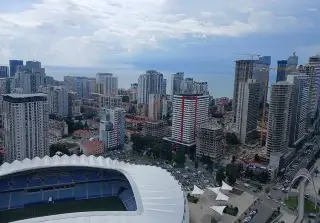
Against that backdrop, Georgia looks almost like the opposite market. If part of the Middle East is struggling with an oversupply of ambitious high-end product, Georgia is dealing with a different imbalance: premium and luxury supply is still relatively limited, while demand remains firm. Industry reviews explicitly point to a shortage in Georgia’s premium and luxury hospitality segments, while official tourism data show that branded hotels in Georgia posted 50.4% average occupancy in the first half of 2025, up 7.4% year on year; Batumi reached 66.3%, Tbilisi 53.4%, and international branded hotels in Tbilisi hit 70.6% occupancy in June 2025. That does not look like a market where expensive product is being built far ahead of demand. It looks more like a market where quality upper-end supply is still lagging behind solvent interest. It is important, however, not to confuse the top end with the whole market: Galt & Taggart warns of oversupply risks in Tbilisi’s broader residential sector, so the point is not that Georgia faces an overall property shortage, but that it still appears relatively short of quality luxury product compared with the level of demand it is attracting.