













Saudi oil flows through Yanbu hold steady
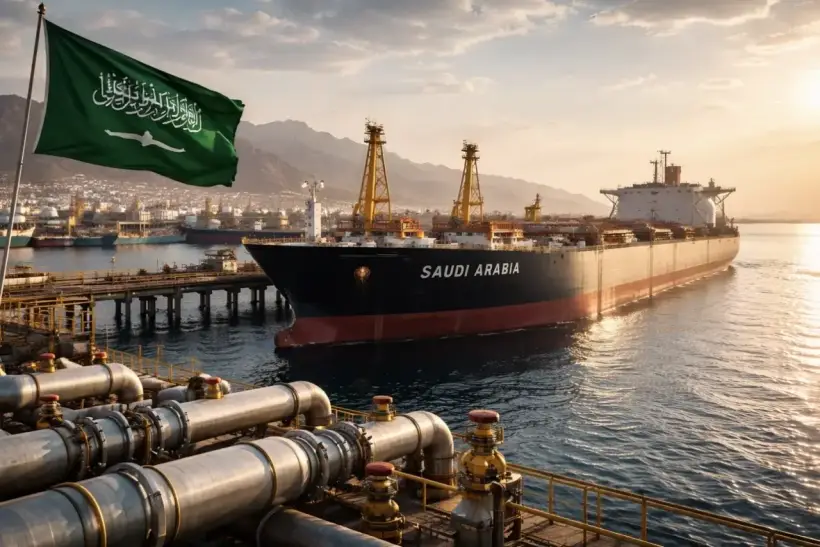
Saudi oil exports from the Red Sea port continue for now
Saudi Arabia is maintaining crude exports through the Red Sea port of Yanbu for now, despite a recent strike on the kingdom’s key east-west pipeline linking its eastern oil fields to western export terminals. Bloomberg reported on April 10 that the impact of the attack on Red Sea exports had not yet fully filtered through, with shipments from the port still holding steady. Two days earlier, Bloomberg had reported that damage at one pumping station was limited and crude flows were continuing.
That route has become central to Saudi oil logistics after the effective disruption of shipping through the Strait of Hormuz. The strait is one of the world’s most important oil transit chokepoints, and the U.S. Energy Information Administration said on April 7 that constrained flows through Hormuz had already contributed to rising production shut-ins across the region.
Saudi east-west pipeline becomes the key bypass route
The east-west pipeline allows Saudi Arabia to move crude from the Persian Gulf side of the kingdom to the Red Sea, avoiding Hormuz. The U.S. Energy Information Administration says the system’s standard crude capacity is about 5 million barrels a day and that it was temporarily expanded to 7 million barrels a day in 2019 after some natural gas liquids lines were converted to carry crude. Bloomberg reported on March 28 that the pipeline had reached its full operating level of 7 million barrels a day.
Yanbu had already become a much larger export outlet in March. Bloomberg reported on March 25 that crude shipments from Yanbu were moving toward 5 million barrels a day as Saudi Arabia diverted supply away from the Gulf after the disruption of normal traffic through Hormuz. On April 1, Bloomberg also reported that Saudi crude exports fell by about 50% in March to an average of 3.33 million barrels a day, while roughly 55 million barrels remained stranded in the Persian Gulf. That backdrop explains why any disruption to the kingdom’s westbound route matters immediately for global supply.
Drone strike has not yet halted Saudi exports
According to Bloomberg’s April 8 report, the drone strike hit one of the pumping stations, but the pipeline was not fully shut down. By April 10, Bloomberg said oil exports through the key Red Sea port were still being maintained. That suggests Saudi Aramco, the kingdom’s state oil producer, had managed at least for the moment to preserve continuity in crude flows.
At the same time, other reports showed that infrastructure risks remain elevated. The Wall Street Journal reported that the strike on the pumping station cut pipeline throughput by about 700,000 barrels a day, while production at some oil fields was also affected. Those figures should be treated as provisional, but they underline that the system is operating under greater stress even if exports have not stopped.
Security risks were reinforced by further aerial threats. Saudi Arabia’s defense ministry said through official and closely aligned channels that multiple drones had been intercepted in early April. On April 8, Al Arabiya, citing the ministry, said nine drones had been intercepted and destroyed over several hours. The Saudi Press Agency had also reported six intercepted drones on April 3 and another three on April 6.
Why Yanbu matters for the global oil market
Yanbu has long been one of Saudi Aramco’s key west coast export hubs. Aramco has said that an upgrade to its west coast export system added around 3 million barrels a day of crude export capacity. That does not mean the full volume is always instantly available, but it confirms Yanbu’s strategic role in the kingdom’s export system.
Even so, the westbound route does not remove all constraints. The U.S. Energy Information Administration has noted that pipelines bypassing Hormuz do not normally run at full capacity, and the practical spare bypass capacity available in the region can be lower than headline design figures suggest. In that setting, any damage to pumping stations, terminals or supporting infrastructure can rapidly turn a local incident into a global price driver.
In its April short-term outlook, the U.S. Energy Information Administration said global oil markets were in a period of heightened volatility and uncertainty because of the de facto closure of the Strait of Hormuz, a chokepoint that normally handles nearly one-fifth of global oil supply. Against that backdrop, the resilience of Saudi exports through the Red Sea has become one of the few stabilizing forces in the market.
What continued Red Sea shipments mean
The fact that exports through Yanbu are continuing does not mean the threat has passed. Instead, the market has gained a short reprieve: the key bypass route is still working, but it is now under direct attack risk and depends on a small number of critical assets remaining operational. Saudi Arabia has avoided a full export-chain breakdown for now, yet the cost of preserving that resilience has clearly increased.
As International Investment experts report, the continuation of loadings from Yanbu shows that Saudi Arabia is still holding open its main backup channel for crude exports to the global market, but the structure of those exports has become materially more fragile. For investors and oil buyers, that means the focus is no longer only on the Strait of Hormuz, but on the entire westbound Saudi chain from pumping stations to Red Sea terminals.
FAQ on Saudi Arabia’s Red Sea oil exports
Why is Yanbu so important for Saudi Arabia?
Yanbu sits on the Red Sea and allows Saudi Arabia to export crude without sending tankers through the Strait of Hormuz. With Hormuz traffic constrained, it has become the kingdom’s main alternative export outlet.
What happened to Saudi Arabia’s east-west pipeline?
Bloomberg reported that one of the pipeline’s pumping facilities suffered limited damage in a drone strike. The system was not reported to have been fully shut, and oil flows continued.
Did Saudi oil exports from Yanbu stop?
As of April 10, 2026, Bloomberg reported that exports from the key Red Sea port were still being maintained, meaning there had been no confirmed immediate halt in Yanbu shipments.
How much crude can this route handle?
The U.S. Energy Information Administration says the pipeline’s standard capacity is about 5 million barrels a day, while Bloomberg reported that throughput had reached 7 million barrels a day in late March.
Why does this matter for global oil prices?
Because the Saudi Red Sea route is one of the few large-scale alternatives to the Strait of Hormuz. Any disruption there could tighten supply further and increase price volatility.