













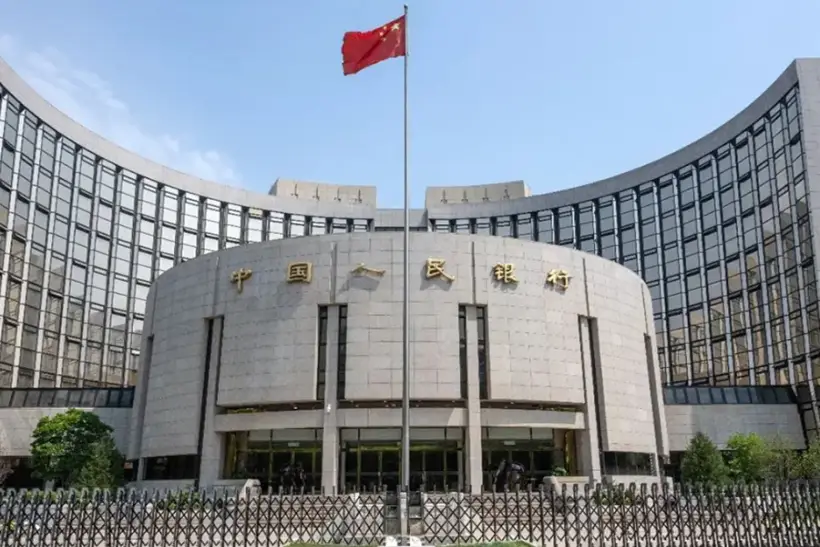
China’s central bank has stepped up liquidity injections into the financial system through short-term reverse repo operations, increasing liquidity amid low market rates, Bloomberg reports. The maintenance of accommodative monetary conditions continues to support demand for government bonds, which remain in a rally.
Monetary policy and liquidity in China
The People’s Bank of China added short-term liquidity to the banking system by injecting 9.5 billion yuan ($1.3 billion) on April 21 and 22 through seven-day reverse repo operations. This marked the largest amount since late March. While relatively small in scale, the move drew attention as the monetary system is already characterised by excess liquidity, with money market rates hovering near three-year lows.
Short-term funding conditions remain loose. The overnight repo rate is holding at around 1.2%, close to a three-year low. Yields on one-month bank negotiable certificates of deposit have fallen to levels not seen since January 2023. In this environment, regulators continue to ensure access to low-cost short-term funding for banks and maintain stability in the money market.
Bond market and preparation for issuance
Rising liquidity has coincided with a continued rally in the government bond market. Futures on 10-year government bonds have risen for eight consecutive sessions, the longest streak since September 2024. Yields have also declined: 30-year bond yields have fallen to around 2.22%, down roughly 13 basis points this month.
Additional support comes from expectations of large-scale issuance. Under a 1.3 trillion yuan ($179 billion) programme announced in March, authorities are preparing to issue ultra-long special government bonds to finance infrastructure and subsidies without widening the official fiscal deficit. A total of 119 billion yuan ($16.3 billion) of 20- and 30-year bonds is set to be issued in the coming days, with the 30-year tranche expected to be the largest on record.
According to Huachuang Securities analyst Guannan Zhou, liquidity in the system remains “extremely abundant”, while regulators appear comfortable with current conditions, including rising leverage in the bond market. This creates a supportive backdrop for upcoming supply.
Changjiang Securities expects the current rally to continue. Under current conditions, 30-year bond yields could fall to as low as 2.15%.
China’s economy
China’s central bank previously reaffirmed its intention to maintain a loose monetary policy, while noting increasing external pressures. The regulator aims to maintain sufficient liquidity, support price recovery, and keep the yuan stable at a “reasonable and balanced level”.
Benchmark lending rates were left unchanged on April 20, marking 11 consecutive months of stability, Reuters reports. The one-year loan prime rate (LPR) remains at 3.00%, while the five-year rate stands at 3.50%.
China’s GDP grew by around 5% in the first quarter, reaching the upper end of the government’s 4.5–5% annual target range, indicating relative resilience compared with other Asian economies. This is supported by significant strategic oil reserves and a diversified energy structure. In March, producer prices in China rose for the first time in more than three years, marking the first sign of pricing pressure linked to the war in Iraq affecting the world’s second-largest economy.
China’s outlook
DBS analysts expect that, in the absence of signs of a sharp slowdown and amid only a modest recovery in credit demand, policymakers will continue to rely on targeted easing measures rather than broad interest rate cuts. Societe Generale also expects regulators to refrain from additional stimulus in the near term.
International Investment analysts note that additional fiscal stimulus may not be required in the coming months as the economy shows signs of recovery. However, structural challenges remain. The property market has been in a prolonged downturn for several years, weighing on related sectors and overall economic momentum.
China continues to face a range of challenges, including excess supply, weak domestic demand, and external pressures. These constraints continue to limit a more sustainable expansion of the economy, despite improvements in some macroeconomic indicators.