







 Poland Poised to Hold Rates at 3.75%
 Ljubljana's Million-Euro Deals Are Increasingly About Land
 Reform UK Reworks Its Offer to Wealthy Foreigners
 US Introduces Visa Bonds of Up to $20,000 for Tourists From 50 Countries
 Portugal Secures €1.5 Billion for Social Housing
 Mortgage Lending in Georgia Increased by Nearly 50%
Moody’s upgrades Georgia’s rating outlook to “stable”

International rating agency Moody’s has affirmed Georgia’s sovereign credit rating at Ba2 and revised the outlook from negative to stable, the National Bank of Georgia reports. The agency highlighted the effectiveness of fiscal policy, successful investment attraction, and raised its forecast for the country’s GDP growth to 6.4%.
Georgia maintains strong GDP growth
Georgia’s strong economic indicators have helped reduce risks related to domestic and geopolitical challenges, which became the basis for the improved rating outlook. Moody’s noted that cooperation with international financial institutions contributes to the effectiveness of fiscal and monetary policies and makes the country’s development more resilient to external factors.
The agency also emphasized Georgia’s strategic location and its role in the development of the Middle Corridor, which helps attract investment flows from the region and other countries.
Moody’s also highlighted strong economic growth, fiscal discipline, and declining public debt. The average GDP growth rate in Georgia over the past five years has been around 9.3%. In 2025, the country’s economy expanded by 7.5%, while GDP reached 104.6 billion lari (around $40 billion) for the first time.
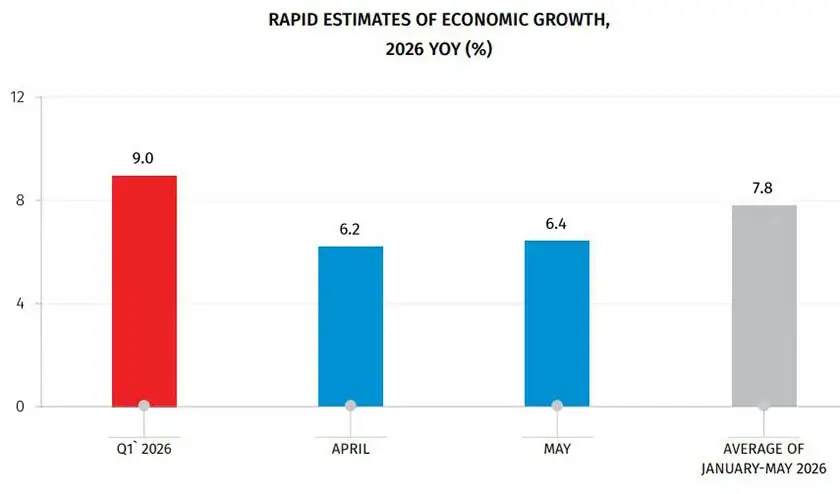
According to the National Statistics Service of Georgia (Geostat), real GDP growth amounted to 6.4% in May 2026 compared with the same month of 2025. The average economic growth rate for the first five months of the year reached 7.8%. The largest contributions came from financial and insurance activities, information and communication, manufacturing, and transportation and storage.
Foreign investment in Georgia
Georgian Prime Minister Irakli Kobakhidze confirmed the expansion of investment activity and improvements in the country’s external economic indicators. In 2025, exports of goods increased by 11.2% to a record $7.3 billion. Foreign direct investment grew by 7.6% to $1.7 billion.
In the first quarter of 2026, foreign direct investment in Georgia increased by almost 48% compared with the same period of 2025, reaching $271.2 million, according to Geostat. The main source of growth was reinvested earnings by foreign companies already operating in the country. In January–March, reinvested earnings amounted to $145.8 million, accounting for 53.8% of total FDI. Equity investments reached $101.6 million, while debt instruments accounted for $23.8 million.
The largest sources of investment in the first quarter were the United Kingdom ($52.4 million), the United States ($47.5 million), and the Netherlands ($29.2 million). By sector, financial and insurance activities remained the leading destination, attracting $125.1 million, or 46.1% of total FDI. Real estate activities ranked second with $48.8 million, followed by information and communication activities with $37.2 million.
Georgia’s economic outlook
Moody’s raised its forecast for Georgia’s economic growth in 2026 to 6.4%. The agency expects that strong domestic consumption, investment activity, and prudent economic management will continue to strengthen the country’s economic position. In its medium-term forecast for 2026–2031, the International Monetary Fund places Georgia among the leading economies in terms of growth rates in the region and Europe.
International Investment analysts note that Moody’s revised outlook reflects the combined result of structural changes in Georgia’s economy, stronger fiscal policy, and increased resilience of the financial system. The combination of GDP growth, rising foreign direct investment, expanding foreign trade, and a declining debt burden is creating a more predictable environment for businesses.
The improved assessment from one of the leading international rating agencies strengthens Georgia’s position among regional investment destinations and may support further interest in projects in real estate, infrastructure, logistics, tourism, and other sectors focused on long-term growth.