







 Russian and Belarusian Owners List More Latvian Property
 Georgian Law Enforcement Busts Scammers Posing as Real Estate Brokers
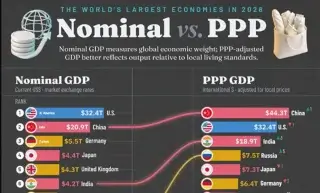 World’s Largest Economies in 2026: GDP and Purchasing Power Rankings
 Turkish Airlines Cancel Flights to Moscow
 Escalation in the Middle East: New US and Iranian Strikes
 Hong Kong Property Rebounds as Momentum Slows
Portugal Raises Tax on Non-Residents

Portugal is changing the tax treatment of foreign homebuyers: a new flat 7.5% IMT rate for non-residents has become part of a broader attempt to shift housing policy from attracting external capital toward protecting affordability for residents. For the market, it signals that the era of maximally friendly rules for foreign buyers is gradually ending.
IMT becomes a housing-policy tool
Portugal long competed for international capital through visa programmes, tax incentives, safety, climate and real estate that was once comparatively affordable by European standards. Now the authorities are increasingly using the tax system to influence buyer behaviour in the housing market.
Benoit Properties says the new IMT rate for non-residents signals a shift in housing policy. IMT, or Imposto Municipal sobre as Transmissões Onerosas de Imóveis, is Portugal’s municipal property transfer tax. It is paid by the buyer, usually on the higher of the transaction price or the taxable value of the property.
According to professional tax guides, buyers of urban residential property who are not Portuguese tax residents face a flat 7.5% rate. Unlike the progressive scale, where the tax depends on property value, use and exemptions, the new rate operates as a separate regime for non-residents. It makes purchases more expensive mainly for those buying second homes, investment assets or seasonal properties.
Who the new rate affects
The dividing line is not nationality but tax residency. A tax resident is a person who meets Portugal’s criteria for residence and tax connection. In practice, this usually involves physical presence, centre of life interests and the obligation to report income under Portuguese tax rules.
The new rate targets buyers who acquire housing without becoming part of Portugal’s tax base. For the state, this is a sensitive category: such buyers may support home prices, but they do not always contribute proportionately to local revenue, schools, healthcare, transport or long-term urban life.
The practical impact depends on the price of the property. In expensive markets such as Lisbon, Cascais, the Algarve, Porto and Madeira, the additional tax cost can reach tens of thousands of euros. For some buyers, this will not be a barrier, but it will change yield calculations and may make speculative or short-term strategies less attractive.
Why Portugal is tightening the rules
Housing affordability has become one of Portugal’s main political issues. In 2025, the house price index rose by 17.6%, with existing homes up 18.9% and new homes up 14.2%. That shows pressure not only in new developments but also in the older housing stock where most households buy.
A shortage of supply remains the key driver. The government is pushing the Construir Portugal strategy to expand housing supply, develop public housing, support young people and simplify construction procedures. Under the Recovery and Resilience Plan, the authorities have said they intend to bring 25,000 homes to the market.
Construction, however, responds slowly. Years can pass between a policy decision, land allocation, licensing, financing and completed homes. A tax on non-residents is a faster instrument: it does not create new apartments, but it can limit part of the external demand competing with residents for scarce housing.
Foreign buyers remain important
Portugal is not closing the market to foreigners. It is trying to rebalance capital attraction and social sustainability. Data published from the Bank of Portugal’s Financial Stability Report indicate that foreign buyers accounted for about 28% of home purchases in 2025 when both residents and non-residents are included. Brazil, Angola and France were among the main countries of origin.
That share shows that foreign demand has become a systemic part of the market. But it is important to distinguish foreign residents from non-residents. A foreigner who lives, works, pays taxes and participates in the local economy is viewed differently from a buyer who purchases a home mainly for holidays, capital preservation or rental income.
For the government, that distinction is politically useful. It avoids a direct ban on foreign purchases and preserves Portugal’s investment image, while showing voters that external demand will no longer enjoy the same terms as permanent residents.
Lisbon, the Algarve and Madeira will feel it most
The new IMT rate will have uneven regional effects. In areas where foreign and non-resident demand represents a significant part of the market, the impact will be more visible. That includes Lisbon, Cascais, the Algarve, Porto, parts of Madeira and premium coastal destinations.
In Lisbon, the problem is not only foreign buyers. The capital faces limited supply, expensive land, tourism demand, short-term rentals, technology-sector growth and an inflow of wealthier residents. But non-resident purchases add competition in segments where local incomes are already disconnected from prices.
In the Algarve, the situation is different. Foreign demand is part of the region’s economic model. Second-home buyers, retirees, relocators and investors support construction, services, renovation, restaurants and employment. Higher taxes may cool some transactions, but they will not eliminate the region’s appeal for wealthy buyers from Northern Europe, the UK, the US and elsewhere.
The tax will not solve the supply problem
The measure has a clear limitation: a tax on non-residents does not create new homes. It can influence demand, but it does not remove construction shortages, expensive land, slow licensing or the lack of affordable projects. If supply remains tight, prices can continue rising even if purchases become more expensive for non-residents.
This is especially important for the mainstream market. In many areas of Portugal, local families are not competing with foreign millionaires but with a lack of properties, expensive mortgages, low wages relative to prices and a weak rental stock. For them, the tax measure may have an indirect effect, but not a decisive one.
At the same time, tax policy can help if it is part of a broader package. If additional revenue, lower speculative demand and long-term rental incentives are combined with real construction, the effect will be stronger. If the tax remains a standalone symbolic step, it will change market sentiment more than market structure.
Residency and long-term rentals become key conditions
Professional tax reviews indicate that some buyers may be able to obtain a refund or neutralise the difference if they become Portuguese tax residents after purchase or place the property in long-term rental under moderate-rent conditions. This is an important detail: the state is not only penalising non-residents, but pushing capital toward forms that are more useful to the housing system.
That changes the investment logic. Previously, a buyer could treat Portugal mainly as a second-home destination with minimal presence. Now the more favourable regime may be linked to a real connection with the country: tax residency, long-term renting or participation in the local economy.
For developers, this is also a signal. Projects aimed only at non-residents and seasonal use may face a narrower audience. Properties suitable for long-term living, rental and resident demand gain a more stable base.
The market will adapt through pricing and deal structures
Higher IMT will not necessarily trigger a sharp price correction. In the premium segment, buyers are often less tax-sensitive, especially when buying for personal use, relocation or wealth preservation. But the tax may change negotiations: some buyers will seek discounts, delay transactions, change ownership structures or consider tax residency.
The effect may be stronger in the mid-market investment segment. If a property is bought for yield, an additional 7.5% entry tax worsens the economics of the deal. That matters when borrowing costs, rental taxes, renovation, management and possible short-term rental restrictions are already part of the calculation.
For sellers, the new rate means a narrower pool of non-resident buyers. Homes that previously sold easily to foreign investors may stay on the market longer or require more realistic pricing. In locations with scarcity and strong domestic demand, however, the effect will be limited.
Portugal changes its investment signal
The new IMT rate fits a broader European trend. Countries that long attracted external capital into housing are facing political pressure as affordability deteriorates. Spain has discussed tougher measures for non-EU buyers, while the Netherlands, Ireland and Greece have tightened selected rental or tax regimes, and cities across Europe are restricting short-term accommodation.
Portugal is moving more cautiously. It is not closing the market or relying on a direct ban. Instead, it is creating a tax filter: buying remains possible, but it becomes more expensive for those who do not shift their tax and life connection to the country.
For international investors, this means Portugal is no longer only a welcoming capital haven. It remains open, but now requires more careful tax planning, residency analysis, holding-period assumptions, rental strategy and political-risk assessment.
What it means for buyers
For non-residents, the practical conclusion is simple: acquisition budgets must be recalculated. In addition to the purchase price, buyers must account for stamp duty, notary and registration costs, legal fees, bank charges, annual municipal property tax and possible taxes on rental income or capital gains.
The new rate is especially important for buyers comparing Portugal with Spain, Italy, Greece and France. Portugal once stood out through its combination of price, climate and tax appeal. Part of that advantage may now narrow. Still, the country retains strong advantages: safety, quality of life, international schools, healthcare, transport, English-language services and resilient rental demand in key areas.
For those who genuinely plan to relocate, the measure may be less painful. A buyer who becomes a tax resident and uses the home as a main residence is closer to the logic of the new policy: support those who live in the country, not only those who own an asset.
What happens next
The most likely scenario is not an exit of foreign buyers, but a redistribution of demand. Some non-residents will continue buying premium homes, treating the tax as an additional entry cost. Some will accelerate tax residency plans. Others will shift toward commercial property, long-term rental strategies or other Southern European markets.
For Portugal, the main test is not how much extra tax the rate generates. The bigger question is whether it reduces pressure in the segments where local families compete, and whether the state can speed up affordable housing delivery. If prices continue rising at double-digit rates, the non-resident tax will quickly look insufficient.
For the real estate market, this marks the start of a more regulated phase. After the Golden Visa, tax incentives and relocation boom, Portugal is trying to redefine who should receive priority in the housing market. The answer is still a compromise: capital remains welcome, but residency, long-term use and the social function of housing now matter more.
As experts at International Investment report, the new IMT rate for non-residents is not a minor fiscal adjustment but a political signal. Portugal is acknowledging that openness in housing has limits when prices rise faster than incomes and construction. But tax cannot replace supply: without faster building, mobilisation of vacant homes and long-term rental expansion, the measure risks becoming an expensive filter for foreigners rather than a solution to the housing crisis for Portuguese residents.
FAQ
What is IMT in Portugal?
IMT is Portugal’s municipal property transfer tax. It is paid by the buyer before completion, usually on the higher of the purchase price or the property’s taxable value.
What is the new IMT rate for non-residents?
Non-resident buyers of urban residential property face a flat 7.5% IMT rate. This differs from the standard progressive scale used for residents and other buyer categories.
Who is considered a non-resident?
A non-resident is a buyer who is not tax resident in Portugal. The key issue is not passport nationality, but tax status and the buyer’s actual connection to Portugal.
Why is Portugal raising the tax for non-residents?
The aim is to reduce pressure from external demand and prioritise residents during a housing affordability crisis. The measure is also part of a wider policy push to expand housing supply.
Will the new rate affect Lisbon and the Algarve?
It may cool some investment demand, but it is unlikely to sharply lower prices by itself. In Lisbon, the Algarve and other scarce markets, prices are supported by limited supply as well as foreign demand.
Can buyers avoid the higher rate?
Professional tax guides indicate that refunds or adjustments may be available if the buyer becomes a Portuguese tax resident or places the property into long-term rental under defined conditions. Buyers should seek tax advice before signing.