







 Israel Cuts Rate to 3.25% for Third Meeting
 Russian and Belarusian Owners List More Latvian Property
 Georgian Law Enforcement Busts Scammers Posing as Real Estate Brokers
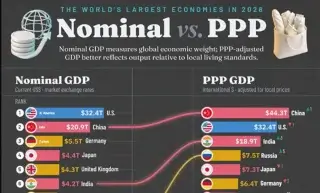 World’s Largest Economies in 2026: GDP and Purchasing Power Rankings
 Turkish Airlines Cancel Flights to Moscow
 Escalation in the Middle East: New US and Iranian Strikes
SNB Rate Hike Expectations Shift Beyond Mid-2027

Economists have pushed back expectations for the Swiss National Bank’s first interest-rate increase, with none of the forecasters in Bloomberg’s August survey now anticipating a move before June 2027 and most expecting the first hike only in early 2028. The SNB policy rate remains at 0%, annual inflation was just 0.4% in July and economic growth is running below its historical average. The timing of any increase, however, is not predetermined: the SNB’s official inflation forecast uses a constant-rate assumption and does not constitute a commitment to keep borrowing costs at zero until any specific date.
No economist now expects a hike before June 2027
Expectations for Swiss monetary policy have shifted further into the future.
Bloomberg’s August 10 survey shows that economists who had previously expected borrowing costs to rise as early as 2026 have abandoned that view. The earliest forecast now points to June 2027, while the majority of respondents expect the first increase only in early 2028.
The same survey shows analysts expecting Swiss GDP growth to slow slightly to around 0.3% in the second quarter after 0.4% in the first three months of the year. The first estimate is due on August 14.
The shift suggests Switzerland could remain at zero rates for considerably longer than previously anticipated.
It does not, however, amount to formal forward guidance from the central bank.
Zero rates through 2027 are a scenario, not a commitment
Bloomberg reported in late July, citing people familiar with internal SNB thinking, that the central bank’s current baseline scenario envisages a zero policy rate through the end of 2027 before rates probably begin to rise.
That information should not be confused with an official SNB commitment.
The central bank declined to comment on the report, and its policymakers have repeatedly stressed that they do not commit themselves to a fixed rate path.
The scenario also assumes no major new economic shocks. Negative rates remain an available option if the economic outlook deteriorates sharply, although they are not the base case under the internal assessment described in the report.
The more accurate conclusion is therefore that current conditions favor a prolonged pause, not that the SNB has formally promised zero rates until 2028.
The SNB rate has been at zero since June 2025
The Swiss National Bank cut its policy rate from 0.25% to 0% in June 2025, with the new level taking effect on June 20.
That followed a March 2025 reduction from 0.5% to 0.25%. Taken together, the two moves lowered the policy rate by half a percentage point during the first half of the year.
The SNB subsequently kept the rate unchanged in September and December 2025 and again in March and June 2026.
Switzerland consequently remains one of the advanced economies with the lowest nominal policy rates.
The SNB held its policy rate at zero in June
At its latest monetary-policy assessment on June 18, the central bank again left its policy rate unchanged at 0%.
The SNB said the current stance was appropriate to keep inflation consistent with price stability while supporting economic activity.
It also said it had an increased willingness to intervene in the foreign-exchange market if a rapid and excessive appreciation of the Swiss franc threatened price stability.
Its conditional forecast puts average inflation at 0.6% in 2026, 0.6% in 2027 and 0.7% in 2028. The central bank expects economic growth of around 1% this year and roughly 1.5% in 2027.
Those numbers provide little evidence of an economy that requires immediate monetary tightening.
A constant-rate inflation forecast is not rate guidance
A key methodological distinction is necessary when interpreting the SNB’s projections.
The inflation forecast is calculated on the assumption that the policy rate remains constant at 0% throughout the projection horizon.
That is a technical assumption used to show how inflation might evolve under an unchanged monetary-policy setting.
It does not mean the Governing Board has decided in advance to keep rates at zero through 2027 or 2028.
If inflation, economic growth or the exchange rate develop differently from the SNB’s expectations, the bank can change its policy rate and publish a new conditional forecast based on that new rate.
The forecast therefore supports the case that there is currently no urgent need to tighten policy, but it is not a calendar forecast for interest rates.
Swiss inflation falls to 0.4%
The latest inflation figures strengthen the case for patience.
Switzerland’s Consumer Price Index fell by 0.1% in July from the previous month to 101.1 points, with December 2025 equal to 100.
Annual inflation was only 0.4%.
Inflation had been 0.6% in May, with higher oil-product prices accounting for much of that increase.
The latest result suggests that the energy-price impulse has not developed into a broad and persistent inflation surge.
That leaves the SNB facing a very different problem from central banks dealing with inflation materially above target.
The SNB does not have a symmetric 2% target
Descriptions of Switzerland as having a formal “0% to 2% target range” can be misleading.
The SNB officially defines price stability as an annual increase in the Swiss Consumer Price Index of less than 2%. At the same time, sustained deflation also breaches its price-stability objective.
This differs from the symmetric 2% medium-term target used by the European Central Bank.
Current inflation of 0.4% is consistent with the SNB’s definition of price stability, but very weak price growth still matters because tighter monetary policy could push inflation even lower.
A rate increase could also increase appreciation pressure on the franc, further reducing imported inflation.
The Swiss franc remains central to the policy outlook
The exchange rate has an unusually important influence on Swiss monetary policy.
Official SNB calculations for August 7 put the euro at 0.9347 Swiss francs and the US dollar at 0.8111 francs.
A stronger franc lowers the Swiss-currency cost of imported goods and commodities and therefore tends to suppress inflation.
At the same time, it creates pressure for exporters and companies that earn substantial revenues abroad while carrying costs in Switzerland.
This is why interest rates are not the SNB’s only tool. Foreign-exchange intervention can also be used when exchange-rate movements threaten price stability.
Negative rates remain possible but are not the base case
Switzerland has extensive experience with negative interest rates, so moving below zero remains technically possible.
Current conditions, however, do not make that the central scenario.
Inflation remains positive, the economy is still expanding and the SNB retains the option of acting in foreign-exchange markets.
A return to negative rates would become more plausible after a major external shock that produced a sharp safe-haven flow into the franc and renewed deflationary pressure.
Conversely, stronger growth and a durable increase in inflation would bring a rate hike closer.
Swiss GDP grew 0.4% in the first quarter
Sport-event-adjusted Swiss GDP increased by 0.4% quarter on quarter in the first three months of 2026, following growth of 0.2% in the fourth quarter of 2025.
Manufacturing made an important contribution to growth, while domestic demand remained relatively weak.
The adjustment for sporting events is particularly relevant in Switzerland because financial flows associated with large international sports organizations headquartered in the country can distort quarterly national-account figures.
The current consensus points to somewhat slower second-quarter growth, but not to a contraction.
Government economists expect only 0.9% growth in 2026
The Swiss federal government’s Expert Group on Business Cycles lowered its growth forecast in June.
Sport-event-adjusted GDP is now expected to increase by only 0.9% in 2026 before growth accelerates to 1.6% in 2027.
The previous March projections were 1% and 1.7%, respectively.
Higher energy prices, weaker global growth and elevated uncertainty were among the main reasons for the downgrade.
The outlook therefore provides little evidence of economic overheating.
KOF is even more cautious
The KOF Swiss Economic Institute at ETH Zurich has an even softer forecast.
It expects sport-event-adjusted real GDP growth of 0.8% in 2026 and 1.5% in 2027, down from previous estimates of 1% and 1.7%.
The three main projections are therefore closely aligned: around 1% from the SNB, 0.9% from the federal expert group and 0.8% from KOF for 2026.
None implies the kind of rapid growth that would by itself require an urgent increase in interest rates.
A eurozone recovery could bring tightening closer
One of the stronger arguments for an earlier hike is an improvement in demand from Switzerland’s main European trading partners.
UBS economist Maxime Botteron sees June 2027 as a possible starting point for higher rates, arguing that stronger euro-area demand could bring Swiss GDP growth closer to its longer-term trend.
Under that scenario, the case for maintaining a mildly expansionary zero-rate stance would gradually weaken.
A hike would become more likely still if stronger economic activity were accompanied by firmer inflation and less appreciation pressure on the franc.
June 2027 corresponds to a specific SNB meeting
The SNB conducts in-depth monetary-policy assessments four times a year, in March, June, September and December.
The next decision is scheduled for September 24, 2026, followed by December 10.
In 2027, monetary-policy assessments are scheduled for March 18, June 24, September 23 and December 16.
The earliest forecast in the latest survey therefore effectively points to the June 24, 2027 meeting.
Most economists expect the zero-rate period to last longer.
The franc and inflation matter more than one forecast date
Switzerland’s current monetary configuration is unusual: the policy rate is zero, inflation is only 0.4%, economic growth is running at roughly 1% and the franc remains a major global safe-haven currency.
That makes premature tightening potentially costly.
A higher policy rate could increase the relative attraction of franc assets. A stronger franc can then lower import prices and weaken inflation further.
A sustainable normalization of monetary policy is therefore more likely to require several conditions at the same time: stronger economic activity, a durable increase in inflation and the absence of excessive upward pressure on the currency.
As International Investment experts note, pushing the first expected hike out to at least June 2027 is consistent with inflation of only 0.4%, a zero policy rate and below-average economic growth. Investors should not, however, interpret reports of zero rates through the end of 2027 as formal SNB guidance. The official inflation projection is conditional, while the reported internal rate scenario is based on anonymous-source reporting. The more important investment variables are the interaction between inflation, the franc and economic growth. Renewed safe-haven demand could postpone normalization, while stronger European demand and a durable increase in Swiss inflation could bring it forward.