











Foreigners Bought 52% of Apartments in Batumi in 2025
Investors from Israel and the EU Take the Lead
The Black Sea coast of Georgia continues to attract foreign investors. According to a study by Galt & Taggart, in 2025, the share of foreigners in Batumi’s residential real estate market exceeded half of all transactions, reaching 52%. However, this figure is slightly below the peak levels seen two years ago, with a noticeable decline in interest from certain countries, including Russia.
Who is Buying Property in Batumi
Georgia: Decline and Recovery
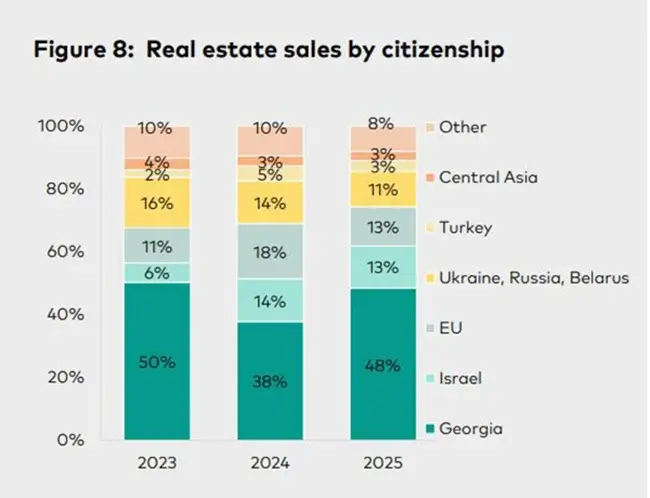
In 2025, Georgian citizens purchased 48% of apartments in Batumi. This is a significant increase compared to 2024 (38%), when local demand fell by 12 percentage points from 2023 (50%). The recovery may indicate a return of confidence among local buyers after a period of uncertainty and growing wealth.
Israel: Twofold Growth
Israeli buyers were the main “discoveries” of 2024, with their share more than doubling—from 6% in 2023 to 14% in 2024. In 2025, it slightly adjusted to 13% but remained high, securing Israel’s position as the second-largest group of foreign investors.
European Union: Rise and Fall
The EU also showed sharp fluctuations: the share of Europeans grew from 11% in 2023 to 18% in 2024, then fell back to 13% in 2025. This “swing” trend may result from one-off large transactions or changing assessments of Batumi’s residential market.
Ukraine, Russia, Belarus: Cooling
Buyers from this region have been declining for three consecutive years—from 16% in 2023 to 14% in 2024, and 11% in 2025. The peak of interest in 2022–2023 has passed, and demand now stabilizes at a lower level.
Turkey: Minimal Presence
Contrary to stereotypes of mass investment, Turkish buyers remain a minor share: 2% in 2023, a slight increase to 5% in 2024, and a decrease to 3% in 2025.
Central Asia and Other Countries
Buyers from Kazakhstan, Uzbekistan, and other Central Asian countries account for 3–4% of the market over the past three years. In 2025, their share was 3% with no notable changes. The share of other countries fell from 10% in 2023–2024 to 8% in 2025.
Key Trends
Batumi’s real estate market in 2025 showed three main trends:
-
Recovery of Georgian demand (48%, +10 pp year-on-year);
-
Sharp increase in Israel’s share (from 6% to 13–14% over two years);
-
Decline in interest from Eastern Europe (from 16% to 11%) and volatility among Europeans.
Overall, foreigners accounted for 52% of transactions, with Israel and the EU remaining the main drivers of external demand.
Batumi Real Estate: Demand Structure
In 2025, apartment transactions in Batumi increased by 15%, reaching 17,478 deals. In monetary terms, the volume surpassed $1.3 billion for the first time, up 23.8%.
New Buildings vs. Existing Properties
Galt & Taggart experts note a key shift in demand structure—secondary housing overtook new constructions in sales for the first time. In 2025, 9,500 deals involved ready-to-move-in apartments, while 8,000 involved new builds. For comparison, in the peak year of 2023, the numbers were reversed (8,400 vs. 7,300). Buyers increasingly prefer completed properties to avoid construction delays.
Challenges on the Primary Market
At the same time, the market faces an accumulation of unsold units. By the end of 2025, approximately 12,400 apartments were unsold in ongoing projects—up 13.9% from the previous year. Supply is growing faster than demand, creating a risk of oversaturation.
About 30% of new units move to the secondary market within the first two years after completion. It’s clear that investors unable to rent or resell are trying to exit. Meanwhile, sales in the secondary segment have nearly halved compared to 2022.
Large-Scale Construction Plans
In 2020, Batumi had 86,000 apartments, growing to 119,000 by 2024. Between 2025–2029, around 58,000 new units are expected, with 46,300 (80% of the total) planned exclusively for short-term rentals. In some neighborhoods, investment apartments account for up to 96%.
Prices Rise, Yields Fall
By the end of 2025, the average price per square meter in new buildings reached $1,865, and $1,450 on the secondary market. Over the year, new apartments rose 9.4%, ready-to-move-in properties 6.9%.
Rental rates remain almost frozen at $35.6 per sq.m per year. As a result, rental yields fell from 10% in 2023 to 7.4% in 2025. Moreover, this is the gross yield — a raw, pre-expense figure. These indicators do not take into account operating costs or vacancy periods. These figures exclude operating costs and vacancies. International Investment analysts note that net real yields, considering all expenses, are 2–4%. Further declines are expected in 2026 as supply continues to grow, keeping rents low.
If the apartment stock doubles—as forecasted by Galt & Taggart—owners may earn only 1.5–2%, and in some cases, face losses. This raises questions about the viability of investing in Batumi apartments, prompting investors to consider alternative assets. Among the most profitable and stable options, experts highlight international brand hotels — a unique segment with high returns due to strong demand and limited supply in the market.