











Tbilisi Real Estate Market in February 2026: Rising Prices and Transactions
The Tbilisi real estate market shows increased activity in 2026. Analysts from Galt & Taggart recorded growth in both the number of transactions and their monetary volume in January–February. At the same time, the primary segment remains key, the volume of unsold new developments is increasing, and residential yields are declining.
Apartment Sales Dynamics in Tbilisi
In 2024, apartment sales in Tbilisi ranged from 3.0–3.8 thousand units per month, with the usual spike in December (over 4,000 units). In January 2025, sales fell to 2.9 thousand, followed by recovery and higher levels in the second half of the year—over 4,000 transactions per month. In January 2026, a seasonal decrease was recorded again, but by February the volume increased to about 3.8 thousand.
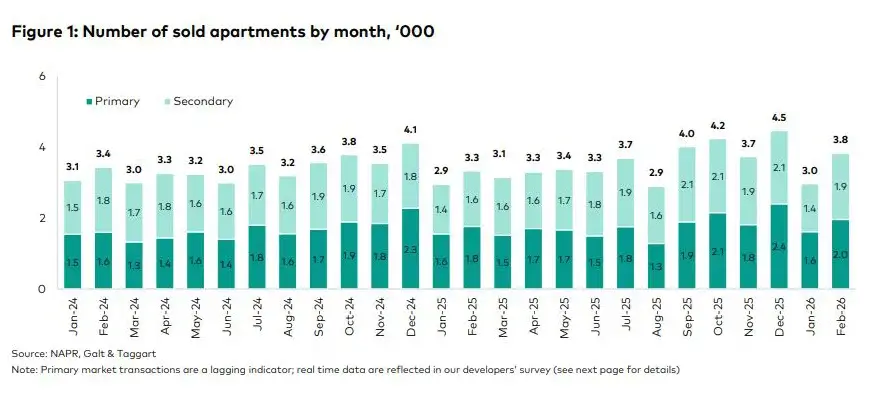
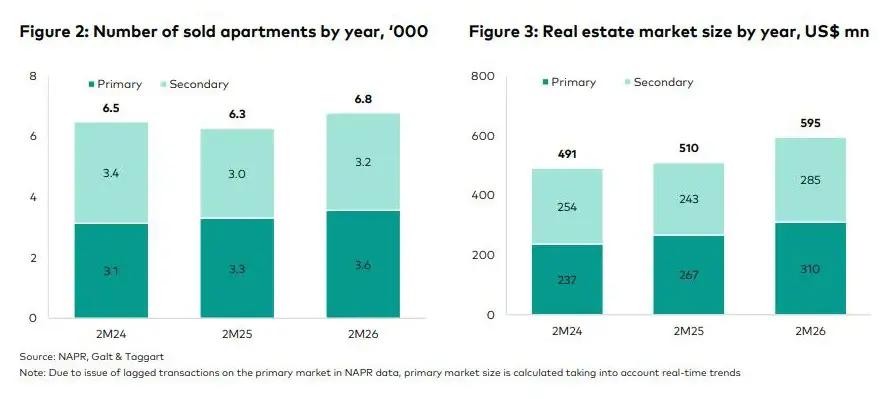
A comparison of the first two months shows uneven market development. In January–February 2024, about 6.5 thousand apartments were sold; the same period in 2025 saw 6.3 thousand; and in 2026 — 6.8 thousand. The drop in 2025 was caused by a decrease in secondary market activity (from 3.4 to 3.0 thousand transactions) while the primary segment grew (from 3.1 to 3.3 thousand). In 2026, positive dynamics are observed in both segments: the primary market increased to 3.6 thousand, the secondary — to 3.2 thousand.
Monetary Volume of Housing Transactions
In monetary terms, transactions amounted to $491 million in January–February 2024, $510 million in 2025, and $595 million in 2026. The main contribution came from the primary segment, which increased from $237 million to $330 million over the period. The secondary market, after some decline, recovered to $285 million.
The ratio of the number of transactions to their total value indicates an increase in the average transaction amount, which may indicate both rising prices and a shift in demand toward more expensive housing, primarily new developments.
Structure of Demand in Tbilisi
In February 2026, 3,822 apartments were sold in Tbilisi. Of these, 1,864 transactions were in the ready housing segment, with sales up 19.2% for the month and 8.6% for the first two months of the year.
On the primary market, 1,958 transactions were recorded, 11.2% more than a year earlier and 7.8% higher for January–February. Due to delays in transaction registration, official statistics for new developments may lag behind actual dynamics.
Developer Sales in Tbilisi
Additional data from Galt & Taggart is based on a survey of systemic developers implementing over 100 residential projects in Tbilisi, which account for about half of the primary market.
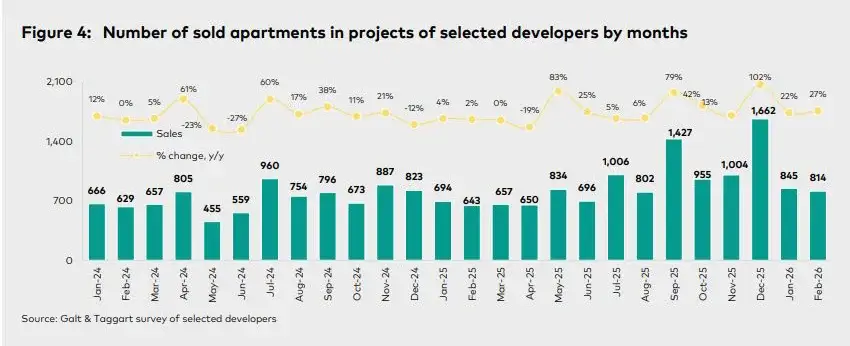
According to developers, the first half of 2024 showed moderate performance — between 550–700 transactions per month. Then growth was recorded — up to 800–960 apartments. In December 2024, sales reached 883 units.
In 2025, dynamics were also uneven: from 640–700 transactions per month to 1,427 in September. The peak was recorded in December — 1,662 sales. In January–February 2026, expected correction occurred — 845 and 814 transactions for major developers, respectively.
Increase in Unsold Units and Decrease in Project Permits
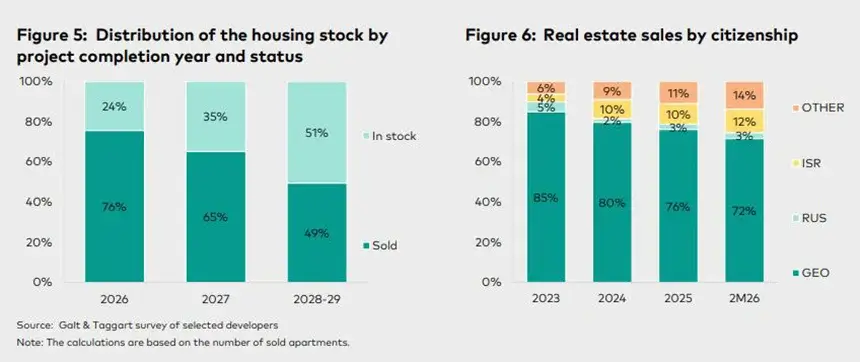
The distribution of housing by construction completion dates indicates a shift toward longer-term projects. In 2026, about 74% of apartments are already sold, and only 26% remain available. For projects completing in 2027, the share decreases to 65%, and for projects in 2028–2029 — to 49%. Accordingly, the number of unsold units increases — up to 51% for longer-term projects, reflecting both expanded developer activity and gradual market saturation at early construction stages.
In February, 10 building permits were issued in Tbilisi for residential projects totaling 60,283 sq. m, 44.7% less than a year earlier. This reduction has continued for five months, and for January–February, the volume of permits fell by 50.7% YoY. This indicates a gradual slowdown in developer activity after a growth period and forms a more limited market supply.
Who Buys New Developments in Tbilisi
The buyer structure by citizenship shows gradual changes. The share of Georgian citizens fell from 85% in 2023 to 72% in January–February 2026. Meanwhile, the share of foreign buyers is increasing. The share of Russians decreased from 10% in 2024 to 9% in 2026, while Israeli buyers became more active, rising from 5–6% to 12%. Other foreign buyers also increased their presence — from 6% to 14%.
Thus, the primary market in Tbilisi shows growing sales with high monthly volatility, expanded long-term supply, and gradual diversification of demand through foreign buyers.
Apartment Prices in Tbilisi: Declining Rental Yields
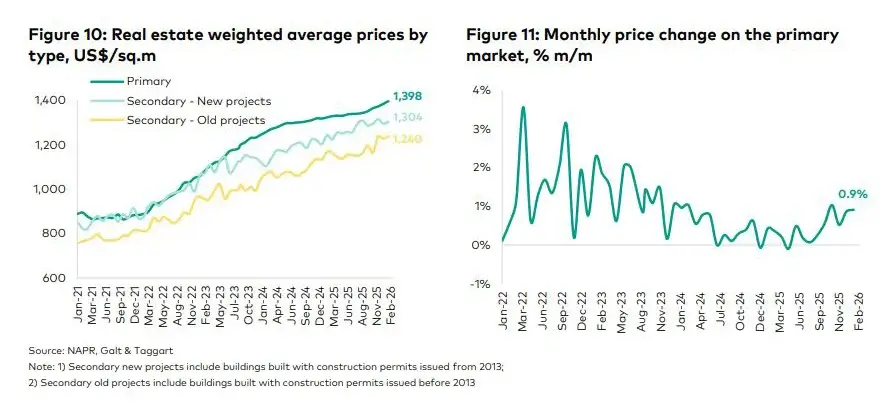
Property prices in Tbilisi continue to rise. In February, the average price in the primary market increased by 0.9% month-on-month, reaching $1,398 per sq. m. In the ready housing market, in new buildings with permits issued after 2013, prices rose by 0.6% — to $1,304.
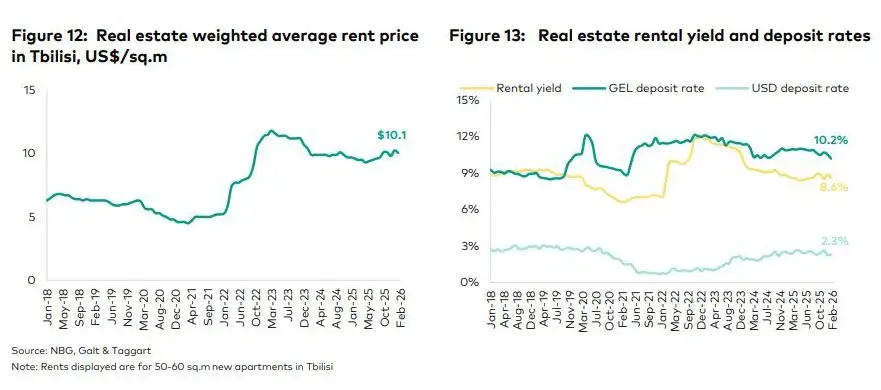
Rent for a 50–60 sq. m apartment in Tbilisi in February was $10.1 per sq. m, down 1.8% from the previous month. Rental yield also decreased to about 8.6%, gross. Net profit after maintenance, promotion, and vacancy periods is significantly lower, around 3–5%, and in some cases, owners risk making a loss.
Conclusion
Analysts from International Investment note that the Georgian real estate market continues to develop, showing growth in the number of transactions, increased monetary volumes, and expanding demand structure through foreign buyers. Key trends include rising property prices, an increase in unsold units in new projects, and a shift in developer activity toward longer-term construction horizons.
At the same time, residential yields are gradually decreasing, and experts expect this trend to continue in the near future. In this context, the hotel real estate segment appears more stable: properties, especially in the high-end segment managed by international brands, show high yields and are perceived by investors as a more reliable and stable instrument.