












UBS Sees Property Stabilization as AI Reshapes Infrastructure

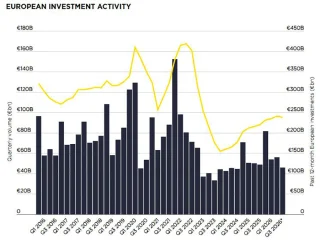
Global commercial real estate continued to show signs of stabilization in the second quarter of 2026, but the recovery remained uneven. Seasonally adjusted global investment volumes declined from the previous quarter while remaining 18% above their year-earlier level. US institutional property values increased by only about 0.1% quarter on quarter, while UK values fell 0.3%. Infrastructure is changing much faster: artificial-intelligence spending is increasing demand for data centers, power generation and grids, while the global value of data-center transactions more than quadrupled between 2023 and 2025.
Property recovery remains uneven
UBS Asset Management’s September review shows a real-estate market moving beyond the sharp repricing of recent years without returning to broad-based growth. After seasonal adjustment, global investment volumes fell quarter on quarter in the second quarter, although they remained 18% higher in US-dollar terms than a year earlier.
Retail supported activity, while investment declined from the previous quarter across industrial, office, apartment and hotel property. Data-center transactions also fell quarter on quarter.
The performance gap between properties remains wide. Prime assets with resilient tenants and rental growth are attracting capital, while buildings with high vacancies, significant refurbishment requirements or weaker demand remain under pressure.
The market is also operating without the powerful tailwind that falling interest rates provided in earlier cycles. Property income, occupancy, financing costs and asset quality are therefore becoming more important to returns.
US property values are rising slowly
The US institutional property market delivered a positive result in the second quarter.
The NCREIF Property Index generated a total return of 1.29%. Income contributed 1.17%, while property appreciation added just 0.12%.
It was the fourth consecutive quarter of improving institutional real-estate returns. The recovery, however, is not uniform. Retail and industrial property supported appreciation, while office, apartment and hotel values remained under pressure.
The UK performed less strongly. All-property capital values fell around 0.3% in the quarter, while total returns declined to about 0.8% from 1.3% in the first quarter.
US deal activity is higher but recovery has slowed
US commercial-property sales increased 14% year on year in the second quarter but declined from the first three months of 2026.
MSCI argues that the sequential slowdown looks more like a leveling-off after the initial recovery than the start of another sharp downturn. Returns across most major property types remain below their 2015–2019 levels, with retail a notable exception.
The result is a more selective market. With lower interest rates no longer a reliable source of valuation gains, investors are paying closer attention to individual properties, tenant quality, leverage and rental-growth prospects.
The wider professionally managed property market has nevertheless started growing again. Global commercial real estate held by institutional investors for investment returns reached $13.5 trillion in 2025, the first increase since 2021. The market expanded 8.5%, although currency movements accounted for a significant part of the gain.
AI is reshaping infrastructure investment
The most rapid changes are taking place in infrastructure connected to artificial intelligence.
Training and operating increasingly complex large language models requires more computing capacity. That is driving demand not only for data-center buildings but also for powered land, electricity generation, substations, transmission networks and battery storage.
Data-center transactions have materially changed the composition of private infrastructure. According to figures cited by UBS, communications infrastructure increased from less than 8% of the market in 2019 to more than 29% in 2025. Global data-center transaction values more than quadrupled between 2023 and 2025.
The type of investment is also changing. Since 2025, most capital has gone into developing new assets rather than acquiring existing data-center businesses. The share of such greenfield projects approached 60% in April 2026.
North America remains the dominant market. It has accounted for about 66% of aggregate data-center transaction capital since 2022, compared with roughly 18% for Asia-Pacific and 13% for Europe.
Electricity is becoming the scarce resource
Power availability is becoming one of the main constraints on further data-center development.
The International Energy Agency expects global data-center electricity consumption to rise from about 485 TWh in 2025 to around 950 TWh in 2030, equivalent to about 3% of global electricity demand. Consumption at AI-focused data centers is expected to triple over the same period.
US data centers currently consume around 4% of national electricity supply, according to figures cited by UBS, and that share is forecast to exceed 10% by 2030. The IEA expects data centers to account for close to half of US electricity-demand growth through the end of the decade.
That changes the economics of development sites. Land near a large population center may be less valuable for digital infrastructure than a more remote site capable of securing hundreds of megawatts of power.
Grid bottlenecks are already pushing developers toward combinations of network supply, on-site generation, renewable energy and battery storage. AI infrastructure is consequently becoming as much an energy investment story as a technology or property story.
Data centers are pulling power investment with them
The investment impact extends well beyond server buildings.
Large data centers require additional generation, substations and transmission capacity, creating demand for assets that were previously treated as separate infrastructure sectors.
UBS notes that conventional power generation has been one beneficiary. One-year total returns for the relevant infrastructure segment exceeded 60% through the first quarter of 2026. Such past performance, however, does not imply that similar returns will continue, particularly after valuations have already incorporated strong expectations for future electricity demand.
Tenant concentration is another risk. Large facilities are often built for individual hyperscale technology customers. Long contracts can provide predictable revenue, but they also expose owners to the credit quality and strategic decisions of a relatively small number of companies.
Infrastructure fundraising has slowed
The data-center boom has not translated into equal growth across all infrastructure investing.
Funds reaching final close raised about $32 billion in the first half of 2026. UBS contrasts this with the wave of mega-fund closings in 2025, when the corresponding figure reached $216 billion.
Institutional investors are nevertheless increasing their desired infrastructure exposure. Target allocations rose from 5.9% in 2025 to 6.2% in 2026, while actual allocations stand at about 5.1%.
The gap suggests potential future demand but does not guarantee an immediate flow of capital. Valuations are another constraint. In the first half of 2025, median infrastructure enterprise values reached about 13 times EBITDA, while the average was closer to 15 times.
At high entry valuations, future returns depend more heavily on actual cash-flow growth rather than further expansion in valuation multiples.
Private equity is holding assets for longer
Private equity faces a different challenge.
Many portfolio companies continue to report resilient revenue and margins, but exits and distributions have not fully recovered. Assets acquired at elevated valuations in 2021 and 2022 are remaining in portfolios for longer than managers initially expected.
US private equity entered 2026 with recovering deal activity, a reopening exit market and more than $1 trillion of dry powder. The first quarter forced investors to reassess some of those expectations as financing conditions shifted again and concerns about AI disruption hit software particularly hard.
AI is becoming an additional valuation issue for companies acquired before its potential impact was fully reflected in prices. Investors now need to assess not only current revenue and earnings but whether a company’s business model will remain competitive by the time an exit becomes possible.
Businesses whose software or services can be partly automated are receiving particular scrutiny. Strong current financial performance does not necessarily protect a company’s eventual exit valuation.
Private credit remains relatively resilient
Private credit has so far experienced less disruption.
Corporate direct lending returned to positive performance in the second quarter after a more volatile start to 2026. Interest income remained the main return driver, while privately originated loans continued to offer spreads roughly 100–200 basis points wider than broadly syndicated loans.
Credit quality has not shown a sharp deterioration. The non-accrual rate in the Cliffwater Direct Lending Index fell from 1.85% in March to 1.73% in June, slightly below its long-term average of about 2%.
Payment-in-kind interest, where interest is added to a borrower’s outstanding debt instead of being paid in cash, has increased in recent quarters. The structure can preserve liquidity in the short term but also increases leverage and can make financial stress less visible.
Liquidity is another concern. Redemption requests at UBS-approved business development company platforms ranged from about 4% to 38% of net asset value during the second quarter. Funds facing requests above their quarterly liquidity limits generally met them on a pro-rata basis.
The figures highlight a basic feature of private credit: investors may receive attractive income, but their ability to withdraw capital is more limited than in publicly traded bond markets.
Private markets are moving in different directions
Real estate, infrastructure, private equity and private credit are no longer moving as a single trade in 2026. Commercial property is gradually stabilizing after a multi-year repricing, but capital-value gains remain small and highly dependent on sector. Infrastructure is receiving a powerful boost from data-center development while facing grid bottlenecks and elevated valuations. Private equity continues to deal with delayed exits, while private lenders retain attractive income but face rising liquidity demands from investors.
As International Investment experts report, strong data-center demand and the first positive signs in property prices should not be interpreted as a broad recovery across private markets. US institutional property appreciation was only 0.12% in the second quarter, while seasonally adjusted global investment activity declined from the previous quarter. In infrastructure, access to electricity is becoming as important as access to capital. Under these conditions, entry price, leverage, tenant quality and real cash flow matter more than the direction of the overall market. Investors should be particularly cautious with assets whose valuations already assume years of uninterrupted AI-driven growth: demand may continue to expand, but a high purchase price leaves less room for disappointment.
FAQ
Is global commercial real estate recovering?
Some markets are showing stabilization and modest appreciation, but the recovery remains uneven. Seasonally adjusted global investment volumes fell quarter on quarter in Q2 2026 even though they remained above the year-earlier level.
Are US commercial-property values rising?
Yes, but slowly. NCREIF recorded 0.12% appreciation in the second quarter of 2026, while total return including income was 1.29%.
Why are data centers attracting so much capital?
AI systems require rapidly expanding computing capacity. That increases demand for server facilities, powered land, electricity generation, grids and energy storage.
How quickly has the data-center transaction market grown?
Figures cited by UBS show that global data-center transaction values more than quadrupled between 2023 and 2025.
How much electricity will data centers use?
The International Energy Agency expects global data-center electricity consumption to reach around 950 TWh in 2030, up from roughly 485 TWh in 2025.
Where is most data-center investment taking place?
North America has attracted about 66% of aggregate data-center transaction capital since 2022, compared with roughly 18% for Asia-Pacific and 13% for Europe.
What is happening in private equity?
Many portfolio companies remain operationally resilient, but exits are taking longer. Assets acquired at high valuations in 2021–2022 are particularly affected.
How resilient is private credit?
Credit metrics remain relatively stable. The Cliffwater Direct Lending Index non-accrual rate stood at 1.73% in June 2026, slightly below its long-term average of around 2%.
What is the biggest risk for AI infrastructure investment?
In addition to high asset valuations, access to power is becoming a major constraint. Large data-center projects cannot proceed without sufficient grid capacity, even when land and financing are available.