







 Covivio Hotels Revenue Grows 4.7% as European Markets Split
 Lithuanian Apartment Prices Accelerate Across Major Cities
 Georgia's Tourism Revenue Hits Record High
 Norway's Sovereign Fund Commits €1.5bn to European Warehouses
 Market Rout of October 2026: Can Branded Hotels Protect Capital?
 Residential Property Prices in Tbilisi Rise by 5.9% Year-on-Year
Where Europe’s Hotel Markets Are Growing Fastest
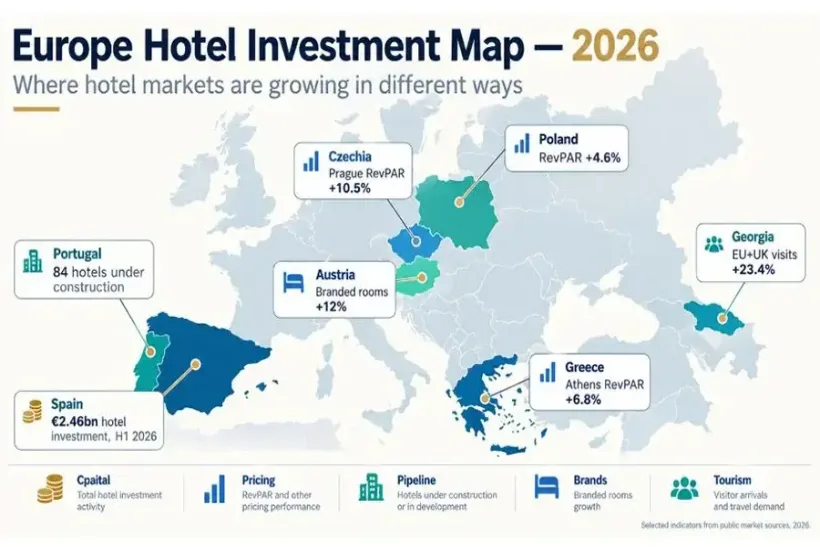
Europe’s hotel market is becoming increasingly uneven in 2026. Average RevPAR rose 4.5% in H1, but the regional number hides several distinct investment stories. Spain remains one of Europe’s deepest hotel capital markets, Greece is pushing room rates higher, Portugal is adding premium supply, Prague is growing with very limited new inventory, and Austria and Poland are expanding branded capacity. CBRE identifies Greece, Austria, Poland and Czechia among the most dynamic markets and expects parts of Central and Eastern Europe to continue outperforming in H2. Outside the EU, Georgia offers an earlier-stage case: international tourism is already sizeable, while professionally managed branded hospitality remains much smaller than the mass resort-apartment market.
Europe Outperforms RevPAR Forecasts
At the beginning of the year, CBRE expected European RevPAR — revenue per available room — to increase by around 1–3% in 2026. By June, the figure was already 4.5% above the previous year’s level. ADR, or the average daily rate for rooms sold, increased by 3.2%, while occupancy also edged higher. Greece, Austria, Poland and the Czech Republic were among the markets growing faster than the European average.
Cushman & Wakefield gives a more conservative estimate: average RevPAR in Europe reached €101 in the first half of the year, up 3% compared with the same period of 2025. Eastern Europe recorded 6% growth, making it the fastest-growing macro-region in the survey. Europe’s hotel room supply increased by 2.9%, with Poland and Austria among the countries showing notable growth in new inventory.
International Investment has previously noted that a single average figure is becoming increasingly inadequate for describing the European market: mature Western destinations are slowing, while parts of CEE continue to expand at a faster pace.
Mapping Europe’s Hotel Markets
Comparing countries solely by RevPAR would be misleading: in some markets, publicly available statistics are published at the national level, while in others they primarily cover the capital city. The table therefore does not present an absolute ranking. Instead, it highlights different growth models and separately shows operating indicators, demand, new supply and investment activity.
For Georgia, estimated first-quarter RevPAR was around $38 in Tbilisi and $25 in Batumi. This is the low season for the Black Sea resort, so these figures cannot be directly compared with half-year national indicators for Spain or Portugal.
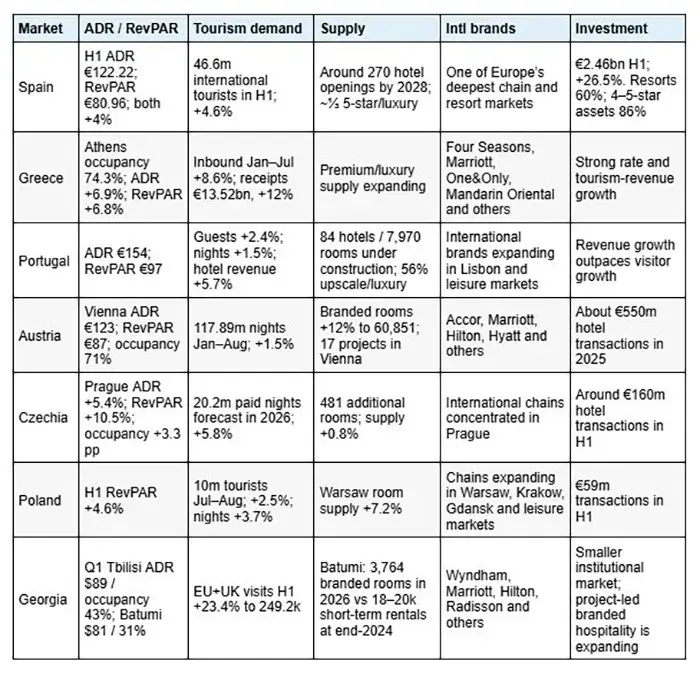
Spain Leads by Investment Volume
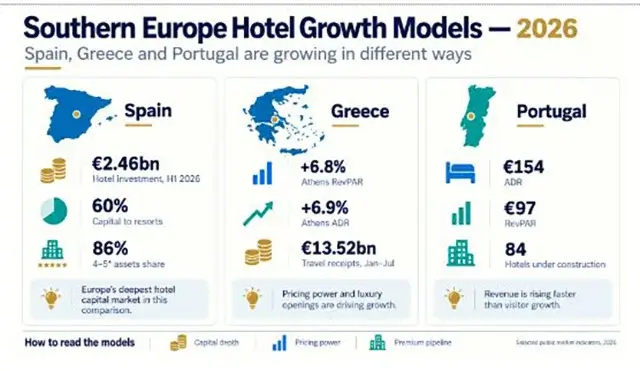
Spain remains the largest hotel investment market in this group. Hotel transactions reached a record €2.46 billion in the first half of the year, up 26.5% compared with the same period of 2025. Over six months, 88 assets comprising more than 12,000 rooms changed hands. Resort properties attracted 60% of total capital, while four- and five-star hotels accounted for 86%. The average price per room in transacted hotels rose to €213,300.
The Spanish market shows that investors are not paying a premium for hotel stock in general, but for high-quality resort and upscale assets with strong operating models.
Greece Grows Through Higher Room Rates
Athens combines stable occupancy with substantial rate growth. In the first half of the year, occupancy stood at 74.3%, ADR increased by 6.9%, and RevPAR rose by approximately 6.8%. Between January and July, the number of inbound travellers to Greece increased by 8.6%, while international travel receipts rose by 12% to €13.52 billion. Athens operating indicators are published by GBR Consulting.
At the same time, supply is shifting towards the upper end of the market. In July, the Four Seasons Hotel Mykonos opened with 94 rooms, suites and villas. For investors, this matters more than simple growth in room supply: a higher-quality product can sustain a stronger average rate.
Portugal Grows Through Product Quality
In Portugal, hotel revenue is increasing faster than tourist arrivals. By May, the sector had generated €2.36 billion, up 5.7% compared with the same period of 2025. Guest numbers increased by 2.4%, while overnight stays rose by 1.5%. ADR reached €154 and RevPAR €97. A total of 84 hotels with approximately 7,970 rooms are under construction, with 56% of the new supply in the upper-upscale and luxury segments.
Growth is becoming less dependent on simply attracting more visitors. The market is generating higher revenues through pricing, product quality and new premium properties.
Prague Grows With Almost No New Supply
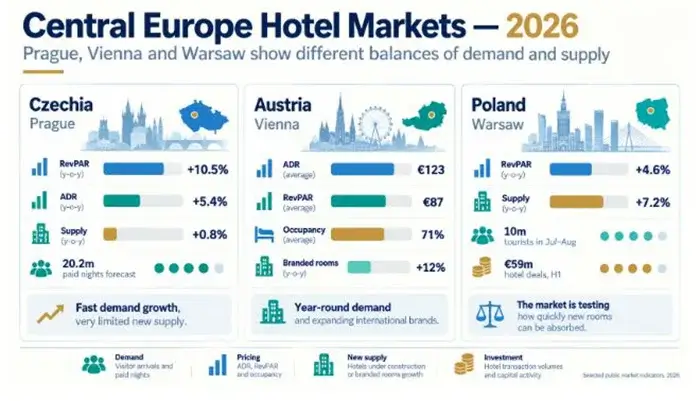
In Prague, RevPAR increased by 10.5% in the first half of the year, ADR by 5.4%, and occupancy by 3.3 percentage points. Only 481 new rooms are expected to enter the market during the whole of 2026, representing supply growth of around 0.8%. At the same time, paid overnight stays are forecast to rise to 20.2 million, up 5.8%, while international guests are expected to account for 86.4% of demand. Source: Cushman & Wakefield Czech.
International Investment previously reported a shift by investors towards Czech hotels and rental housing.
Austria Rapidly Expands Its Branded Hotel Segment
From January to August, Austria recorded 117.89 million overnight stays, up 1.5% compared with the same period of 2025; international guests accounted for 75.3%. Vienna is operating with an ADR of around €123, RevPAR of €87 and occupancy of 71%. Hotel transactions in Austria reached approximately €550 million in 2025, the third-highest result in the market’s history.
The branded segment is changing even faster. Austria became the fastest-growing DACH market by this measure: the number of branded hotel rooms increased by 12% in a year to 60,851. Vienna leads Austria’s development pipeline with 17 announced hotel projects.
Poland Tests How Quickly the Market Can Absorb New Supply
Polish RevPAR increased by 4.6% in the first half of the year. Warsaw is expanding supply faster than any other CEE-6 capital, with hotel room inventory expected to grow by 7.2% over the year. Hotel transactions, however, totalled only €59 million in the first half, suggesting that investment activity remains considerably more subdued than operating performance.
Summer demand remains positive: in July and August, accommodation establishments welcomed 10 million tourists, 2.5% more than in the same period of 2025. Overnight stays increased by 3.7% to 29.4 million.
Georgia Is at an Earlier Stage of Development
Georgia is not yet comparable with Spain or Austria in terms of institutional transaction volumes. It is more useful to assess the country through the structure of its market. In the first half of 2026, visits from the EU and the United Kingdom increased by 23.4% to a record 249,200. This is one indication that the geography of international demand is becoming more diversified.
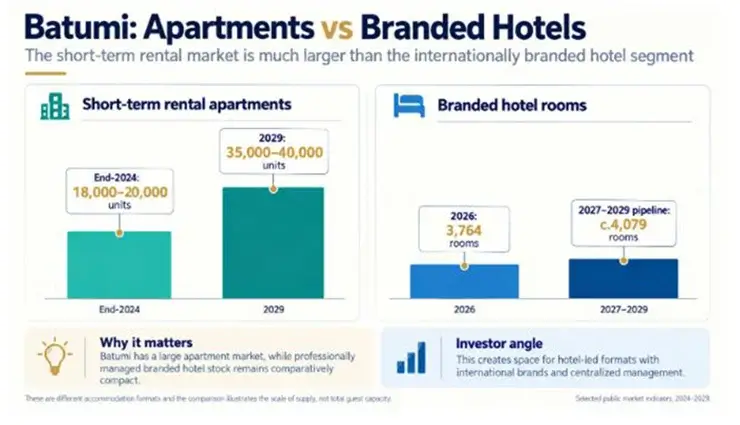
In Tbilisi, hotel occupancy rose from 39% to 43% in the first quarter, while ADR increased from $83 to $89. In Batumi, ADR rose from $74 to $81. The most notable feature of Georgia’s Black Sea coast is the structure of supply: Galt & Taggart expects 3,764 branded hotel rooms in 2026, while the number of short-term rental apartments had already reached around 18,000–20,000 by the end of 2024 and could rise to 35,000–40,000 by 2029.
This does not mean that Batumi has a shortage of accommodation. It is more accurate to speak of a relatively small segment of high-quality hotel real estate with international branding and professional management alongside a large market of privately owned apartments.
International Investment identifies Georgian hotel real estate as a separate investment segment.
Wyndham Grand Batumi Gonio Follows the Same Trend
In mature markets, capital is increasingly concentrated in resort and upscale properties, while international brands are expanding their share of new supply. A similar model is emerging in Gonio, Georgia, although at an earlier stage of market development.
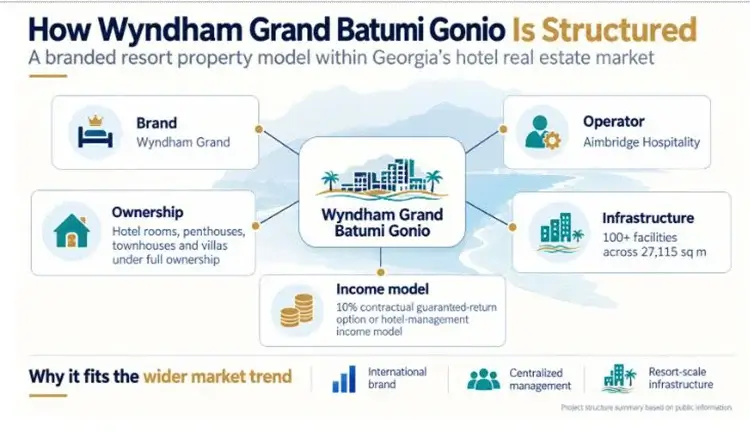
Wyndham Grand Batumi Gonio operates under the Wyndham Grand brand, with Aimbridge Hospitality serving as the management company. The complex comprises 494 units, including hotel rooms, penthouses, townhouses and villas available in full ownership. Its infrastructure includes more than 100 facilities and amenities. For owners, this represents a different model from independently managed short-term rentals: the property is integrated into a centralised hotel system backed by an international brand and professional operator.
The project page states a guaranteed annual return of 10% under the contract, as well as a separate income model linked to hotel operations. In this article, the figure is presented as a condition of this specific project rather than as an average market yield. International Investment has separately analysed the guaranteed income model.
What the Hotel Investment Map Shows
There is no single leader across all metrics. Spain is stronger in transaction volume and liquidity. Greece stands out for rate growth and tourism revenues. Portugal is notable for its new premium hotel supply. Prague combines double-digit RevPAR growth with almost unchanged supply. Austria leads in the expansion of the branded segment. Poland is simultaneously increasing demand and adding new hotel rooms.
Georgia is at a different stage. Its tourism market is already large, while internationally branded hotel real estate remains significantly smaller than the mass apartment market. Its investment case is therefore not based on competing with Spain in terms of capital volume, but on an earlier phase in the development of professionally managed resort products.
According to International Investment experts, in 2026 the number of tourists alone says relatively little about the attractiveness of a hotel market. For investors, the combination of RevPAR, ADR, the pace of new construction, the presence of international brands and the ability of a property to sustain room rates matters more. These indicators show that Europe’s hotel investment landscape is divided into several distinct growth models.
FAQ: European Hotel Market 2026
Where is the European hotel market growing fastest?
CBRE identifies Greece, Austria, Poland and the Czech Republic among the most dynamic markets in the first half of 2026. Parts of CEE may retain their advantage in the second half of the year.
What is RevPAR?
RevPAR stands for revenue per available room. The metric reflects both room rates and occupancy.
What is ADR?
ADR, or average daily rate, is the average price of a hotel room actually sold for one night.
Where is hotel investment highest?
Among the countries covered in this article, Spain leads: hotel transactions reached €2.46 billion in the first half of 2026.
Where is RevPAR growing fastest?
Among the city-level figures cited here, Prague stands out with growth of 10.5% in the first half of the year.
Why is Georgia included in the comparison?
Georgia is not an EU member, but it competes for the same international tourism demand. Its market is notable for being at an earlier stage in the development of branded hotel real estate.
What makes Batumi different?
The number of private short-term rental apartments is several times higher than the number of rooms in internationally branded hotels. Professionally managed resort properties therefore form a separate market segment.