







 Covivio Hotels Revenue Grows 4.7% as European Markets Split
 Lithuanian Apartment Prices Accelerate Across Major Cities
 Georgia's Tourism Revenue Hits Record High
 Norway's Sovereign Fund Commits €1.5bn to European Warehouses
 Market Rout of October 2026: Can Branded Hotels Protect Capital?
 Residential Property Prices in Tbilisi Rise by 5.9% Year-on-Year
$84 Trillion Wealth Transfer Reshapes Luxury Homes

An enormous transfer of family wealth is changing luxury property decisions long before heirs receive their inheritance. Savills cites an estimate of approximately $84 trillion in assets expected to pass over the next two decades. That figure covers financial assets, businesses, real estate and philanthropy; it is not a forecast of luxury home purchases. For developers and investors the more useful question is what younger owners will keep, sell and acquire as they divide their lives across countries.
Savills identifies a growing preference for turnkey and professionally managed homes, privacy, schools, wellness and legal stability. Rather than ranking billionaire cities, the evidence points to a more selective way of owning high-value residential property.
The $84 trillion figure does not mean $84 trillion in housing
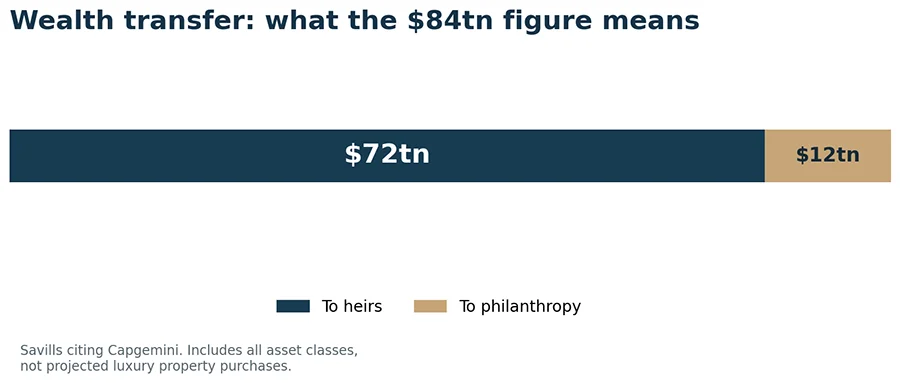
In its October Spotlight on Wealth Trends, Savills cites Capgemini's estimate of approximately $84 trillion changing hands between generations over two decades. Of that, about $72 trillion is expected to reach heirs and $12 trillion philanthropic causes. The figure covers multiple asset classes, and the share that will be spent on prime residential property has not been established
Cerulli Associates separately estimated in December 2024 that U.S. households would transfer $124 trillion through 2048, including $105 trillion to heirs and about $18 trillion to charities. That is a U.S.-focused calculation with its own timeframe and methodology, not an updated world total to add to Savills' estimate.
Transferring wealth can also generate listings: heirs may sell inherited homes that no longer suit their lives. Funds may be reinvested in businesses, securities or different real estate assets. Wealth transfer alone therefore does not guarantee an across-the-board rise in luxury property values.
Inherited homes may not fit a new family's needs
An estate held for decades may now be expensive to maintain, far from a family's workplace or unused for most of the year. Younger owners can decide to sell for practical reasons rather than financial necessity. Properties needing major renovations may be less attractive than finished homes with reliable operating systems and clear maintenance costs.
Savills' next-generation wealth category is broader than heirs: it includes people under 40 who have inherited wealth, expect to inherit, or have built fortunes through entrepreneurship. The preferences of young technology founders should not be automatically attributed to every inheriting family.
International mobility changes the purpose of a home
Savills estimates that nearly 20% of high- and ultra-high-net-worth individuals live outside their birth country. About 80% of self-made UHNWIs live outside the country in which they made their wealth. These are different groups and do not prove that every wealthy family owns several properties.
Business, schooling and leisure can take place in different jurisdictions. Homes consequently serve distinct purposes: a principal residence, accommodation near a school, a holiday property or a place for longer seasonal stays.
Owning a property abroad does not automatically provide immigration status or tax residence. Acquisition taxes, ownership costs, estate duties, disclosure rules and legal structures vary by country. A multi-jurisdiction lifestyle requires separate advice in each relevant market.
Four criteria matter more than another city ranking
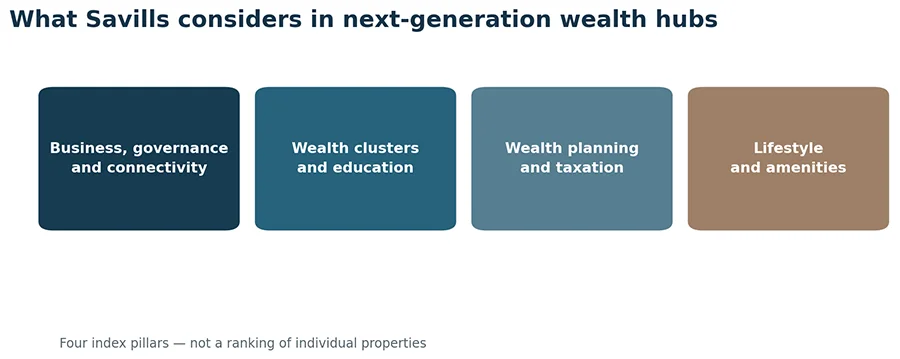
Savills assesses more than 100 wealth hubs through four pillars: business, governance and connectivity; wealth clusters and education; wealth management and taxation; and lifestyle. This framework explains why wealthy families may use different cities for different activities rather than choose one universally attractive destination.
Low tax alone does not establish property investment value. Business infrastructure, education, healthcare, the enforceability of ownership rights and dependable transport links all affect how long a family can use and retain an asset.
Turnkey homes reduce the owner's workload
Turnkey means a property is ready to occupy without a lengthy refurbishment or complicated setup. For a buyer who spends part of each year elsewhere, reliable maintenance, digital systems, security and professional access management matter as much as luxury finishes.
High service charges are not automatically a disadvantage, but the buyer needs to know what is delivered, what costs can change, and how the building is managed when the owner is absent. A recognised brand or elaborate design does not by itself establish resale liquidity.
Privacy, education and wellness shape residential demand
International Investment's earlier review of luxury buyers examined the growing importance of privacy and multigenerational homes. In practice, privacy involves secure access, staff vetting, information protection and the ability to use a property discreetly. A professionally managed community may offer greater practical control than a remote villa that requires a separate team.
International schools and family routines can determine where buyers actually live for most of the year. Location near education and healthcare facilities can matter more to an owner-occupier than a projected rental yield.
Wellness is also changing from an optional spa to integrated exercise, recovery and health-focused facilities. These services require capital and ongoing maintenance; buyers should assess operating contracts and compulsory fees as carefully as the amenities themselves.
Branded residences meet demand for managed ownership
Hotel-linked and other branded residential schemes can combine private ownership with concierge services, security and facilities management. The appeal is operational convenience, not a guarantee of investment returns.
Knight Frank surveyed nearly 1,800 live and pipeline schemes across 90 countries. There were 903 operational developments at the end of 2025; around 1,088 could be operating at the end of 2026, with the total potentially approaching 1,800 by 2031. It is incorrect to describe the entire pipeline as already built.
More than half of current schemes are now outside major cities, in coastal, island and mountain destinations. International Investment has examined this movement towards managed resort homes and the importance of how a property operates when its owner is away.
|
Property format |
Buyer priority |
Due diligence |
|
Primary city home |
Schools, work, healthcare |
Costs and connections |
|
Resort residence |
Services and accessibility |
Off-season operation |
|
Turnkey home |
Ready-to-use condition |
Building warranties |
|
Branded residence |
Service and management |
Contracts and fees |
|
Multigenerational home |
Flexible family layouts |
Long-term adaptability |
|
Cross-border property |
Mobility and privacy |
Tax, status, succession |
Tax, succession and residency rules remain decisive
Cross-border ownership can create obligations concerning succession, inheritance taxes, reporting and residency. The implications depend on citizenship, physical presence and the ownership structure. A low headline tax rate is no substitute for enforceable property rights or legal certainty.
Owners should consider whether heirs will wish to keep the home, how much it will cost to operate and whether the property can be sold without a material discount. These questions belong in the acquisition model rather than being deferred until succession.
Wealth creation does not lift every luxury market
Savills' World Cities Prime Residential Index recorded just 0.6% capital-value growth and 1.1% rental growth across a sample of 30 cities in H1 2026. The figures are not global property totals, but they illustrate the limits of drawing automatic price forecasts from the size of private fortunes.
Inherited assets can add supply as some families sell costly houses. Other owners may acquire professionally managed residences, concentrating demand in a narrower set of properties. The difference will depend on building quality, running costs, location and legal liquidity.
What developers and investors need to change
The next owner may compare real estate with private companies, financial assets and other uses of capital. Developers must demonstrate functioning services, adaptable floorplans, long-term maintenance costs and clear rules of ownership, not only prime addresses and luxury finishes.
The Great Wealth Transfer will unfold over decades. Its real estate impact is likely to come through portfolio reviews, sales, refurbishment and selective purchases rather than one sudden influx of $84 trillion into the housing market. The properties with the strongest appeal will be those heirs are willing to keep and use.
FAQ
What is the Great Wealth Transfer?
The intergenerational transfer of assets through inheritance and lifetime gifts, with some of the wealth also directed towards philanthropy.
Will heirs spend $84 trillion on real estate?
No. Savills cites around $84 trillion across asset classes: approximately $72 trillion to heirs and $12 trillion to philanthropy.
Why does Cerulli give a $124 trillion estimate?
It is a separate U.S. household forecast extending through 2048, with a different population, period and method.
What changes in luxury housing demand?
Turnkey condition, property management, privacy, education, wellness, international connectivity and long-term liquidity are increasingly relevant.
What is a turnkey luxury home?
A property ready for use without extensive refurbishment or a lengthy owner-managed setup process.
Does buying a home abroad provide residency rights?
Not automatically. Immigration, tax residency and inheritance rules depend on the jurisdiction and the owner's circumstances.
How many branded residence schemes are operating?
Knight Frank reported 903 operating schemes at end-2025 and projects around 1,088 by end-2026. Nearly 1,800 reflects the broader operational and development pipeline.