







 Covivio Hotels Revenue Grows 4.7% as European Markets Split
 Lithuanian Apartment Prices Accelerate Across Major Cities
 Georgia's Tourism Revenue Hits Record High
 Norway's Sovereign Fund Commits €1.5bn to European Warehouses
 Market Rout of October 2026: Can Branded Hotels Protect Capital?
 Residential Property Prices in Tbilisi Rise by 5.9% Year-on-Year
Big Investors Shift How Europe Builds Housing

International investors are increasingly using development partnerships and residential platforms to access future housing supply. In October 2026, Spain's Culmia and Cross Ocean outlined €400 million of planned investment in 900 homes around Madrid, while Hines and Vastint acquired a former industrial site in Düsseldorf for a new neighbourhood of approximately 1,700 apartments. In the UK, CBRE Investment Management is working with Moda Living on a rental housing platform backed by £400 million of initial available capital.
These transactions do not represent the same investment model. One combines a financial investor with a local developer, another pairs two international real estate groups on a regeneration site, and the third integrates patient capital with a UK rental housing operator. What they share is a focus on development expertise, land access and a repeatable project pipeline rather than a single completed building. Purchases of operating rental assets nevertheless remain important.
European housing development, investment partnerships and residential neighbourhoods. Original editorial illustration for International Investment.
Madrid: €400 million for 900 planned homes
On 15 October, Spanish residential developer Culmia announced a co-investment venture with Cross Ocean. The platform will begin with Valdecarros in Madrid and Retamar de la Huerta in Alcorcón, with a combined plan for 900 dwellings and €400 million of intended investment. The development pipeline belongs to a new partnership, rather than one acquisition of a completed residential block.
Cross Ocean will hold 90% of the JV and Culmia 10%. Culmia will lead site sourcing, planning, technical management, construction and marketing. The arrangement illustrates the role of local execution in deploying international money. It would be inaccurate, however, to assume the equity percentages specify each partner's precise cash contributions: the complete financing arrangements have not been disclosed.
The €400 million is a planned total, not verified capital already spent. The homes are scheduled for future development, and the announcement does not establish that they will all be retained as rental property. The investment case depends on planning, construction costs, sale prices and the scope for further projects within the platform.
Düsseldorf: an industrial site becomes a housing pipeline
Hines and Vastint announced on 14 October that their joint venture had acquired the Glasmacherviertel site in Düsseldorf-Gerresheim. The 193,000-square-metre former glassworks property could become a new mixed-use district with between 1,600 and 1,800 apartments. Current proposals envisage approximately 210,000 square metres of gross floor area, at least 80% for residential use, alongside shops and social infrastructure.
LEG Immobilien sold the land, with the transaction contracts concluded on 13 October. Vastint says it is the majority partner in the JV. Unlike the Madrid arrangement, this is a partnership between two internationally active real estate businesses, not simply a foreign fund appointing a small domestic contractor. The acquisition price was not disclosed.
The proposed number of dwellings remains subject to planning and approvals. Redevelopment also carries brownfield, infrastructure and phasing risks. The investment is a commitment to create a neighbourhood over time, not a purchase of homes already generating rent.
Britain: a platform rather than a finished portfolio
CBRE Investment Management launched its UK single-family rental strategy in May 2026 in an exclusive partnership with Moda Living. The strategy began with £400 million of available capital and aims to build a platform worth £2 billion over time. Moda will invest alongside CBRE IM. Its parent, Caddick Group, controls a land bank with more than 25,000 plots, giving the partners access to a potential development pipeline.
Here the operating model matters as much as the land. Moda's role covers development and the long-term operation of professionally managed rental housing, while CBRE IM contributes institutional investment and asset-management capabilities. The £400 million is not a measure of completed construction, and the 25,000 plots are not 25,000 committed or delivered homes within the fund.
A second UK example shows how broad the market has become. Legal & General and housing association Hyde formed a 50/50 partnership in March, seeded with more than 1,000 affordable and social homes. It is designed around long-term income and housing management rather than conventional developer sales, demonstrating another route for institutional capital into residential assets.
Three platforms with different risk profiles
Madrid is primarily a residential co-development and sales strategy; Düsseldorf is a large-scale regeneration scheme; Britain offers a professionally managed rental housing platform. Their announced budgets and housing counts measure different things and must not be added together as equivalent investment or completed supply.
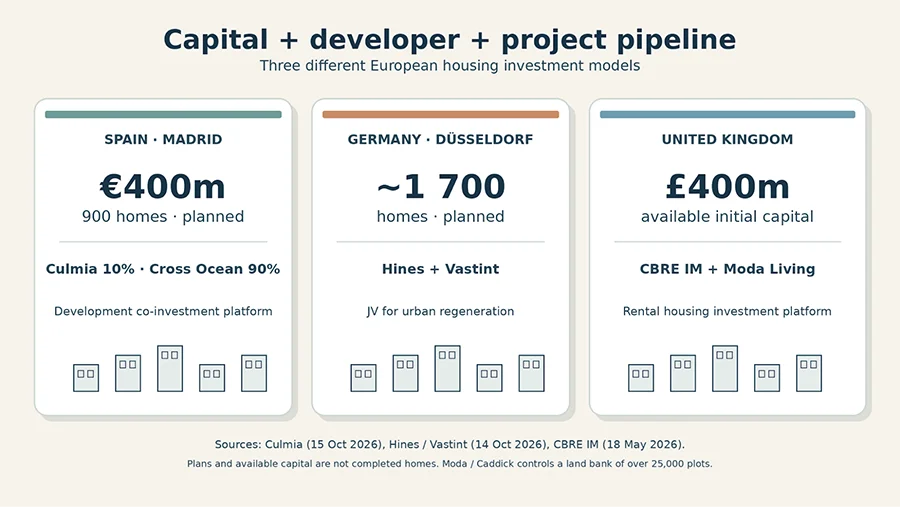
European residential investment models. The figures are planned development expenditure, planned homes and initial available capital, not directly comparable completed investment. Sources: Culmia, Hines, Vastint and CBRE IM.
|
Market |
Partners and scale |
Important distinction |
|
Madrid |
Culmia / Cross Ocean; €400m; 900 homes |
Planned, not spent |
|
Düsseldorf |
Hines / Vastint; 1,600–1,800 homes |
Site price undisclosed |
|
United Kingdom |
CBRE IM / Moda; £400m available capital |
Not completed homes |
Editorial comparison of announced partnership structures; not a projection of investment returns.
Why capital is seeking platforms
Buying an existing residential building offers immediate income and an operating history. A development platform instead provides access to sites, planning skills, contractors, residential design and a specialist management team. Investors can deploy money across successive projects and potentially create scale that would be difficult to assemble through individual building purchases.
A JV can separate capital allocation from local delivery. One partner may finance and oversee risk, while another undertakes development and operations. That does not eliminate costs or uncertainty. Planning delays, weaker sales, changes in interest rates and disputes over additional capital affect all partners. Shareholdings alone reveal little about debt, waterfall distributions, development fees or exit rights.
JLL's EMEA Living Market Perspectives 2026 found that cross-border investment in Europe's living sector grew by 55% during 2025, versus 2% for domestic activity. Large platform and entity transactions gained importance. At the same time, forward investment fell 22% in 2025 as expensive construction reduced the attraction of taking development risk. The evidence points to more selective capital structures, not an automatic rush into every land pipeline.
Buying completed homes is far from obsolete
Savills reported approximately £4.2 billion of UK build-to-rent investment in the first nine months of 2026, the highest year-to-date volume for that point. Development funding accounted for 36% of the total. Operating portfolios continued to attract substantial capital, offering rental income without waiting for planning and construction.
Platforms and acquisitions can serve different objectives within the same fund. A completed portfolio establishes scale and cash flow now; a pipeline creates a potential source of future assets. An investor deciding between them has to compare acquisition pricing with planning risk, the cost of debt, the development schedule and the likely value of the finished property.
Spain: housing shortages meet regulatory uncertainty
Housing demand in Madrid is strong, but a tight market does not guarantee profits. International Investment previously examined Idealista data showing a 61% fall in Spain's available rental listings since 2020. That figure measures listed supply, not the disappearance of the same share of existing homes. It shows pressure in the rental market but does not establish the sales or rental returns of Culmia's new pipeline.
Spain's new rental and property rules also affect institutional investment decisions. A platform needs legal clarity about whether homes will be sold or held, relevant rent restrictions, taxation and the eventual exit. The ability to develop 900 apartments does not imply an agreed occupancy rate, selling price or rental yield.
Germany: large funds still favour standing stock
International Investment reported nearly €5.9 billion of German residential transactions in the first nine months of 2026. Existing assets represented 89% of investment volume, and portfolio deals accounted for most of Q3 activity. That makes the Hines–Vastint brownfield project notable, but not representative of the majority of purchases in the German market.
Industrial land adds environmental remediation, planning, public-space and infrastructure questions. The proposed Düsseldorf neighbourhood may deliver scarce homes, but no financial return has been demonstrated. The case illustrates how patient capital can back complex urban transformation without establishing that development always beats the acquisition of existing rental buildings.
Will platforms make housing cheaper?
Long-term development partnerships may support more housing supply by funding projects that a standalone developer could struggle to finance. But planned units should never be treated as completed dwellings. Projects can be deferred, redesigned or broken into phases. International Investment's previous analysis of Europe's housing shortage explains why new supply typically responds slowly to changes in borrowing costs.
For buyers and tenants, institutional financing is not an automatic promise of lower prices. Sale prices still depend on local incomes and competition; rental terms on demand, costs and regulation. Platforms can improve the organisation and financing of construction, but they do not remove the constraints imposed by land, permits, materials and affordability.
The due diligence behind a residential JV
Investors should determine who owns the land, which approvals are effective, what infrastructure is funded and how many phases are genuinely financed. They also need to examine the operating partner's history, debt terms, capital-call commitments, development fees, construction guarantees, expected exit and cash-flow priority.
The headline amount may represent a proposed development budget, capital available for deployment or the eventual target value of a platform. These are different metrics. The core investment question is whether the development and operating partners can deliver homes at a total cost that supports a credible sale price or sustainable net rent.
Madrid, Düsseldorf and Britain illustrate a widening set of tools for institutional residential investment: co-development, urban regeneration and rental housing platforms. Their appeal is the combination of capital and execution across multiple projects. Their weakness is that a large pipeline remains exposed to time, costs, permissions and the housing market until homes are actually delivered.
FAQ
What is a residential real estate joint venture?
A JV is a shared investment or development structure in which partners agree their ownership, responsibilities, risks and returns. Equity percentages need not match their precise cash contributions.
Why do institutional investors use residential platforms?
Platforms can provide repeatable access to projects, land, local development expertise and professional management. They allow capital to be deployed over time, but do not remove construction risk.
How much will Culmia and Cross Ocean invest in Madrid?
The announced plan is €400 million for developments totalling 900 homes. Cross Ocean will own 90% of the JV, with Culmia owning 10% and managing delivery.
How many homes are planned by Hines and Vastint?
The Düsseldorf Glasmacherviertel site could accommodate 1,600–1,800 homes. The project remains subject to planning and permissions.
What is the CBRE IM and Moda Living partnership?
It is a UK rental housing development and operating strategy backed by £400 million of initial available capital. Access to Caddick's land bank is not the same as completed or fully funded houses.
Are platforms replacing investments in existing buildings?
No. Standing rental portfolios continue to attract substantial capital. Development platforms and existing portfolios have different cash-flow and risk profiles.