







read also
 Australia’s Spring Auctions Rise but Remain Well Below 2025
 Number of Foreigners Holding Turkish Residence Permits Exceeds 1.27 Million
 Demand from Russian Tourists for Holidays in Georgia Rises by 20–25%
 Montenegro Property Buying Costs in 2026
 Four in Ten Companies Would Not Choose Slovakia
 Gulf Countries Prepare Unified Tourist Visa
Tourism & hospitality / News / Reviews / Research / Analytics / United Kingdom / Tourism Britain 20.11.2025
PwC: UK Hotel Market Remains Resilient in 2026 — Time for Innovation, Efficiency, and Strategic Growth
The UK hotel sector is entering 2026 with renewed confidence and resilience, despite economic headwinds and rising operational costs. According to the PwC UK Hotels Forecast 2025–2026, the industry continues to demonstrate stability, supported by strong international demand, event-driven travel, and steady domestic leisure recovery.
UK Hotels: Resilience Amid Cost Pressures
PwC notes that despite inflation, high energy prices, and ongoing labour shortages, the country’s hospitality industry remains profitable. The main factors driving this are international tourism, the return of corporate travel, and large-scale events such as conferences, concerts, and sports tournaments.
With limited new supply across the market, conditions remain favourable for well-managed operators, and those who adapt their business models are maintaining solid margins.
“2026 presents a window of opportunity. The market continues to reward those who act quickly, think strategically, and invest in innovation,” said Nick Frendo, Partner at PwC UK and Real Estate & Hospitality Transaction Services Leader.
Adapting to Change: Strategies for Sustained Growth
PwC identifies four key areas that will help hotel operators and investors strengthen their positions in a challenging environment:
1. Boost Operational Efficiency
With costs rising faster than revenues, the focus must shift to productivity and smarter cost management. PwC recommends:
Investing in automation and data-driven revenue management tools.
Implementing multi-skilled staffing models and flexible workforce management.
Benchmarking performance to identify savings in energy use, procurement, and labour.
2. Invest in Sustainability and ESG
Energy efficiency, resource monitoring, and waste reduction not only cut costs but also meet expectations from lenders and guests.
Adopting renewable energy solutions, smart environmental systems, and transparent ESG reporting helps future-proof assets while enhancing brand and investor appeal.
3. Rethink Product and Revenue Mix
Changing travel behaviours demand new approaches to guest experiences:
Expanding extended-stay and hybrid accommodation models.
Monetising underutilised spaces through co-working, wellness, and F&B concepts.
Aligning offerings with demand for value, flexibility, and experience-driven stays to maintain occupancy and diversify revenue.
4. Maintain Financial Agility and Explore Partnerships
Even with stabilising interest rates, financing remains selective. PwC advises using debt restructuring, refinancing, and joint ventures to strengthen liquidity. Active asset management and repositioning underperforming properties will be essential to protect profitability and ensure long-term portfolio value.
Outlook: Innovation and Selective Resilience
PwC forecasts that the UK hospitality market in 2026 will follow a pattern of “selective resilience” — meaning that growth will be uneven across segments.
Those who act decisively, embrace innovation, and adopt flexible business models will outperform competitors.
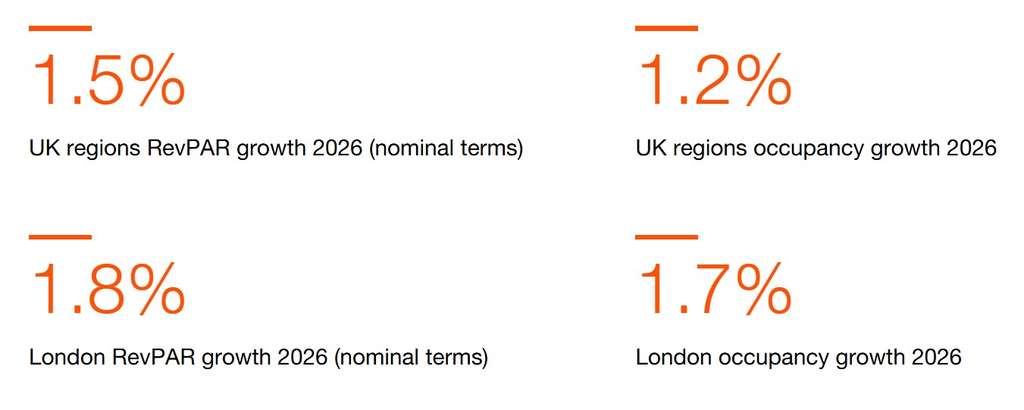
Revenue per available room (RevPAR) is expected to continue moderate growth in 2026, supported by stable demand and constrained supply. However, margins will remain under pressure, and success will depend on cost control, service innovation, and operational agility.
Analysts at International Investment highlight that the UK hotel market exemplifies strategic adaptation in a volatile global environment:
“The UK hospitality sector is entering a phase of maturity where success depends not only on revenue growth but on operational excellence. PwC accurately identifies efficiency, sustainability, and digital transformation as the new profitability drivers,” experts note.
They add that in 2026, market leaders will be those who invest in ESG, technology, and hybrid models, achieving both profitability and long-term resilience.
Tags: UK, hotels, PwC, hospitality, ESG, sustainability, investment, RevPAR, tourism, real estate, innovation, International Investment