







 Australia’s Spring Auctions Rise but Remain Well Below 2025
 Number of Foreigners Holding Turkish Residence Permits Exceeds 1.27 Million
 Demand from Russian Tourists for Holidays in Georgia Rises by 20–25%
 Montenegro Property Buying Costs in 2026
 Four in Ten Companies Would Not Choose Slovakia
 Gulf Countries Prepare Unified Tourist Visa
Aviation Crisis in Asia: Over 1,400 Flight Delays and 93 Cancellations
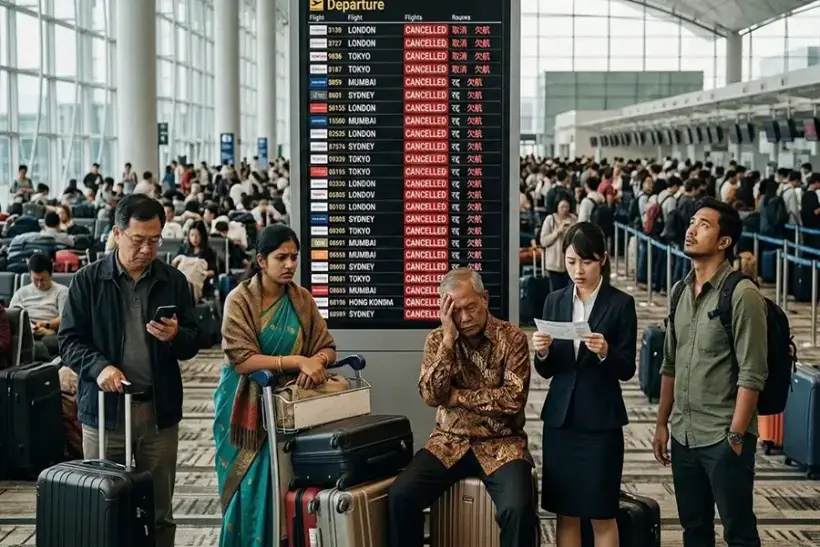
Major airports in China, India and Malaysia face heavy congestion
A large-scale disruption of air traffic has been recorded across Asia: on February 27, 2026, more than 1,400 flight delays and 93 cancellations were registered at airports in China, India, Indonesia, Japan and Malaysia. The most critical situation developed in Delhi, Mumbai, Kuala Lumpur and Jakarta, Travel And Tour World reports.
Flight Delays at Airports in India and Malaysia
The highest concentration of disruptions was observed at the region’s largest international hubs. At Indira Gandhi International Airport in Delhi and Chhatrapati Shivaji Maharaj International Airport in Mumbai, the total number of delays exceeded 500 flights. While cancellations remained relatively limited, the accumulation of delayed departures created pressure on ground services, aircraft parking stands and terminal capacity.
In Malaysia, Kuala Lumpur International Airport recorded the highest number of delays in the region — 470 flights alongside 7 cancellations. This level of disruption affected connecting routes across Southeast Asia and increased operational pressure on low-cost carriers, for which high aircraft utilization is a key stability factor.
Indonesia also experienced significant disruption. At Soekarno–Hatta International Airport in Jakarta, 18 cancellations and 192 delays were recorded. The impact extended to Makassar and Lombok, affecting domestic and tourist routes.
Air Traffic Disruptions in China and Japan
In China, Yining Airport became a focal point of disruption, with 13 cancellations and 18 delays reported. Additional disturbances were recorded in Hotan, Liuzhou and Aksu. For regional destinations, even a limited number of cancellations can substantially reduce daily connectivity, as flight frequency at these terminals is lower than at national hubs.
In Japan, disruptions affected Fukuoka, Kagoshima, Yakushima and Tsushima. Regional and short-haul domestic routes were particularly impacted. The cancellation of several flights at island airports has a disproportionate effect on passenger traffic and logistics, including cargo deliveries and tourism services. As a result, international connections are disrupted and recovery time for schedules increases.
Airline Challenges
AirAsia recorded the highest number of delays — 245 alongside 7 cancellations — intensifying strain on its network in Kuala Lumpur and across Southeast Asian transit routes.
In India, IndiGo faced significant operational pressure with 4 cancellations and 208 delays, mainly in Delhi and Mumbai. SpiceJet also encountered disruptions in Mumbai, with more than 30 schedule changes. For carriers operating high-frequency services, such deviations quickly accumulate and lead to cascading schedule shifts.
In Indonesia, Batik Air reported 18 cancellations and 56 delays, Garuda Indonesia 7 and 13 respectively, and TransNusa 11 schedule disruptions. In Japan, Japan Air Commuter canceled 21 flights and recorded 11 delays, while ANA Wings reported 6 cancellations and 4 delays. In China, China Express Airlines and Chengdu Airlines reported dozens of disruptions on domestic routes, adding to regional network instability.
The combined statistics indicate that disruptions have spread throughout the entire transportation chain, from domestic routes to international connections.
Impact on Tourism and the Regional Economy
Mass flight delays and cancellations in Asia pose direct risks to the tourism sector and related industries. In India and Malaysia, hundreds of delays at major hubs have led to tour rescheduling, booking adjustments and additional pressure on hotel infrastructure. With a high share of transit passengers, any accumulation of delayed flights affects hotel occupancy and transfer services.
In Indonesia, cancellations affecting routes to Lombok and other resort destinations may reduce short-term tourist flows. For regions where a significant share of income depends on domestic and international tourism, such disruptions translate into revenue losses for accommodation providers, transport operators and excursion services.
In China, disruptions at Yining, Hotan and other regional airports may influence visitor inflows to emerging tourist destinations. In Japan, cancellations at island airports have a stronger impact due to limited alternative transport options. Even a one-day reduction in arrivals can affect small business turnover and supply logistics.
The situation highlights the sensitivity of the regional aviation system to the accumulation of delays. Restoring stable schedules will be a key factor in minimizing economic consequences in the coming days.
Why the Disruptions Reached Such Scale
Analysts at International Investment note that the statistics point to a chain reaction within the regional aviation system. With high schedule density, even a limited number of primary delays quickly spreads through connecting routes. This is particularly evident at transit-heavy hubs, where each deviation affects dozens of subsequent departures.
For low-cost carriers operating under high aircraft utilization models, accumulated delays become a critical factor. Any disruption to aircraft servicing windows shifts the entire daily flight program. As a result, congestion concentrates at major hubs and increases pressure on ground services.
The incident has also exposed the vulnerability of regional airports with limited flight frequency. The cancellation of several departures within a single day effectively reduces transport accessibility for a significant period. This affects business travel, tourism and logistics.
Further developments will depend on the speed of fleet redistribution and the restoration of connection schedules. If delays are not resolved promptly, the impact may extend into the following days.