












Middle East War Drives Seychelles Tourism to 2021 Lows

Tourist arrivals in Seychelles fell sharply due to the war in the Middle East. In March 2026, the number of visitors dropped by 37.2%, Bloomberg reported. The figure is comparable to post-pandemic levels, when the country was only beginning to recover. Tourism Minister Amanda Bernstein noted that around 40% of international passenger traffic to Seychelles is provided by airlines from Gulf countries, and geopolitical events have significantly disrupted key flight routes.
Overall trend: setback in Seychelles tourism recovery
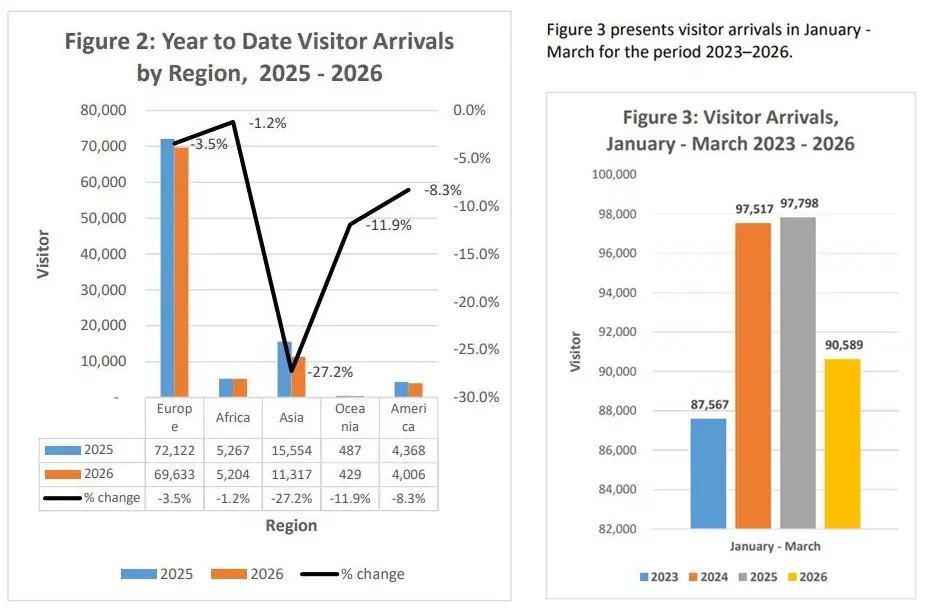
In the first quarter of 2026, Seychelles received 90,589 tourists. This is below the 2024 and 2025 figures of 97,517 and 97,798 respectively, but higher than 2023’s level of 87,567, according to the National Bureau of Statistics. The March decline was the key factor behind the weaker quarterly performance: 23,746 visitors arrived in the country, 37.2% fewer than in the same period of 2025. This was the lowest figure for March since 2021, when the tourism industry was hit by the Covid-19 pandemic.
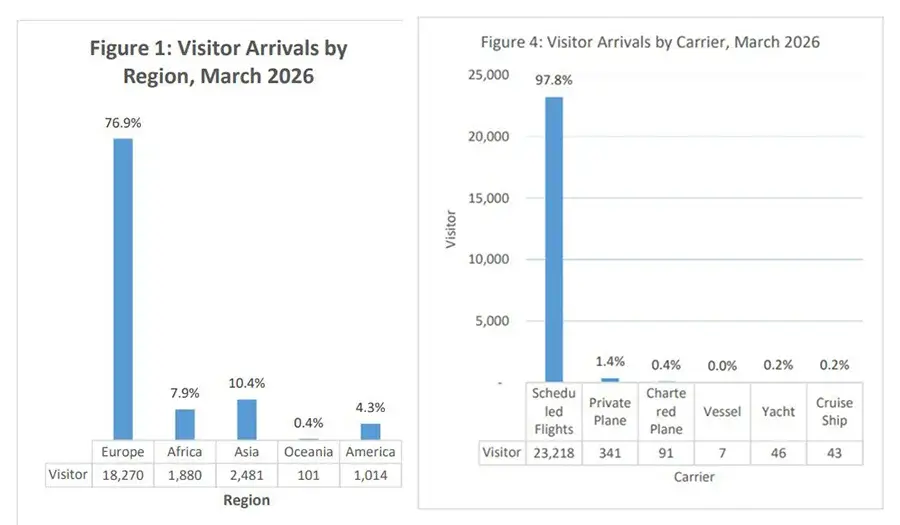
Seychelles is almost entirely dependent on air transport: 97.8% of tourists arrive on scheduled commercial flights. Private jets account for only 1.4% of arrivals, while the share of charters, yachts, and cruise ships remains minimal.
In this context, disruptions to air traffic through the Middle East have a direct impact on the industry. Even where alternative routes exist, reduced accessibility and longer travel times suppress demand.
Geography of arrivals: pressure on Asian markets
Europe retained its dominant position, accounting for 76.9% of all arrivals in March (18,270 visitors), although this still represents a 3.5% decline. Asia accounted for 10.4% (2,481 visitors) and showed the sharpest year-to-date decline of 27.2%. Africa represented 7.9% (1,880, down 1.2%), followed by the Americas at 4.3% (1,021, down 8.3%) and Oceania at 0.4% (down 11.9%).
The data indicates that disruptions in Middle Eastern aviation hubs have a stronger impact on routes connected to Asian markets.
Structure of arrivals and purpose of travel
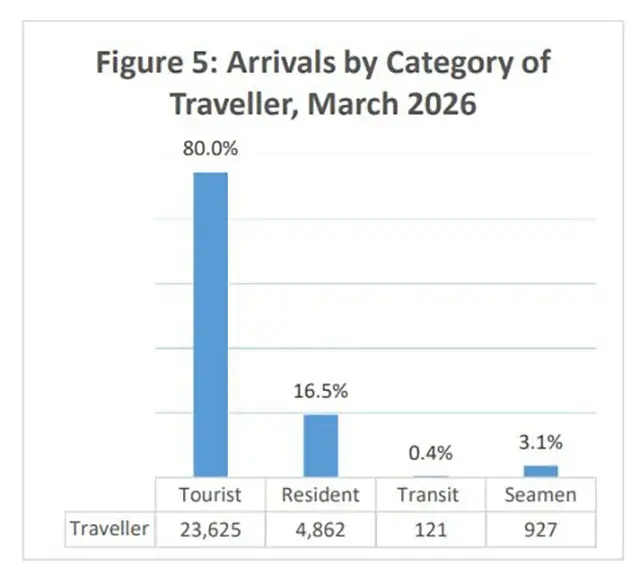
Tourists accounted for 80% of arrivals (23,625), while residents made up 16.5%, seafarers 3.1%, and transit passengers less than 1%.
Leisure remained the main purpose of travel, representing 87.4% of all visits. Visiting friends and relatives accounted for 9.4%, while business trips made up 4.3%. The average length of stay was estimated at 11 nights.
Most visitors (70.3%) stayed on Mahé, 15.6% on Praslin, and 7.2% on other islands. Hotels remained the dominant accommodation type (77.2%). Staying with friends or relatives accounted for 2.8% of tourists, while yacht accommodation represented 2.5%.
Repeat visits to Seychelles
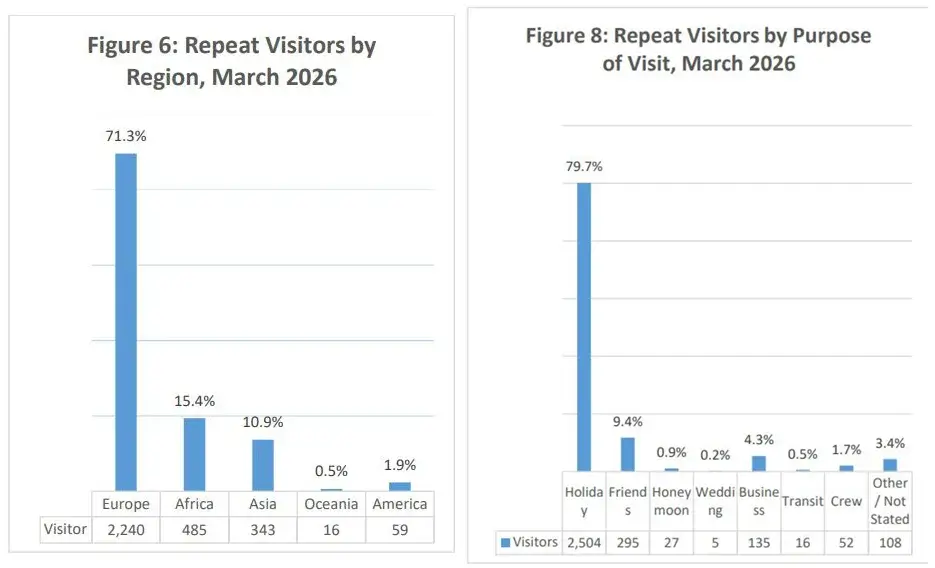
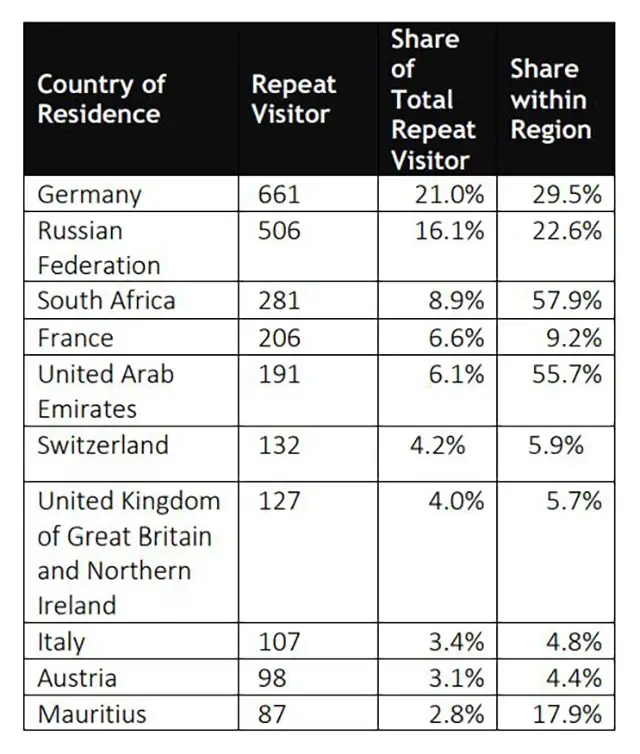
Repeat visitors accounted for 13.2% of arrivals (3,143 people). The largest share came from Europe at 71.3%. The leading source countries were Germany (661, or 21% of all repeat visits), Russia (506), and South Africa (281).
By region, the highest proportion of repeat travel came from Africa (57.9%) and from Asia, particularly the UAE (55.7%). Most travelers visited Seychelles for leisure purposes (79.7%).
Conclusion
Analysts at International Investment note that the demand structure in Seychelles appears stable on the surface: leisure travel dominates, average stays remain long, and repeat visitation is significant. However, this stability is increasingly inertia-driven and heavily dependent on external logistics.
The situation highlights the high vulnerability of the island tourism market to external shocks. Any disruptions in Middle Eastern aviation hubs quickly translate into declines in passenger flows, as alternative routes are limited and the long-haul model of demand is critically dependent on transit. The market reacts quickly to changes in routing, increasing volatility and making tourism flow forecasts less reliable.