







 Turkey Is Losing Its Cheap-Holiday Advantage
 Development Is Rewriting Southeast Asia’s Historic Districts
 How Ukraine’s New-Build Housing Market Has Changed Over Four Years
 European Prime Rents Rise as Property Yields Turn Higher
 The Most Expensive Airlines in Europe in 2026
 Housing Prices in Italy Reach a Two-Year High
Hotel Guest Numbers in Georgia Rose by 6.5%

Georgia’s hotel sector continued to expand in 2025: the number of accommodation facilities, room stock and capacity all increased, while guest numbers also grew. Foreign travelers accounted for the largest share of demand, with the overwhelming majority visiting the country for leisure, underscoring the sector’s continued reliance on international tourism, according to a report by the National Statistics Office of Georgia (Geostat).
Adjara and Tbilisi Lead the Hotel Market
In 2025, the number of hotels and hotel-type enterprises in Georgia increased by 4.5% to 2,783, including branches and local units. According to official data, these services were provided not only by companies but also by individual entrepreneurs, with 2,731 economic entities operating in the sector in total.
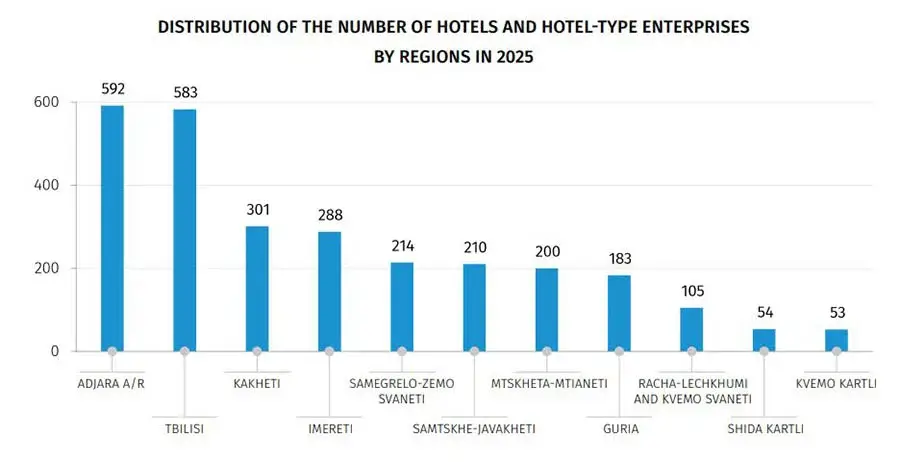
The highest concentration of hotel infrastructure remained in Adjara, with 592 establishments, or 21.3% of the total. Tbilisi ranked second with 583, or 20.9%. Together, the country’s two largest tourism hubs accounted for more than 42% of Georgia’s hotels.
Kakheti and Imereti had 301 and 288 establishments respectively. Samegrelo-Zemo Svaneti had 214 hotels, Samtskhe-Javakheti 210, Mtskheta-Mtianeti 200, and Guria 183. The numbers were significantly lower in Racha-Lechkhumi and Kvemo Svaneti, with 105 establishments, Shida Kartli with 54, and Kvemo Kartli with 53.
The hotel sector employed 29,101 people, of whom 54.5% were women.
Private Sector Expands Georgia’s Hotel Capacity
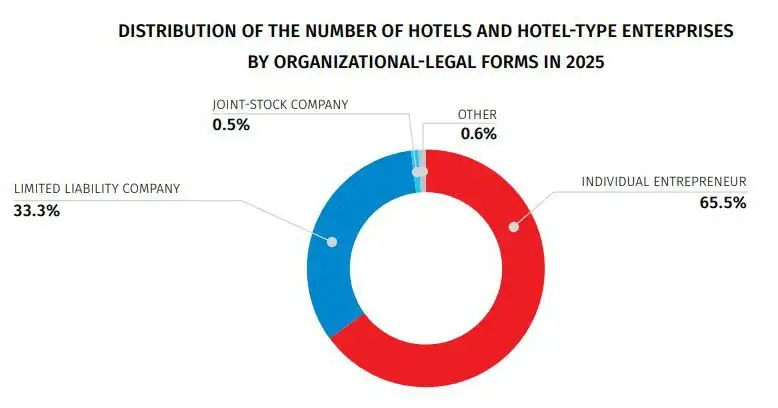
Georgia’s hotel market is almost entirely privately owned: private establishments accounted for 99.8% of the total in 2025, while state-owned properties made up just 0.2%. Individual entrepreneurship remained the most common form of business organization, accounting for 65.5%. Another 33.3% of enterprises were registered as limited liability companies and 0.5% as joint-stock companies.
The sector’s physical capacity also increased. The total area of hotels and hotel-type enterprises grew by 9.8% over the year to 3.965 million sq m. The living area of guest rooms increased by 8.9% to 1.761 million sq m. The number of bed-places rose by 6% to 120,200, while the room stock expanded by 6.1% to 54,300 rooms.
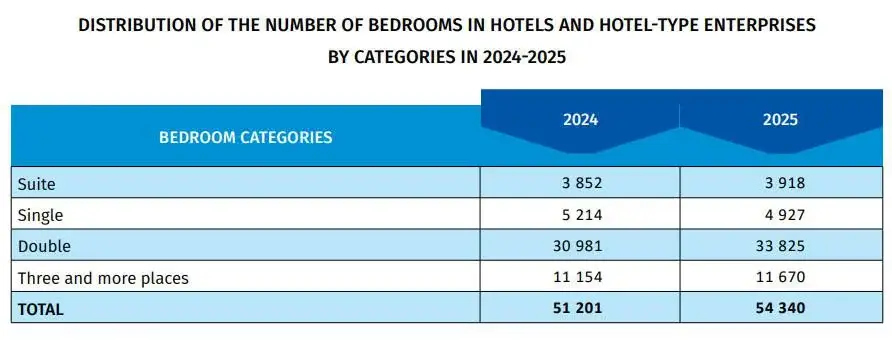
Double rooms make up the core of the market: their number increased from 30,981 to 33,825 over the year. The number of rooms for three or more guests rose more moderately, from 11,154 to 11,670. The number of suites increased from 3,852 to 3,918. The only decline was recorded in single rooms, which fell from 5,214 to 4,927.
Foreign Guests in Georgian Hotels
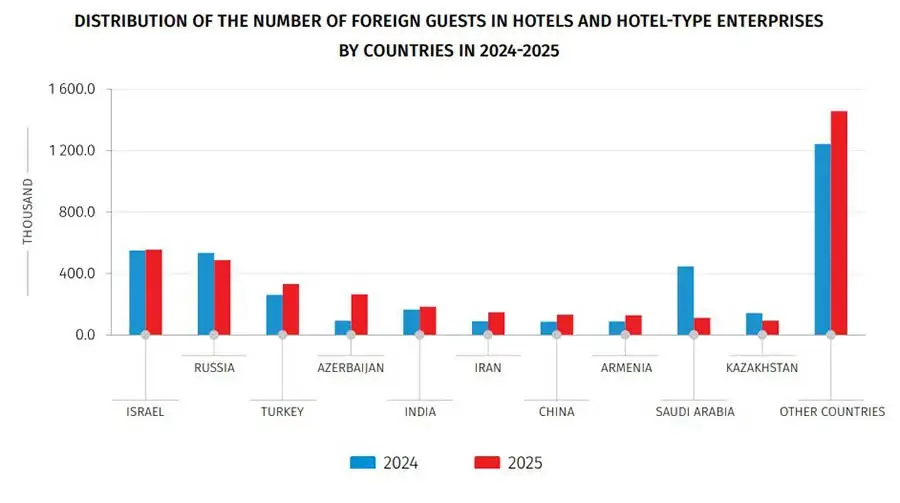
In 2025, hotels and hotel-type enterprises in Georgia served 6.2 million guests, 6.5% more than in 2024. Foreign visitors accounted for 62.7% of the total. Around 3.9 million international travelers stayed in accommodation facilities during the year. Israeli citizens formed the largest group, with 555,400 guests, up 1% from the previous year and accounting for 14.3% of the total foreign flow. Citizens of EU countries made up 10.4%.
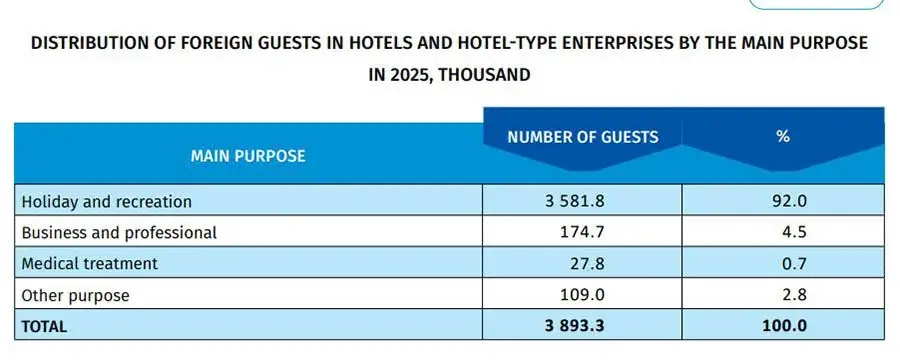
Leisure was the main purpose of travel, accounting for 3.582 million foreign guests, or 92%. Another 174,700 foreigners, or 4.5%, stayed for business and professional reasons, while 27,800, or 0.7%, visited for medical treatment. A further 109,000 people, or 2.8%, cited other purposes.
Among foreign guests traveling specifically for leisure, citizens of Israel and Russia were the largest groups, accounting for 14.7% and 12.9% respectively. This shows that hotel demand in Georgia is largely driven by inbound tourism, with foreign stays overwhelmingly linked to leisure rather than business or medical travel.
New Opportunities for Investors in Georgia
International Investment analysts note that the investment market along Georgia’s Black Sea coast is largely shaped by apartments and apart-hotels intended for short-term rental. The high volume of supply is increasing competition between such properties, while gross rental yields in Batumi have fallen from 10% to 7.4% over the past three years. After maintenance, marketing and tax costs, actual returns are estimated at around 3–4%, and may be even lower during periods of vacancy.
At the same time, official statistics indicate growing demand for premium accommodation formats. This segment is still at an early stage of development in Georgia, making it potentially more attractive for investors. High-end properties can offer more stable occupancy thanks to international branding, professional management, extensive infrastructure and a focus on higher-spending guests. Returns from such hotels can also be significantly higher.
One of the largest projects in this niche is Wyndham Grand Batumi Gonio. It belongs to the luxury segment of an international brand and operates in an All Inclusive format. There are only 95 Wyndham Grand hotels worldwide. For investors, projects of this type offer an opportunity to shift away from the saturated apartment market toward a less competitive segment with stronger pricing potential. If demand continues to grow, premium hotel projects may gain an additional advantage in the coming years.