







 Covivio Hotels Revenue Grows 4.7% as European Markets Split
 Lithuanian Apartment Prices Accelerate Across Major Cities
 Georgia's Tourism Revenue Hits Record High
 Norway's Sovereign Fund Commits €1.5bn to European Warehouses
 Market Rout of October 2026: Can Branded Hotels Protect Capital?
 Residential Property Prices in Tbilisi Rise by 5.9% Year-on-Year
Portugal Picks Lufthansa to Buy 44.9% of TAP
Portugal selected Lufthansa Group to acquire 44.9% of TAP Air Portugal for €1.025 billion. The holding could rise to 49.9%, for up to €1.201 billion including an additional fee, if employees do not exercise their option on the reserved 5%. Portugal would retain 50.1%. The decision was announced on 14 October and formalised in Council of Ministers Resolution No. 201/2026, published on 16 October. The purchase agreement has not yet been signed and regulatory approval is still required.
TAP's network links Lisbon with Brazil and other transatlantic markets. Lufthansa aims to strengthen these connections and build up long-haul operations in Porto. For Portugal's hotels, the outcome will depend on how many additional passengers actually visit and stay in the country rather than connecting through its airports.
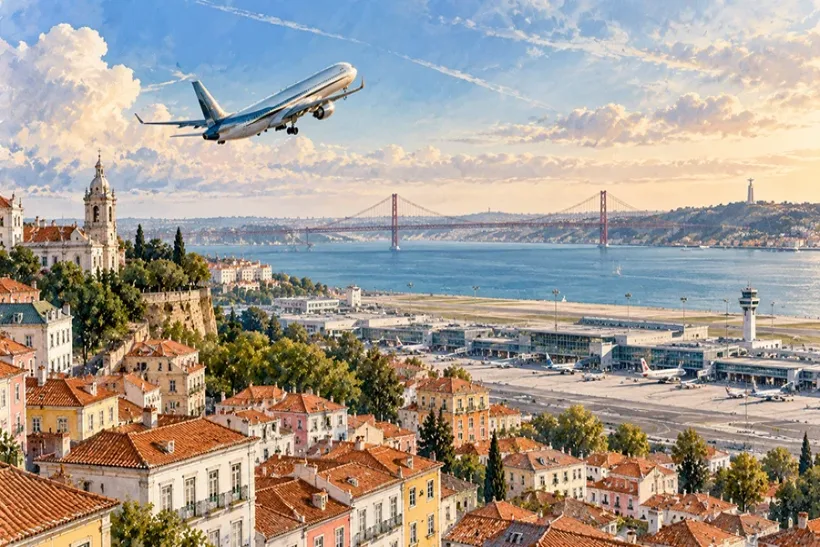
Lisbon and Portugal's aviation network. Editorial illustration for International Investment, not documentary airport photography.
Why the government selected Lufthansa
Air France-KLM was the other bidder for the TAP stake. Portugal's government said Lufthansa's financial offer was up to 16% higher and considered it the more robust proposal after assessing commercial, contractual and financial conditions. The stated objectives also include preserving the carrier's national identity and strategic links.
TAP completed the restructuring programme agreed with the European Commission. Its 2025 results showed 16.7 million passengers, €4.313 billion in operating revenue, €742.9 million in recurring EBITDA (a 17.2% margin) and €4.1 million in net profit. The small net profit relative to revenue should not be confused with the much larger EBITDA figure, which excludes several categories of costs.
The government intends to retain the TAP name and headquarters, its island connectivity and the Lisbon hub. Lufthansa would have a significant management role, while Portugal would remain the majority shareholder in the first stage.
What the €1.025 billion offer covers
The initial bid values a 44.9% holding at €1.025 billion. A further 5% is reserved for employees. If the employees decline their purchase option, Lufthansa may take that additional holding and increase its stake to 49.9%. The amount could then reach €1.201 billion, including a time-related additional fee. These are conditional variants of the first stage, not two completed transactions.
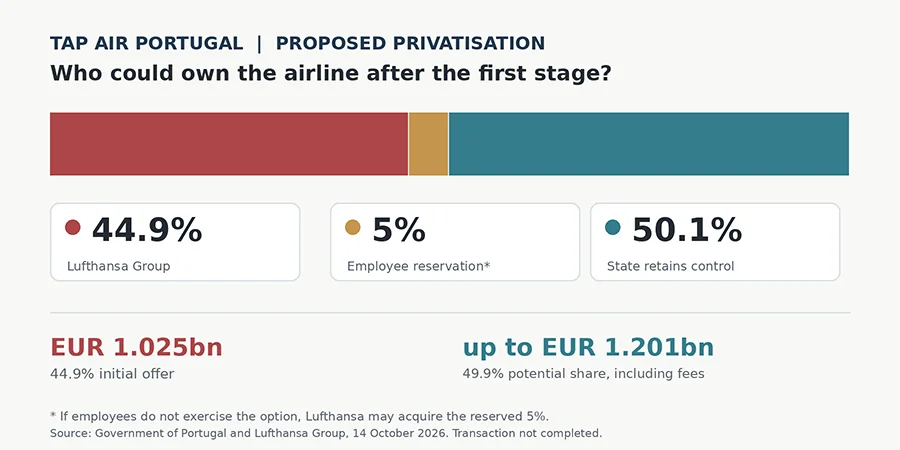
Proposed first-stage ownership: 44.9% Lufthansa, 5% reserved for TAP employees and 50.1% retained by Portugal. The acquisition remains conditional. Sources: Government of Portugal and Lufthansa Group.
A possible second stage could give Lufthansa a controlling interest. The Portuguese government presented a €2.552 billion valuation of TAP under that scenario, including a possible €488 million share exchange that could leave Portugal with around 5% of the combined company. This is a conditional valuation for a potential subsequent phase, not the price of an agreed second transaction. The government has discussed a timetable extending into 2028.
Lisbon's value as a transatlantic hub
TAP's most strategically important network connects Europe to Brazil and other Atlantic destinations. Lufthansa's stated ambition is to strengthen North and Latin American connectivity while maintaining TAP within Star Alliance. The potential commercial benefit lies in coordinated routes, schedules and onward connections, not in an immediate alliance switch.
Lufthansa already has an established Portuguese operation. The group reports 353 weekly flights to six destinations in Portugal and says its seat capacity is 75% above 2019 levels. These existing services must not be counted as newly announced capacity attributable to the TAP transaction.
The physical scale of the Lisbon hub is substantial. Airport operator ANA reported 36.1 million passengers at Lisbon Airport in 2025, up 2.9% year on year. Airport throughput counts departing, arriving and connecting passengers, however, and should not be confused with international visitors staying in Lisbon.
Airport capacity remains a constraint
More long-haul flights will require sufficient aircraft, departure slots and airport infrastructure. Lisbon's existing airport is constrained, while Portugal is progressing plans for the proposed Luís de Camões airport at Alcochete. In March 2026, the government confirmed the site and requested revisions to traffic forecasts. That project is a separate investment and cannot be treated as an immediate capacity increase resulting from Lufthansa's selection.
An airline hub may process a growing number of passengers without a comparable increase in local accommodation demand. Transfer travellers can remain airside or leave within hours. The number who stop in Portugal, their spending and the number of nights they stay will determine how much of any network growth benefits the visitor economy.
Porto could gain a larger role
The proposed plan would turn Porto into a stronger second base for TAP, with eight long-haul aircraft stationed there. Its fleet roadmap envisages 117 aircraft by 2035 and 130 afterwards, potentially including up to eight Airbus A350-900 aircraft after 2030. These are proposed commitments, not an implemented flight schedule.
These are proposed investment and network commitments, not an implemented timetable. Greater connectivity could support northern Portugal's hotels, corporate travel and regional services, but a measurable effect requires routes, frequencies and traffic data.
What the sale may mean for Portuguese hotels
The hospitality sector has a sizeable base. Turismo de Portugal reported 32.5 million guests and 82 million overnight stays in 2025. Almost 70% of overnight stays were attributable to non-residents, with Greater Lisbon and the Algarve accounting for approximately half the national total. Hotels represented around 60% of stays.
If TAP improves long-haul access, some additional passengers may spend time in Lisbon, Porto, Madeira or the Algarve. Hotel operators could benefit from more business travel, more overnight stopovers and a wider mix of source markets. Yet those outcomes depend on how the expanded network is used. A flight connection does not guarantee a hotel booking.
International Investment previously examined Portugal's strong tourism receipts, including a March 2026 reading above €2 billion. Tourism receipts represent international visitor spending across categories, not hotel revenue alone. A fair assessment of the transaction's hospitality impact will require overnight stays, hotel occupancy, room rates and revenue per available room, alongside passenger figures.
Portuguese hotel investment was active before Lufthansa was selected. International Investment has covered Hyatt's projects in Lisbon and the Algarve, as well as the relationship between RevPAR growth and hotel operating costs in 2026. Better air access may help individual hotels, but no improvement in profitability or asset valuations can yet be attributed to the proposed transaction.
What changes for property investors
Enhanced aviation links can improve the attractiveness of offices, hospitality property and regional business services. But that impact is indirect, particularly in residential real estate. Additional airline passengers are not equivalent to additional homebuyers.
International Investment's recent analysis of Portuguese property showed demand spreading beyond Lisbon and Porto while supply constraints and housing affordability remained important. Investors considering short-term rentals will still need to assess local rules, operating costs and address-specific demand, regardless of the airline's shareholder structure.
What remains to be approved
As of 17 October 2026, the acquisition has not closed. Council of Ministers Resolution No. 201/2026, which entered into force on 17 October, formally confirmed the selection of Lufthansa and instructed Parpública to proceed with the transaction process. Final agreements and the relevant competition and aviation approvals remain outstanding. The government aims to complete the first-stage documentation in 2026.
The next evidence to watch is the signed contract, governance terms, specific route additions, fleet decisions and changes in airport and hotel performance. For tourism investors, the commercial test will be whether a stronger network generates more stays and spending in Portugal rather than simply more passengers transferring through its airports.
FAQ
Has Lufthansa already acquired TAP Air Portugal?
No. The Portuguese government selected Lufthansa on 14 October 2026, but signing and regulatory approvals are still outstanding.
How much of TAP does Lufthansa plan to buy?
The initial stake is 44.9%. Lufthansa could acquire the 5% reserved for employees if they do not exercise their purchase rights, bringing the holding to 49.9%.
What is the proposed price?
€1.025 billion for 44.9%, potentially rising to €1.201 billion for 49.9%, including an additional time-related fee. Any second privatisation stage would be a separate transaction.
Why does Lufthansa want TAP's Lisbon hub?
The strategic appeal includes TAP's routes to Brazil and other transatlantic destinations and opportunities to coordinate services within Star Alliance.
Will TAP's sale increase tourism in Portugal?
Improved routes could attract additional visitors, but there is no measured post-transaction tourism effect yet. Some passengers may remain transit travellers.
Will Portugal retain control of TAP?
Yes, under the first-stage structure the state retains 50.1%. A future transfer of majority control would require a separate decision.