







 Seoul Hotel Demand May Outpace Room Supply Until 2032
 Sweden Property Investment Climbs 40% in Nine Months
 Georgia's Hotel Market: Batumi Room Rates Surge as Tbilisi Occupancy Climbs
 China Eastern Airlines to Boost Shanghai – Tbilisi Flight Frequency to Five Times Weekly from 2027
 Belgian Industrial Property Draws €537m of Capital
 Madrid to Build €1 Billion City of Health Complex
Hotels Use AI for Pricing but Keep Humans in Charge

Artificial intelligence is already influencing hotel room rates, but most operators are not prepared to hand it the final decision. RoomPriceGenie's State of Revenue Management in Hospitality 2026, released on 20 October, found that 53% of surveyed revenue decision-makers use AI for pricing recommendations while only 10% trust it to make most decisions. The findings draw on 450 respondents from Europe, North America and Asia Pacific. They describe a surveyed group of hospitality businesses, not every hotel globally.
Adoption has outrun willingness to delegate
More than half of the respondents already use AI when making rate decisions, including 16% who report extensive use. Another 35% are piloting or considering the technology, while 11% are not planning to use it. A much larger group, 77%, say they trust AI to some degree, but just 10% feel comfortable relying on it for most pricing decisions. That distinction matters: occasional trust in a recommendation is not the same as giving a system operating authority.
An automated pricing recommendation can combine forward bookings, local events, seasonal patterns and competitors' rates faster than an employee could gather them manually. Yet managers still need to understand why the suggested number changed. Without clear inputs and explanations, they often check the decision themselves. The survey does not show that the remaining 90% have no trust in AI; it shows that relatively few are prepared to delegate most decisions.
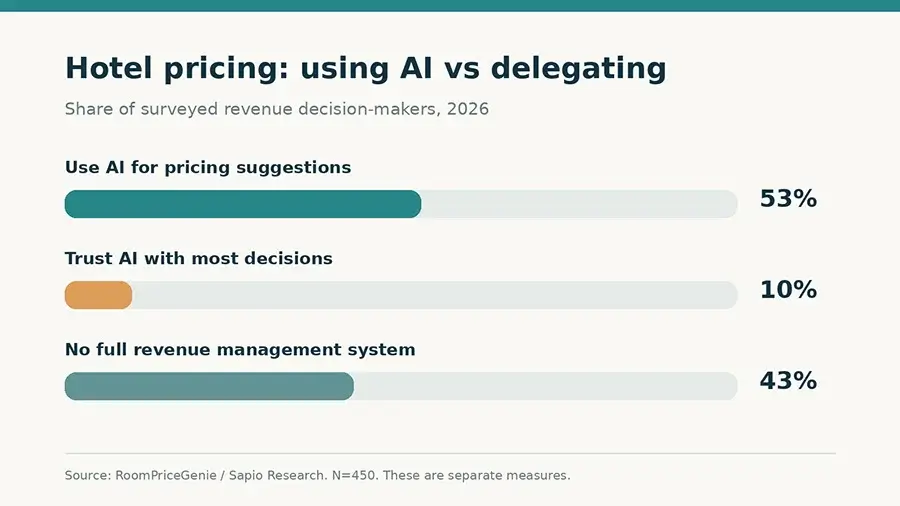
Three separate survey measures: AI used for room-rate recommendations 53%, willingness to delegate most decisions 10%, no full RMS 43%. Source: RoomPriceGenie, sample of 450. ALT EN: bar chart of AI use, delegation and revenue-management system adoption.
Basic revenue systems are still missing in many properties
The research also found that 43% of respondents operate without a full Revenue Management System. Across the surveyed group, 29% rely on spreadsheets with limited automation and 14% still use manual judgement or fixed seasonal rates. The debate over autonomous AI is therefore taking place in an industry where some properties have yet to establish consistent digital revenue-management processes.
Confidence does not always translate into frequent strategic reviews. Some 79% of respondents believe they are maximising revenue potential, but only 36% revisit pricing strategy at least monthly. This does not prove that those hotels are losing a specific amount of money, although it helps explain why a useful automated tool can coexist with limited organisational readiness.
The talent gap creates a second constraint
Nearly half of respondents, 47%, report difficulty recruiting qualified revenue-management specialists. The figure rises to 66% in the German-speaking DACH markets and 56% in Canada. Pricing decisions often remain with general managers or owners who have many other responsibilities. Automation may help those teams work with market data more consistently, but the survey does not demonstrate that specialist revenue managers have already been replaced.
The technology provider argues that operators should focus on the overall revenue process, including demand forecasts, distribution, discounts, channel costs and the quality of the underlying data. Large chains may be able to invest in dedicated analytics resources; smaller properties need transparent recommendations and practical controls if they are to benefit from sophisticated pricing systems.
The investment question is profit, not automation alone
A property investor ultimately depends on cash flows, not an algorithm's adoption rate. Higher average room prices can coincide with weaker occupancy or higher operating costs, making RevPAR, gross operating profit and the cost of technology all relevant. International Investment's hotel performance analysis has documented why growth in room revenue does not necessarily produce proportional margin gains. The latest survey adds evidence about who makes pricing decisions and how mature those processes are.
AI also influences the consumer side of hospitality. International Investment's separate guide to AI travel search examined hotel discovery and shortlist visibility, but those functions differ from revenue management inside an operating hotel. Comparing an AI discovery percentage with a pricing adoption rate would mix different populations and activities. RoomPriceGenie's report provides no guaranteed investment return for AI-enabled hotel assets.
Frequently Asked Questions (FAQ)
What percentage of respondents use AI for hotel pricing? RoomPriceGenie reports 53% among 450 surveyed revenue decision-makers, not all hotels worldwide.
How many would let AI make most pricing decisions? Only 10%, although 77% have some degree of trust in the technology.
What is a hotel RMS? A Revenue Management System supports pricing and demand analysis; 43% of respondents did not have a full system.
Does the survey prove AI raises hotel investment returns? No. It measures technology use and management practices, not investor yield.