







read also
 Covivio Hotels Revenue Grows 4.7% as European Markets Split
 Lithuanian Apartment Prices Accelerate Across Major Cities
 Georgia's Tourism Revenue Hits Record High
 Norway's Sovereign Fund Commits €1.5bn to European Warehouses
 Market Rout of October 2026: Can Branded Hotels Protect Capital?
 Residential Property Prices in Tbilisi Rise by 5.9% Year-on-Year
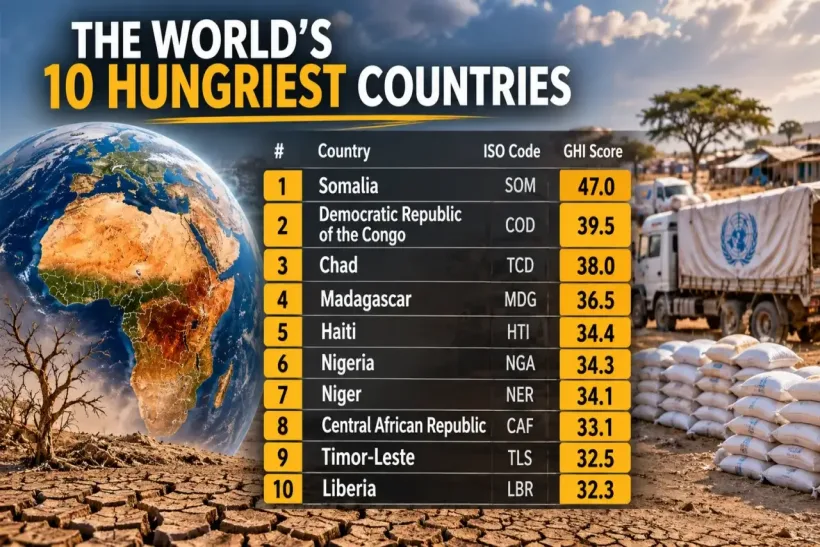
The world has become hungrier for the first time in 26 years of observation. Here is what the map of hunger looks like, who pulled ahead, and why progress has collapsed.
In Somalia, more than half the population (56.5%) does not get enough food. This is the highest figure on the planet. At the other end of the ranking stand 24 countries where, by researchers’ standards, hunger is practically undetectable.
This is the 2026 Global Hunger Index. It was published in October by the German organization Welthungerhilfe, the Swiss organization Helvetas and the Institute for International Law of Peace and Armed Conflict (IFHV). The report’s main finding is alarming: for the first time in the history of observation, the level of hunger has not fallen but risen.
The ten countries where hunger is most severe
Somalia tops the ranking with a score of 47.0 out of 100. It is the country the report names as the hungriest. Next come:
Democratic Republic of the Congo – 39.5
Chad – 38.0
Madagascar – 36.5
Haiti – 34.4
Nigeria – 34.3
Niger – 34.1
Central African Republic – 33.1
Timor-Leste – 32.5
Liberia – 32.3
These are only the countries for which a score could be calculated. Four more states – Burundi, Sudan, South Sudan and Yemen – are missing from the table because reliable data are unavailable. Even so, the report’s authors place them in the “alarming” category. A pattern emerges: the more severe the crisis, the harder it is to measure.
Some of the numbers conceal specific tragedies. In Sudan in 2025, famine was officially confirmed in the besieged cities of El Fasher and Kadugli. In the Gaza Strip, famine was confirmed in August 2025. After the ceasefire it was no longer recorded by December, but in April–June 2026, 59% of residents were in crisis or worse conditions. Such a coincidence had not occurred in all two decades of observation: famine was confirmed in two separate crises in the same year.
The most dramatic deterioration is in Syria. Over 26 years its score has risen by 16.7 points, more than any other country, and now stands at 31.5. In Syria, 40.8% of residents are undernourished. In Haiti, which has become the hungriest country in Latin America and the Caribbean, 51.4% are undernourished, and gangs have driven about 1.4 million people from their homes.
Countries where hunger has almost disappeared
Now for the good news. The group of leaders is unusual: the 24 countries with a score below 5 do not take turns at the top. They jointly occupy positions 1–24, because the differences between them are negligible. The list includes Armenia, Belarus, Bosnia and Herzegovina, Bulgaria, Chile, China, Costa Rica, Croatia, Estonia, Georgia, Hungary, Kuwait, Latvia, Lithuania, Montenegro, North Macedonia, Paraguay, Romania, Russia, Serbia, Türkiye, the United Arab Emirates, Uruguay and Uzbekistan.
What is most interesting here is not the makeup of the group but the speed of the journey. In 2000, Türkiye scored 22.1, Uzbekistan 25.6 and Armenia 20.3. That is the level of “serious” hunger, like India or Ethiopia today. China had 13.8, Paraguay 12.8, Georgia 11.7 and Russia 10.5. Within a quarter of a century, all of them reached a result that countries in sub-Saharan Africa can so far only dream of.
Right behind the leading group come Moldova (5.0), Mongolia (5.3), Argentina, Brazil and Azerbaijan (5.5 each), the Dominican Republic (5.9), and Kazakhstan and Tunisia (6.0 each). In total, the “low hunger” category includes 50 countries with a calculated score, plus Slovakia, which was included provisionally because of insufficient data.
An important caveat: many wealthy countries, such as the United States, Germany and France, are not in the ranking. The index does not cover all states, so absence from the table means neither well-being nor trouble. And “low” does not mean “zero”: all of these countries still face nutrition problems of their own.
The world has gone backward
Now the main point. The global score in 2026 stood at 18.1, compared with 17.6 in 2018. For comparison, in 2000 it was 28.2. For a quarter of a century the figure fell, and now, for the first time, it has turned around.
In 32 countries there is more hunger now than in 2018. In five of them (Fiji, Libya, Papua New Guinea, the Solomon Islands and Syria) it is higher than in 2000, meaning these countries have been set back by more than a quarter of a century. In another 20 countries progress has practically stalled. The total number of countries with serious or alarming hunger is 44, of which 36 are serious and 8 are alarming.
Nigeria holds the record for deterioration: its score rose from 28.2 to 34.3, the largest increase in the world. In Malawi it rose by 3.0, and in the DR Congo by 2.9. Ukraine has also slid noticeably, from 9.8 to 11.6, and the country has moved from the “low” level back to “moderate.” The share of undernourished people there has more than tripled since the start of the full-scale war, reaching 10.8%. In Lebanon the score rose from 7.2 to 9.4.
Who managed to pull ahead
Among the good news there are genuine breakthroughs. Nine countries have cut their score by more than 20% since 2018, including Nepal, Rwanda, Togo, Uganda and Venezuela. Venezuela fell from 16.7 to 8.9, Uganda from 28.7 to 20.7, Togo from 24.3 to 17.6, and Mozambique from 31.6 to 25.9.
Looking over twenty-plus years, the leaders are even more impressive: Tajikistan cut its score from 39.2 to 12.7, Cambodia from 39.8 to 14.3, Sierra Leone from 57.7 to 28.7, and Nepal from 37.0 to 14.5. The report’s authors stress that there are no reliable recipes, and lasting success is always built from several factors: education, sanitation, healthcare, income growth and social protection.
India: enough food, but children are wasted
South Asia is a separate story. With a score of 23.5, the region remains second in severity after sub-Saharan Africa (27.5). India ranked 100th out of 122 with a score of 24.1, the same as Ethiopia.
The paradox is that the share of undernourished people there has fallen to 9.8%, yet 19.0% of children under five suffer from wasting. This is the worst figure in the region, and South Asia as a whole has the highest child wasting rate in the world (15.8%).
Afghanistan and Pakistan remain the only countries in the region where the situation has worsened since 2018. Bangladesh, on the other hand, scored 19.2, and Sri Lanka, at 10.2, came close to the “low” level.
Why this happened: a cocktail of crises
The main cause, according to the authors, is war. In countries with chronic and intense conflict, the median score is 22.1 (“serious” hunger), while in countries without conflict it is 9.7. In 2025, 65 armed conflicts were recorded, more than at any time since 1946.
The second cause is money. In 2025, food programs in crisis regions received about $10.55 billion of the $29 billion needed. Meanwhile, global military spending rose to a record $2.887 trillion. Funding cuts also hit the statistics: in 14 countries there were not enough data to calculate a score.
On top of this came the war involving the United States, Israel and Iran, which disrupted shipping through the Strait of Hormuz. Roughly a third of the world’s seaborne fertilizer exports pass through it. Prices for urea (an agricultural fertilizer) are forecast to rise by about 60% in 2026.
The authors warn that the peak of the price crisis will come in late 2026 and early 2027, and that acute hunger could affect another 45 million people. The index itself reflects the period 2021–2025, so the consequences of this shock are not yet in the ranking.
If nothing changes, 57 countries will not reach a low level of hunger by 2030. The authors consider the UN’s “Zero Hunger” goal increasingly unattainable: in 2025, about 645 million people were undernourished.