







 Covivio Hotels Revenue Grows 4.7% as European Markets Split
 Lithuanian Apartment Prices Accelerate Across Major Cities
 Georgia's Tourism Revenue Hits Record High
 Norway's Sovereign Fund Commits €1.5bn to European Warehouses
 Market Rout of October 2026: Can Branded Hotels Protect Capital?
 Residential Property Prices in Tbilisi Rise by 5.9% Year-on-Year
Cheap Construction Is Gone: Which Projects Still Work?
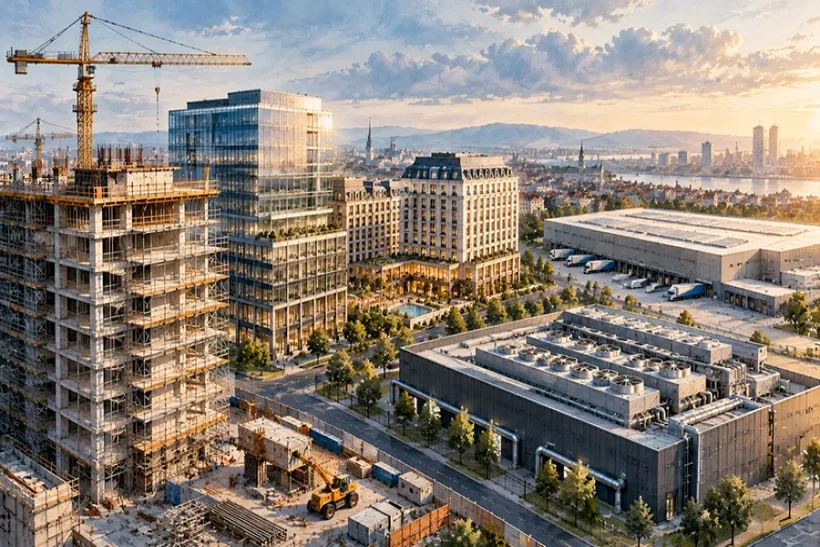
Construction costs across global markets are about 25–30% higher than five years ago, and JLL does not expect the industry to return to its former cost base. Its Global Construction Costs Index, released on 15 October 2026, forecasts a further 3.1–4.2% increase in contractor tender prices in 2027. For investors, the immediate question is what higher build costs mean for the viability of homes, hotels, offices, logistics property and data centres.
The answer is not the same across property types. JLL says industrial logistics and data centres have been better able to absorb rising costs where income and asset values are also growing. The economics of offices and retail are more difficult. Residential and hospitality developments depend on local purchasing power, rental income, hotel operations and funding conditions. Expensive construction does not guarantee higher selling prices.
Construction now costs 25–30% more than five years ago
JLL's 2026 Global Construction Costs Index draws on more than 1,000 projects across six building types in 14 markets. Over five years, average costs increased 25–30%, reaching 40% in some markets. JLL forecasts global construction-cost inflation of 3.5–4.7% for 2026 and tender price inflation of 3.1–4.2% for 2027.
Tender prices are the bids contractors submit for construction work. They should not be confused with the prices of completed homes or total development costs including land, professional fees, financing and taxes. Nor are these global averages a substitute for a local cost consultant's budget.
Before 2020, cost growth of 2–3% a year was considered normal. JLL now uses a 3–6% annual escalation range for planning over the coming years. That does not rule out occasional cost declines in individual markets, but it changes the baseline investors should use when testing new projects.
Where building costs could rise fastest in 2027
JLL expects tender price increases of 2.2–3.5% in Europe, 3.2–4.2% in North America, 3.8–4.7% in Asia Pacific and 3.4–5.4% in the Middle East. Local labour availability, energy costs, regulation, supply chains and contractor competition explain much of the variation. A global average is not an appropriate budget for an individual project in London, Dubai or Singapore. International Investment previously examined the world's most expensive construction markets using Turner & Townsend's city-level benchmarks, which also demonstrate substantial variation.
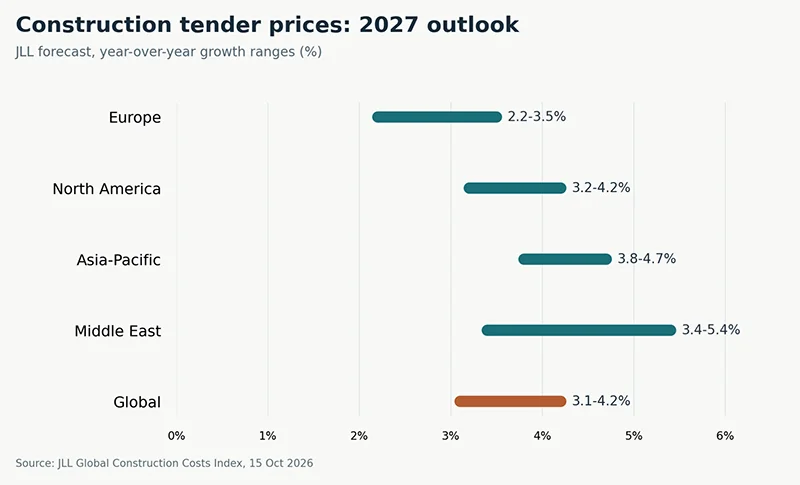
JLL's regional forecast of construction tender price inflation for 2027. Source: Global Construction Costs Index 2026.
Labour is a structural source of pressure. Construction wages rose 8–35% across markets between 2020 and 2026. In JLL's survey, 64% of markets reported skilled labour shortages. Electricians, carpenters and technicians working on mechanical, electrical and HVAC systems are especially scarce. Data-centre development increasingly competes with other construction sectors for those specialist trades.
What a square metre of construction costs
JLL estimates that high-rise residential buildings cost between $2,280 and $3,710 per square metre across the markets in its study. Office shell-and-core construction ranges from $2,600 to $3,410 per square metre, while industrial and logistics facilities range from $980 to $1,520. Differences in specifications, geography and technical requirements are considerable.
These ranges do not describe equivalent finished properties. Land, permits, design, finance, taxes and reserves are additional components of a full development model. Office fit-outs, hotel furnishings, automated warehouse equipment and active servers in data centres can represent substantial separate investments. Using a contractor benchmark as a turnkey asset valuation would therefore misstate the capital required.
Housing: development margins are exposed to affordability
Higher construction costs squeeze the gap between a project's expected sales revenue and its total costs. Developers in undersupplied locations may be able to charge more, but households still face income and mortgage constraints. When prospective buyers cannot absorb another increase, developers may postpone phases, change the specification or accept lower margins.
International Investment reported the impact in the Czech Republic, where developer Central Group delayed new projects amid elevated building and financing costs. Delayed supply can eventually support existing home values, but it does not guarantee that a newly built apartment will sell at any particular price.
Build-to-rent housing faces an additional test: future net rental income must support the completed property's valuation after vacancies, management and maintenance. Rent regulation and local wage growth can limit the rate landlords are able to charge. Higher construction inflation alone cannot justify a higher rental yield. International Investment has separately examined Europe's housing shortage, including constrained supply in Portugal, Spain and Ireland.
Hotels: rising room revenue may not cover a new-build budget
Hotels can adjust their room rates quickly, and restricted new supply can support occupancy in strong destinations. Yet construction is just one element of their cost. Public spaces, guest-room fit-outs, furniture, mechanical systems and pre-opening expenses create substantial capital requirements before a property begins trading.
European revenue per available room, or RevPAR, grew 4.5% in the first half of 2026, according to figures previously examined by International Investment. Labour, utilities and management costs are also rising. Higher RevPAR is not the same as higher operating profit, and an attractive existing hotel's performance is not proof that a new one will justify its land and construction budget.
New hotel projects require realistic room-rate and occupancy assumptions, operating-margin forecasts, brand and management contracts, and an appropriate cost of capital. Where a good existing hotel can be acquired and refurbished at a reasonable price, renovation may offer a more predictable alternative. Heavy refurbishment costs can erase that advantage.
Offices: the tenant matters more than an impressive specification
JLL identifies offices among the sectors where capital values do not always increase fast enough to offset construction inflation. High-performance ventilation, building controls, sustainability requirements and occupier fit-outs raise the cost of new space. Vacancies in competing properties may prevent landlords from achieving the rents necessary to justify construction.
Prime projects in constrained business districts can still work, particularly with strong pre-leasing commitments and credible tenants. Speculative developments without evidence of demand are more exposed. The investment test is the net rental income a building can generate and the capitalisation rate applied to that income, not simply the cost per square metre.
Logistics: simpler buildings still face occupier risk
Industrial and logistics construction is significantly less expensive than high-rise housing and offices at the shell-and-core level. Straightforward low-rise buildings and long leases can make costs and income easier to anticipate. In some locations, rental growth and stronger asset values allow the sector to absorb inflation better, as JLL notes.
But a basic warehouse is not comparable with an automated distribution campus. Fire protection, clear height, refrigeration, handling equipment, electrical capacity and road access all change the budget. A weak tenant or local oversupply can eliminate the benefit of inexpensive construction.
For investors, the practical questions concern tenant demand, transport access, fit-out obligations and whether the space can be used by another operator if the original tenant leaves. The lowest tender price is not automatically the best property investment.
Data centres: power availability can matter more than land
Demand from artificial intelligence and cloud computing supports development of data centres, but this is a highly capital-intensive market. In its separate 2026 Global Data Center Outlook, JLL forecast an average of approximately $11.3 million per MW for core and shell construction, 6% above 2025. This metric is not comparable with a standard building's cost per square metre. The benchmark excludes land and active IT equipment; AI technology fit-outs can cost as much as $25 million per MW.
Higher contracted rents and stronger values can absorb some of the construction inflation. However, electrical grid access, the date power becomes available, cooling technology and customer commitments often decide whether a project can operate profitably. A data centre without secured power and a credible anchor tenant may face substantial financial risk even in a growing market. International Investment has separately examined the shortage of available data-centre capacity in EMEA, where grid connection and pre-leasing have become central to project viability.
International Investment previously explored how US data-centre construction spending was approaching spending on office space. That shift shows how technology is redirecting building demand, but does not mean every speculative data-centre development will earn attractive returns.
How a 4% cost increase can cut profit by 24%
Consider an illustrative development generating 100 units of revenue. The original plan allocates 60 units to construction and 30 to land, financing and other expenses, leaving 10 units of profit. This is an editorial scenario, not a JLL project estimate or a forecast for a particular market.
If the construction budget rises by 4% while revenue and other costs remain unchanged, construction spending becomes 62.4 and profit falls to 7.6 units, a 24% decline. Two years of compounded 4% cost growth would lift the construction budget to about 64.9, reducing profit to about 5.1 units, nearly half the original profit. In a real project, delays and financing costs could further change the outcome.
The exercise shows why sector-level inflation is not a measure of lost profit. A well-capitalised development with strong demand and a large initial margin can remain viable; a marginal deal can become unfinanceable after a relatively small change in cost or time to completion.
Five sectors, five different tests of viability
An investor needs a separate decision threshold for each building type. Housing depends on achievable sale prices or net rents; hotels on sustainable operating profit; offices on lease commitments; logistics on occupier demand; and data centres on power availability and contracted customers. The following editorial matrix identifies factors to stress-test, not a JLL ranking of sector returns.
|
Asset type |
When economics may work |
Critical risk |
|
Housing |
Sales or net rent cover all development costs |
Affordability, loans, approvals |
|
Hotel |
Occupancy and operating profit support the capital spend |
Seasonality, payroll, fit-out |
|
Office |
Strong leases signed before completion |
Vacancy and expensive fit-out |
|
Logistics |
Confirmed tenant demand and access |
Automation costs, oversupply |
|
Data centre |
Power and long-term customers secured |
Grid delays and cooling |
Editorial feasibility matrix based on sector economics and the risks described in the cited research; not a ranking of investment returns.
What investors should do with 2027 cost forecasts
Global forecasts should be translated into current, location-specific contractor bids. A robust appraisal separates hard construction costs from land, debt, permits, taxes and revenue, then tests how each variable changes during the development timetable. A model built in 2023 or 2024 may require a complete reappraisal before procurement.
JLL recommends ongoing financial re-underwriting, earlier procurement for equipment with long lead times, portfolio-wide purchasing strategies and careful examination of renovation alternatives. Phasing a development can reduce exposure, although delay itself creates carrying costs. No recommendation in the index should be read as a signal to start every available project immediately.
Expensive construction can constrain the pipeline of new real estate and indirectly benefit high-quality buildings already in operation. It also reduces developer margins and raises entry-price discipline. The right question for 2027 is therefore not which asset class is universally most profitable, but which individual project can support its full costs with credible future income.
FAQ
Why have global construction costs increased?
JLL estimates that construction costs rose by an average of 25–30% over five years, driven by materials, energy, supply-chain disruption and shortages of skilled labour. Some markets experienced increases as high as 40%.
How much will construction costs rise in 2027?
JLL forecasts a 3.1–4.2% rise in global tender prices in 2027, and 2.2–3.5% in Europe. These are construction-bid forecasts, not predictions of house prices.
What does it cost to build apartments, offices and warehouses?
JLL's global reference ranges are $2,280–3,710 per square metre for high-rise residential, $2,600–3,410 for office shell and core, and $980–1,520 for industrial and logistics buildings. These are not complete development budgets.
Which property sector will be most profitable to develop in 2027?
There is no universal answer. JLL finds that industrial and data-centre assets can absorb higher build costs more easily in markets with strong income and value growth. Project-level returns still depend on demand, financing, tenants and infrastructure.
Does expensive construction mean house prices must rise?
No. Construction affects developer costs, while sale prices also depend on buyers' budgets, mortgage access and competition. If prices cannot rise, developers may accept lower margins or postpone projects.
Is refurbishing an existing hotel cheaper than building a new one?
Sometimes. The comparison depends on the purchase price, renovation scope, downtime and operating outlook. Refurbishment is not necessarily the cheaper choice if the building needs extensive structural work.
What makes a data-centre project viable?
Confirmed power availability, grid-connection timing, technical feasibility, customer commitments, cooling and financing. Demand for AI computing alone is insufficient.