







 ART Riverfront Hotel Opens in Tbilisi with $68 Million Investment
 One in Three Renters in Spain Lives Below the Poverty Line
 Dubai Home Prices Fall for the First Time in Several Years
 Five Danish Hotels With 928 Rooms Change Hands
 Prague and Warsaw Lead CEE Office Recovery
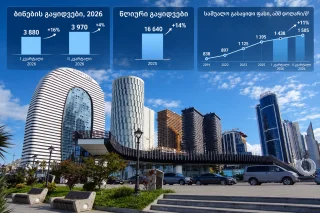 Apartment Sales in Batumi Rose by 16% in Q1 and 4% in Q2
UK Grid Charges Could Rise 25% for Offices
UK distribution network charges are projected to rise unevenly across property types. Savills Earth research dated 21 October 2026 estimates DUoS charge increases between 2020/21 and 2027/28 of 25% for offices, 12% for residential properties and 11% for industrial buildings. These are the network-use component of electricity costs, not projected increases in total energy bills.
Why networks cost more despite lower electricity distribution
From 2015 to 2025, Britain's local distribution network length increased by 3%, or approximately 23,000 kilometres, while the amount of electricity distributed through the system fell by 11%, equivalent to some 33,000 GWh. Savills estimates £5.8 billion was spent operating and developing these networks in 2025, 22% above the level a decade earlier.
Distribution Use of System charges, known as DUoS, recover the cost of maintaining and upgrading local electricity networks from their users. When more infrastructure investment is recovered over fewer units of electricity, the charge per unit can rise. This feeds into property operating costs even where the lease terms and property itself remain unchanged.
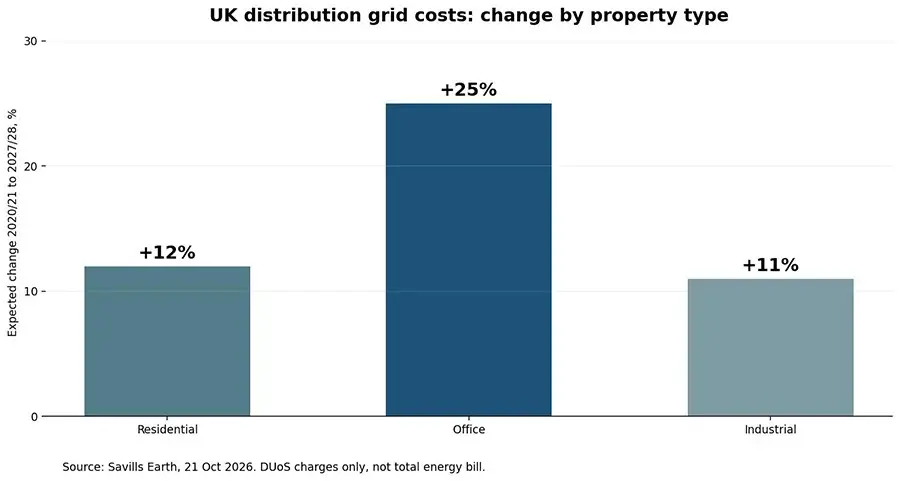
Savills Earth projections for DUoS changes, 2020/21–2027/28: residential +12%, offices +25%, industrial +11%. Not overall electricity bill inflation.
The scale of the cost difference
In Savills' illustrative modelling, average annual DUoS charges could reach around £277 for a home, £16,000 for an office and £128,000 for an industrial property in 2027/28. Those are not standard tariffs for every building: electricity demand, property scale, local network operator and connection arrangements all affect the outcome.
Regional differences are especially wide. For a model industrial property in the SP Manweb network area, the increase across the period could amount to £93,000 annually, while the equivalent in SSEN Scotland could see charges fall by £52,000. Comparisons must therefore match building type and consumption before attributing value differences to location.
Powered land becomes a different investment product
Network charges are only part of the equation for developers. A project may require expensive substation reinforcements or face long connection queues before it can secure the needed power. A larger, cheaper plot may consequently be less practical than a smaller site with deliverable grid capacity. This is particularly relevant to data centres, logistics facilities and heavily electrified commercial buildings.
International Investment's earlier analysis of AI power demand in European data centres explored the growing scarcity of suitable connected sites. The latest Savills research adds a direct operating-cost and regional network-pricing dimension to that discussion, extending the relevance well beyond computing facilities.
What changes after 2028
Regulator Ofgem is preparing the ED3 distribution network price-control period for 2028–2033. Under the planning approach described by Savills, network operators are expected to use spatial forecasts of electricity demand and generation in their investment proposals, reducing reliance on a solely reactive first-come, first-served expansion model.
For property investors, early diligence on network geography, future capital spending and connection timetables could become more important to land valuation. Electricity costs and access to power already feature in broader infrastructure research; International Investment's UBS coverage traced how AI-driven demand makes powered land and substations more strategically significant.
Frequently Asked Questions (FAQ)
Are UK office energy bills going up 25%? Savills forecasts a 25% increase in DUoS network charges over 2020/21–2027/28, not a 25% increase in total electricity bills.
What are DUoS charges? Fees paid through electricity tariffs to maintain and develop local distribution networks.
Why do charges vary by region? Each local network operator faces different infrastructure requirements and operating costs.
Does this make every industrial property more expensive? No. The impact depends on the network area, site demand and connection arrangements.