

Domestic Tourism Spending in Georgia Up 11.5%, Trips Rise 5.5%: Geostat Data

According to the National Statistics Office of Georgia, both the number of domestic visitors and the volume of visits made by them increased in the III quarter of 2026. At the same time, the average monthly expenditure of resident tourists inside the country amounted to 445.4 million GEL, which is 11.5% more compared to the same period last year. The data indicates that alongside the expansion of the domestic tourism market, spending per trip is also rising, with food, shopping, and transport accounting for the main share of total expenditures.
Number of Domestic Trips Growing Faster than Visitor Numbers
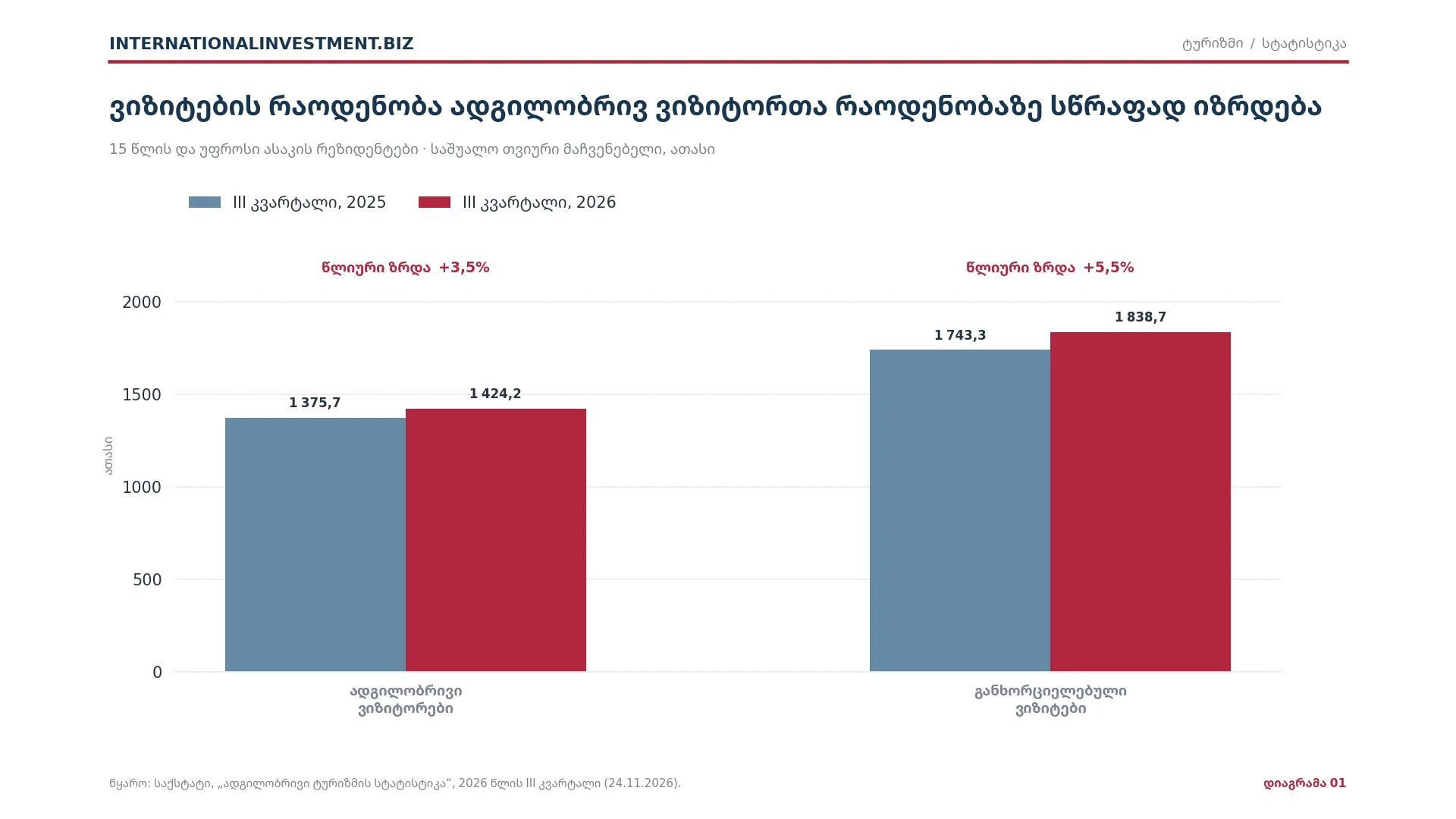
According to the report published by Geostat on 24 November 2026, in the III quarter of this year, the average monthly number of domestic visitors aged 15 and older in Georgia was 1.424 million, which is 3.5% higher than in the same period last year. Over the same period, the average monthly number of visits reached 1.839 million, an increase of 5.5% year-on-year.
A comparison of the data shows that the number of trips is growing at a faster pace than visitor numbers. Accordingly, the expansion of domestic tourism is driven not only by engaging more people, but also by the increased frequency and intensity of trips taken by the same travelers.
The dynamics of tourist and excursion trips also stand out clearly. Specifically, in the III quarter of 2026, the average monthly number of tourist-type trips stood at 856.1 thousand, which is 7% higher than in the same period last year. As for excursion visits, their number rose from 943.4 thousand to 982.6 thousand, equivalent to an increase of about 4.2%.
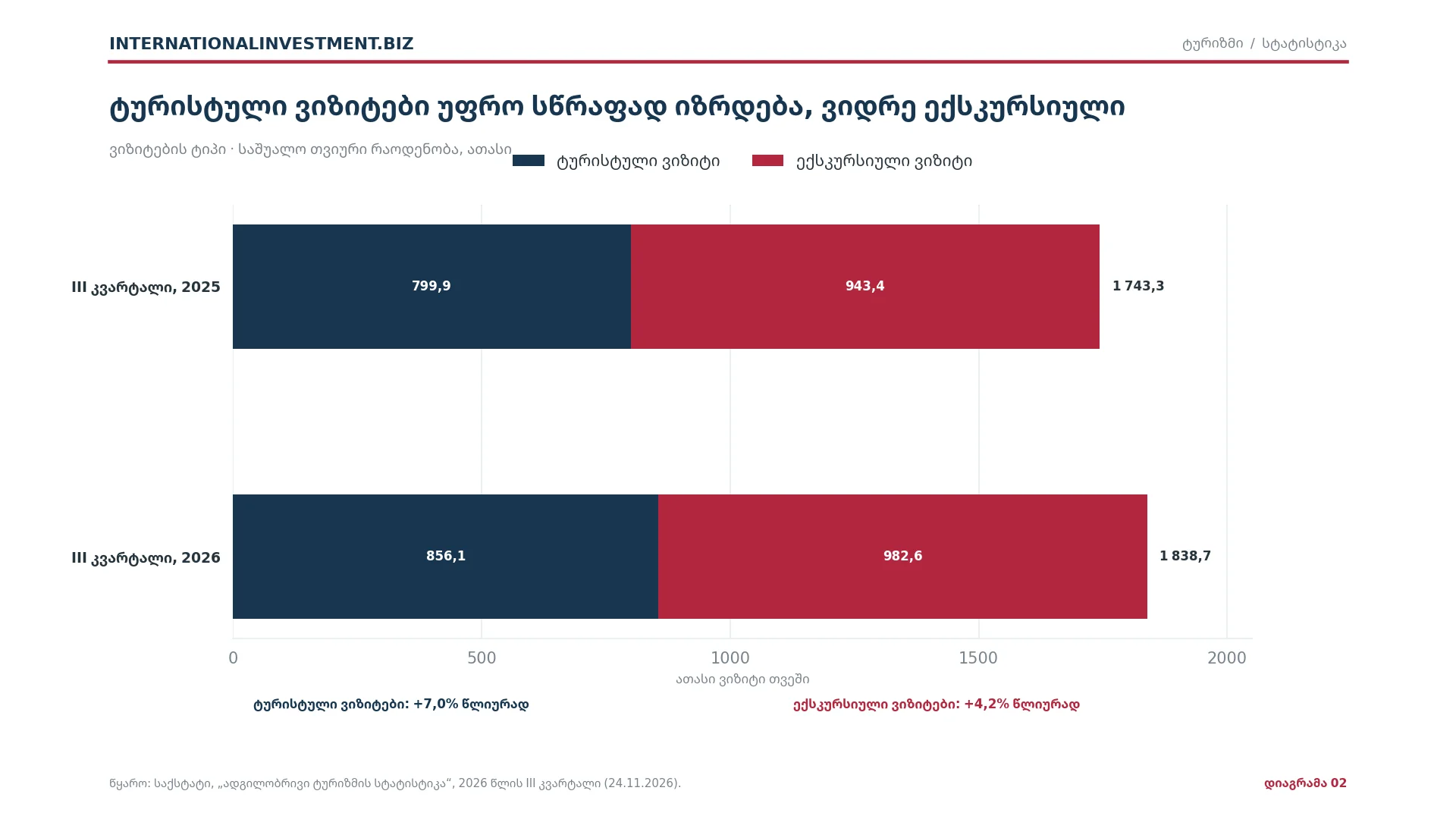
As a result, the share of tourist trips in total visits grew to about 46.6%, while the share of excursion visits declined to 53.4%. For comparison, a year earlier these figures were 45.9% and 54.1%, respectively.
Thus, in the structure of domestic tourism, the share of overnight trips is expanding due to faster growth rates.
Nearly Half of All Trips Involve Visiting Friends and Relatives
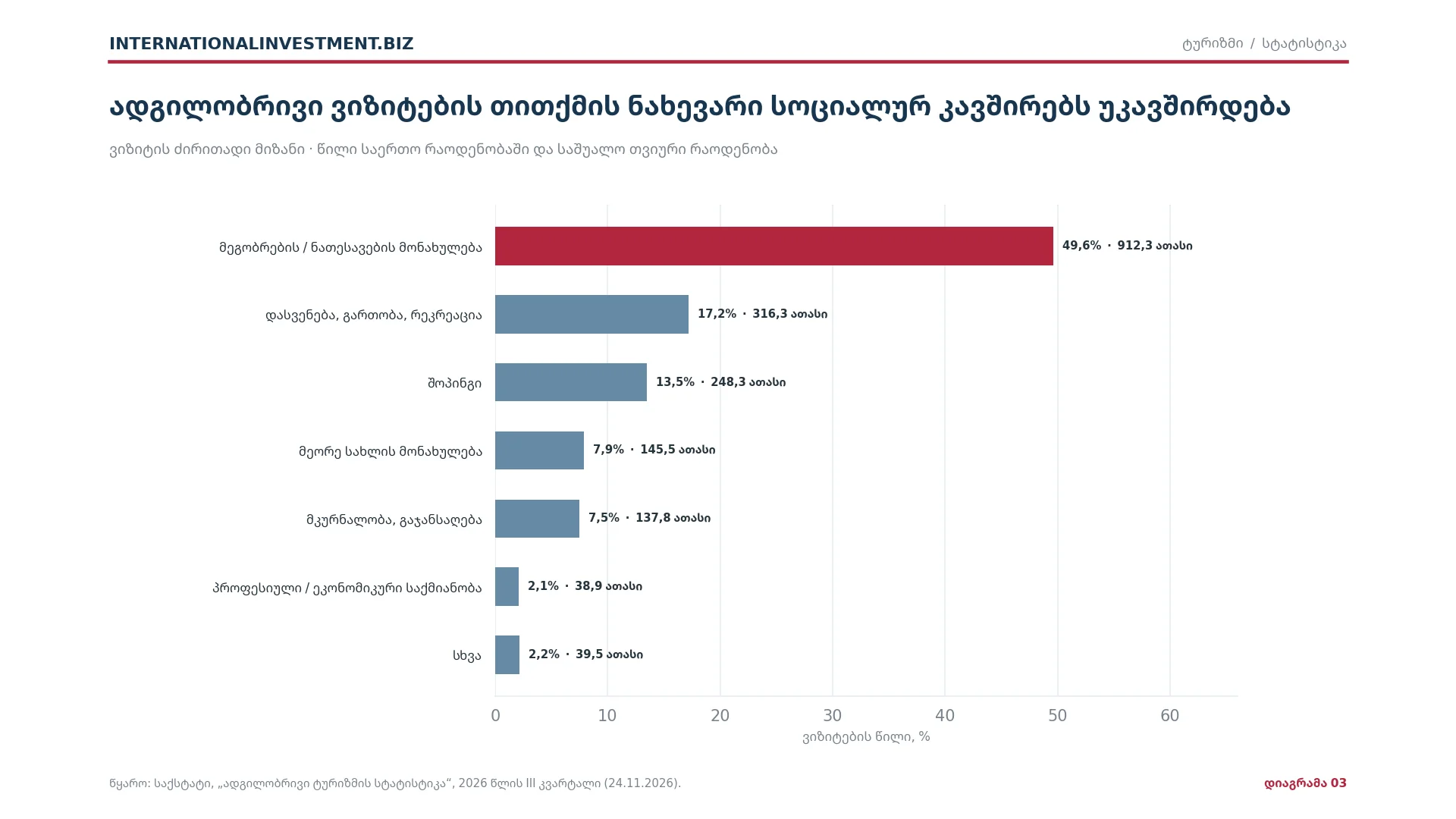
One of the key characteristics of domestic tourism is the purpose-of-visit structure. In the III quarter of 2026, the overwhelming majority of trips—49.6%—were made to visit relatives and friends.
Holiday, leisure, and recreation ranked second with a 17.2% share. Shopping accounted for 13.5% of trips, visiting a second home or dacha 7.9%, health and medical care 7.5%, professional and business activities 2.1%, and other purposes 2.2%.
This distribution demonstrates that social ties remain the primary driver of domestic travel in Georgia, rather than purely leisure or the purchase of commercial travel services. Accordingly, demand for domestic tourism extends far beyond the traditional customer base of hotels and resort complexes.
At the same time, the combined share of recreation, leisure, shopping, and health tourism reaches 38.2%, confirming strong demand across various segments of local tourist services.
Tbilisi, Imereti, and Adjara: Key Destinations for Domestic Trips
Geographically, Tbilisi led among visited regions in the III quarter of 2026, recording an average monthly number of visits of 394.1 thousand.
Imereti took second place with 349.8 thousand monthly trips. The Autonomous Republic of Adjara ranked third.
In the breakdown of trips by region, Tbilisi's share was 21.3%, Imereti's was 18.9%, and Adjara's was 13.1%. Together, these three destinations accounted for 53.3% of all domestic trips.
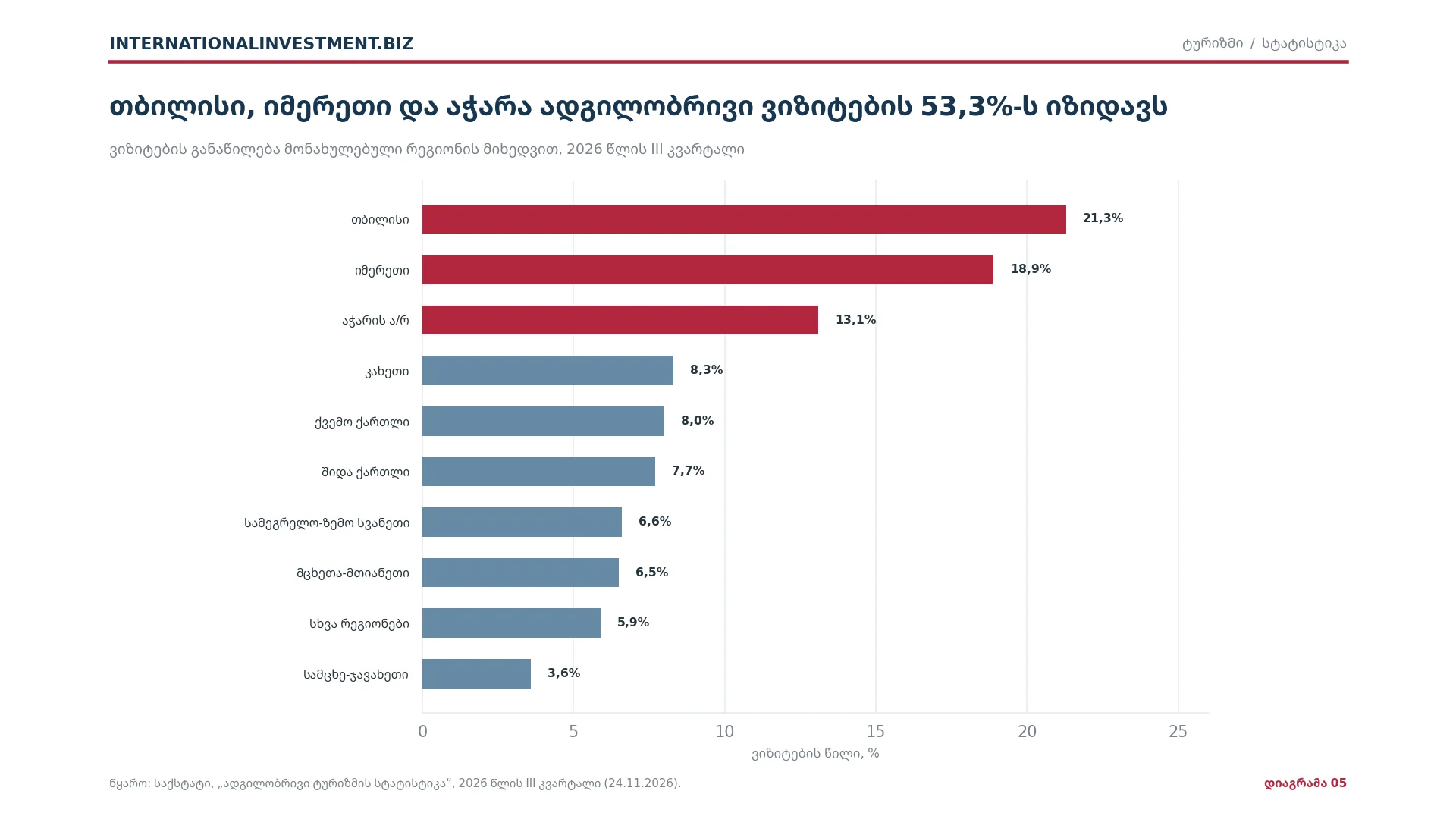
The subsequent spots went to Kakheti—8.3%, Kvemo Kartli—8.0%, Shida Kartli—7.7%, Samegrelo-Zemo Svaneti—6.6%, and Mtskheta-Mtianeti—6.5%. Samtskhe-Javakheti accounted for 3.6%, and other regions for 5.9%.
By region of permanent residence of domestic travelers, the largest share—36.9%—came from residents of Tbilisi. They were followed by Imereti, Racha-Lechkhumi and Kvemo Svaneti (15.9%), Kvemo Kartli (10.1%), and Adjara (7.9%).
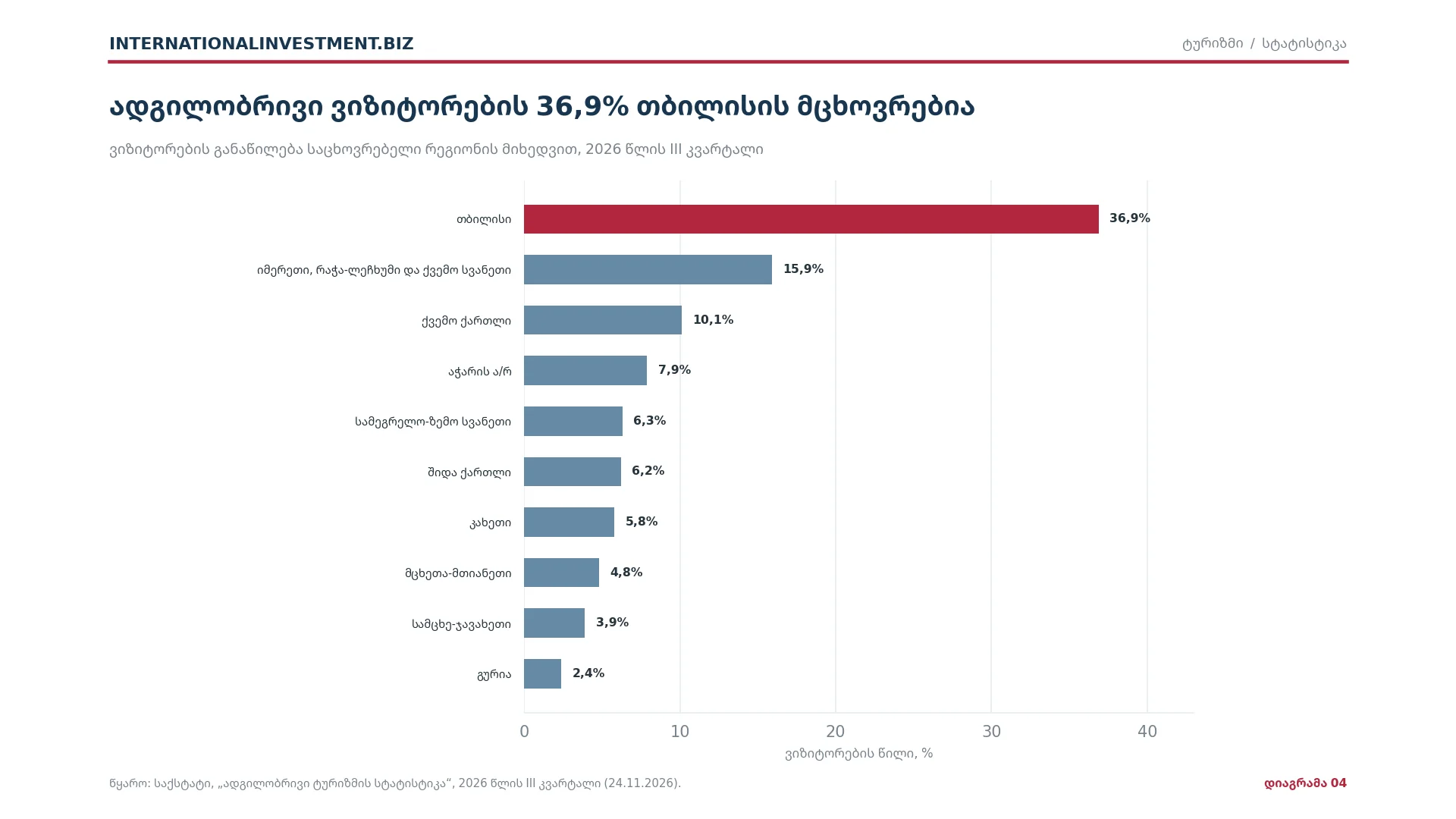
Comparing these figures paints an interesting geographical picture. Tbilisi and Imereti simultaneously act as both the largest generators of tourist flow and primary points of attraction. In Adjara, however, the share of visits substantially exceeds the share of local residents among all travelers, underscoring its key role as a recipient of domestic tourist traffic.
Core Audience of Domestic Tourism: Citizens Aged 31 to 70
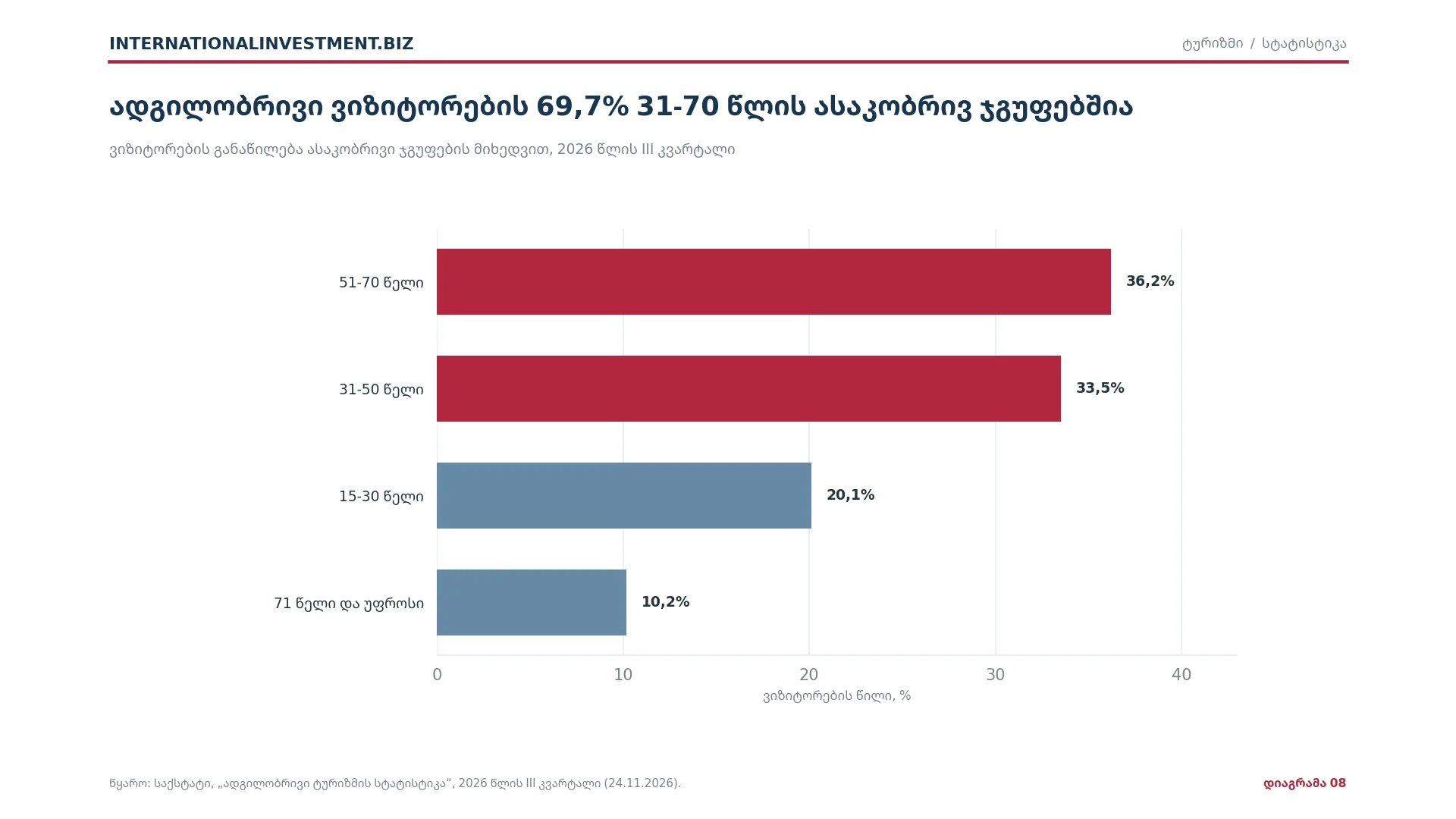
In the age breakdown for the III quarter of 2026, the largest group of visitors consisted of citizens aged 51 to 70 (36.2%). The 31–50 age category accounted for 33.5% of trips, youth aged 15–30 for 20.1%, and the group over 71 years old for 10.2%.
Thus, citizens aged 31 to 70 generated 69.7% of all domestic tourist traffic.
In terms of gender distribution, the share of women was 55.8%, while men accounted for 44.2%.
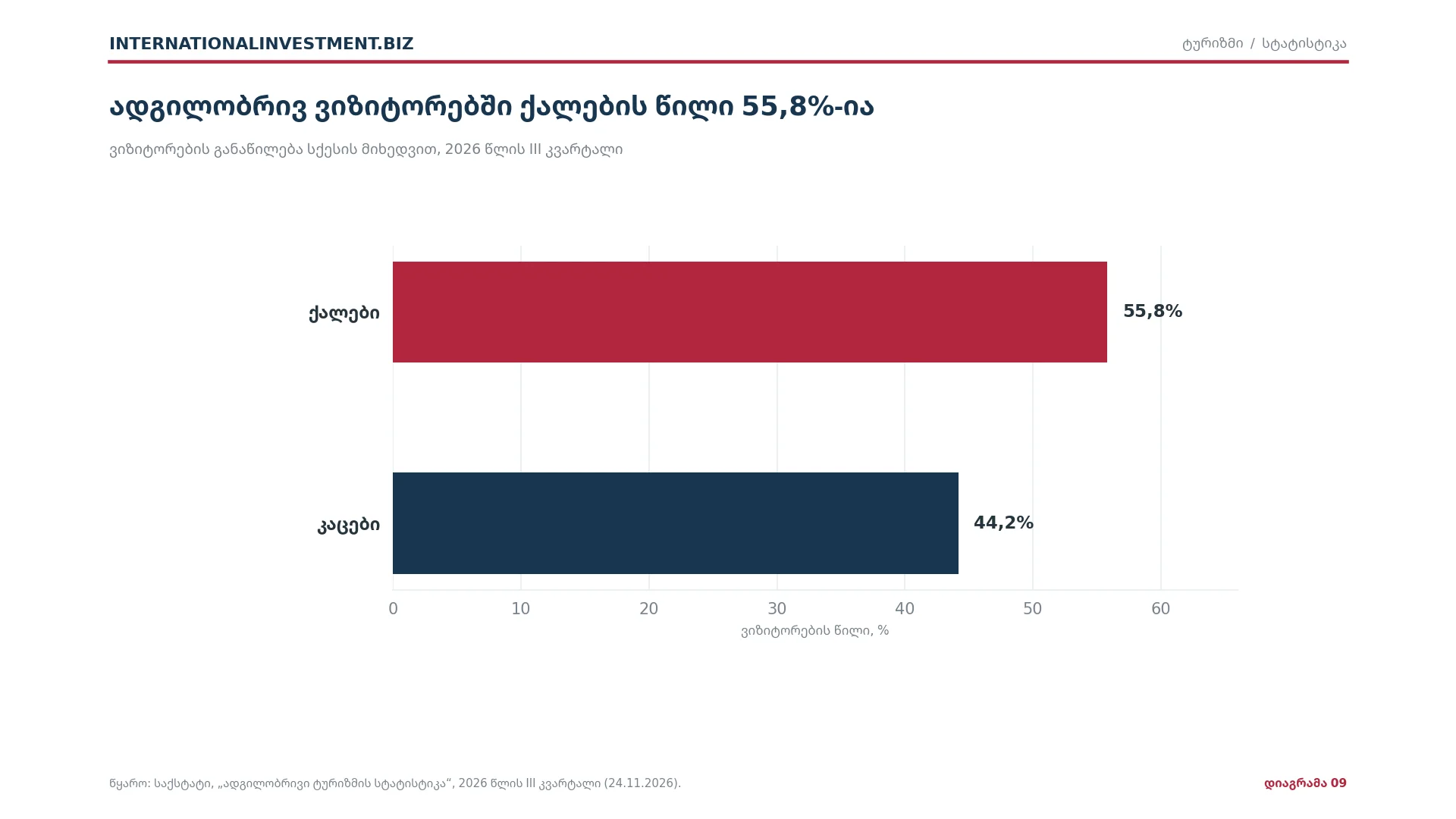
The statistics confirm that the primary consumers of local tourism services are middle-aged and older individuals, with a predominance of women.
Domestic Tourism Expenditure Up 11.5% Year-on-Year
One of the report's most revealing economic indicators is the trend in spending during travel across the country.
According to Geostat, in the III quarter of 2026, the average monthly expenditure of domestic visitors amounted to 445.4 million GEL, which is 11.5% higher than in the same period last year. The average spend per trip increased by 5.7% to reach 242.3 GEL.
This growth is particularly telling when viewed together: the average monthly number of trips increased by 5.5%, and average spending per trip rose by 5.7%, which together formed the total 11.5% expansion in the domestic tourism budget.
This confirms that the rise in total spending was driven not only by expanded traffic, but also by genuine growth in average outlays per trip.
What Do Domestic Tourists Spend the Most On?
Spending on food and drinks dominates the expenditure structure: average monthly spending stood at 133.7 million GEL, or 30% of total expenditure.
Shopping ranked second at 113.3 million GEL (25.4%). Transport expenditures reached 85.2 million GEL (19.1%).
Travelers spent an average of 48.9 million GEL on accommodation (11% of the total budget), 60.5 million GEL on other categories, and 3.8 million GEL on entertainment, wellness, cultural, and sports activities.
In total, travelers allocate 74.5% of all funds to food, shopping, and transport, making these sectors the prime beneficiaries of domestic demand.
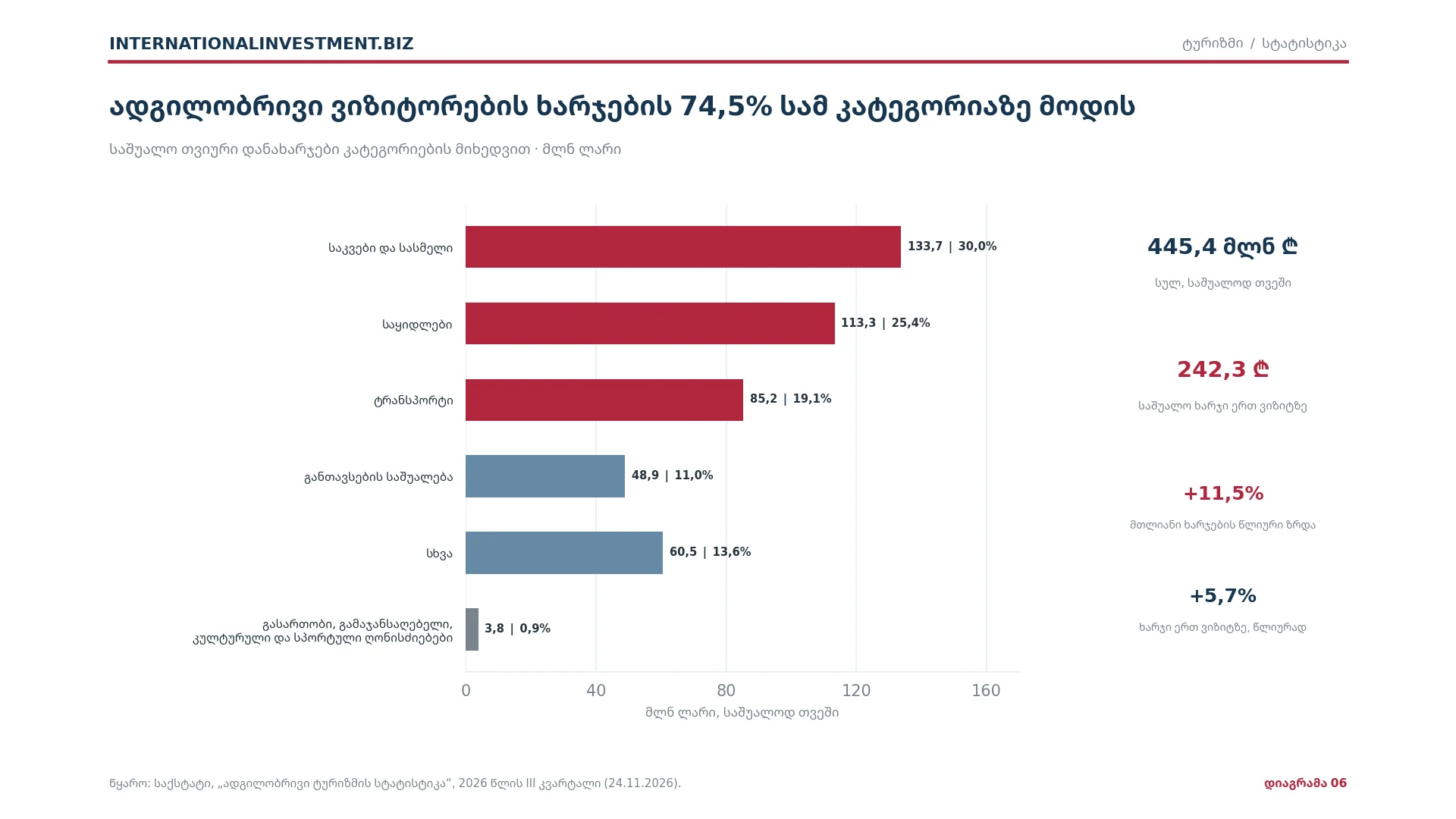
The low share of accommodation expenditure is noteworthy: this is largely explained by the prevalence of trips to visit family and friends, though Geostat does not explicitly establish a direct causal link.
The modest share of spending on cultural and sporting events (0.9%) likewise does not reflect overall market capacity, as it captures only tourists' budgets during domestic travel.
High Level of Satisfaction with Trips
Geostat's survey recorded a positive assessment of travel quality among domestic travelers in the III quarter of 2026.
88.1% of respondents rated their trips positively: 50.6% expressed satisfaction, while 37.5% remained "very satisfied."
A neutral assessment ("neither satisfied nor dissatisfied") was given by 10.7% of respondents. Only 0.3% were dissatisfied, and 0.2% were "very dissatisfied." 0.6% of respondents found it difficult to answer.
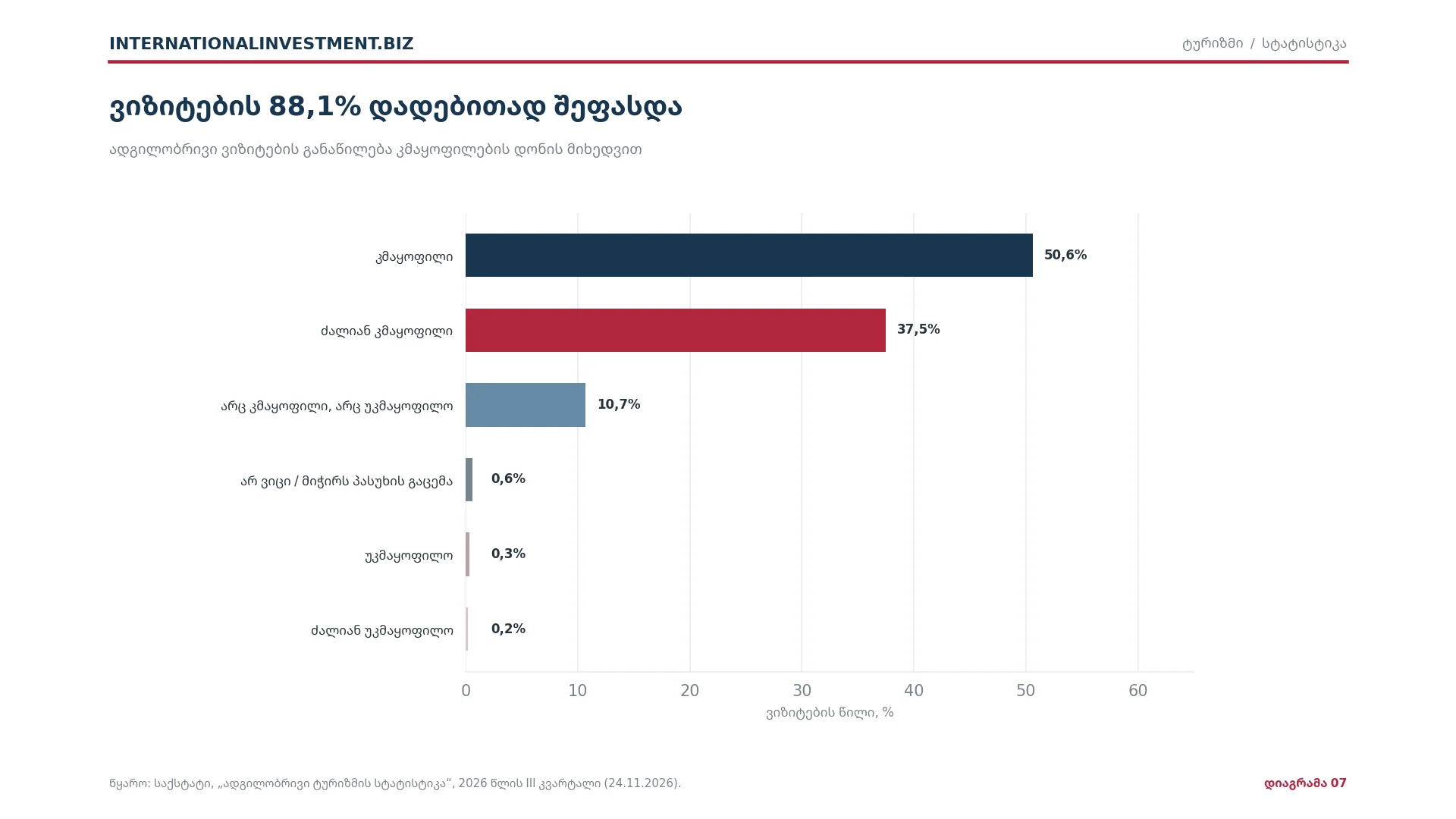
Such a level of loyalty underscores a favorable perception of local travel, although the study does not contain a detailed breakdown of reasons behind potential complaints regarding service.
What Do Local Tourism's Economic Trends Reveal?
The results of the III quarter of 2026 reflect several fundamental trends in the domestic tourism market:
First, growth in the number of trips outpaces the rise in tourist numbers, indicating increased population mobility.
Second, tourist-oriented trips with overnight stays are growing faster than day-trips, strengthening their position in the market structure.
Third, the lion's share of spending goes toward food services, retail, and transport. The economic momentum of tourism extends beyond the classic hospitality sector, stimulating adjacent service and retail industries.
The 11.5% increase in spending confirms the enduring role of domestic tourism as a vital source of effective demand for Georgia's economy.
At the same time, this figure is nominal, and statistics do not provide inflation-adjusted data, precluding a direct equivalence between spending growth and an absolute physical expansion in service consumption.
Overall, the results of the III quarter of 2026 demonstrate qualitative growth in Georgia's domestic tourism. Higher mobility of citizens, an increasing share of overnight trips, and higher average spending underscore the substantial economic potential of the local tourism market.
Source: National Statistics Office of Georgia — "Domestic Tourism Statistics (III Quarter 2026)", 24 November 2026
Planning to buy property abroad?
Discuss the country, budget and goals with a consultant.