


Tourism Investment in 2026: Hotels, Aviation and Travel Tech
In October 2026, Skift tracked 59 developments related to investment in tourism. Hotel owners sold properties to reduce debt, aircraft lessors ordered planes, and startups sought funding. These decisions reflect different priorities across the industry. Not every announcement represents an investment already completed: some transactions and payments are still pending.
Hotels: asset sales rather than construction
United States, Europe and Asia-Pacific: investment trends
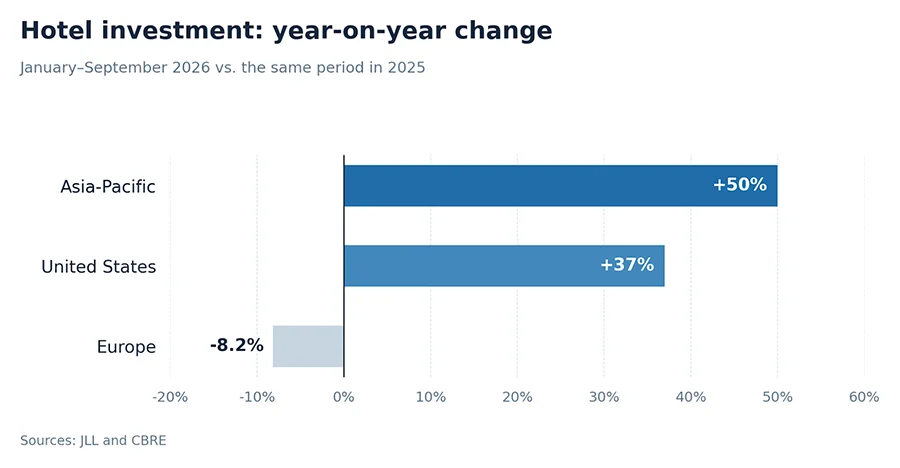
From January through September 2026, hotel investment in the United States reached $22.2 billion, up 37% from the same period a year earlier, according to JLL. The number of transactions increased by 58% to 928. Acquisitions of individual properties accounted for $20.4 billion (+50%).
According to CBRE, the volume of hotel transactions in Europe declined by 8%, from €17.1 billion in January–September 2025 to €15.7 billion in the same period of 2026. JLL recorded a 50% increase in the Asia-Pacific region, to $12 billion. Because the methodologies differ, these figures cannot be combined.
Asset sales and acquisitions
Hotel deals announced in October served different purposes. Some owners sought to reduce their financial burden, while others bought existing properties and entire chains to expand their businesses. Some announcements concerned agreements that had only been signed: the transfer of ownership and final payments were expected later.
Pandox agreed to sell seven hotels in Sweden and Denmark for SEK 2.1 billion. The portfolio comprises 1,248 rooms and generated annual net operating income of approximately SEK 130 million. The agreed price exceeds the properties' book value. The company intends to use the proceeds to reduce debt, with both transactions expected to close in the fourth quarter of 2026.
In Hong Kong, managers sought buyers for two Shimao hotels, while in India some ownership transfers took place through insolvency proceedings. These cases were linked to debt problems and differ from voluntary portfolio expansion.
Endeavor acquired seven hotels near Chicago Midway Airport, comprising a total of 1,057 rooms. According to RLJ Lodging Trust, the price was $110 million. The seller received $90 million at closing and provided the buyer with a further $20 million in financing. The transfer of ownership was completed on October 8, 2026.
Sunday PropTech signed an agreement to acquire Fletcher, a chain of around 170 hotels. Such an acquisition offers access to new markets without waiting for construction to be completed, but it calls for advance assessment of financial liabilities, occupancy and future refurbishment costs.
Aviation: fleet renewal
Major aviation investments are planned years ahead. Aircraft lessor Avolon announced orders for 250 Boeing and Airbus planes, while Aviation Capital Group ordered a further 75 A320neo-family aircraft. Together, the two agreements cover 325 planes.
Avolon also secured options for another 100 aircraft. Aviation Capital Group expects deliveries under its agreement between 2032 and 2035. The long lead times reflect manufacturers' production schedules. Signing these agreements does not mean the companies have already paid the full cost of the aircraft ordered.
Leasing aircraft provides lessors with income that is not directly tied to ticket sales. Returns depend on lease terms, the technical condition of the fleet and aircraft residual values. Airlines face a different set of risks, including passenger loads, fuel costs and day-to-day operations.
Southwest, IndiGo and Allegiant were among the airlines raising capital. The funds can support fleet renewal and the fulfilment of existing obligations. The financial outcome will depend on interest rates, passenger demand and delivery schedules.
Aircraft maintenance is another area attracting investment. AAR increased its credit facility from $825 million to $1.375 billion as it prepared to acquire a controlling stake in MRO Holdings, an aircraft maintenance company. The available credit limit should not be treated as money already spent.
Travel tech: fewer venture funding rounds
There were 17 venture funding rounds in travel tech during October. The sector includes technology for bookings, trip planning and hotel management. In ten cases, investments were no more than $5 million, representing almost 59% of all rounds. Only a handful of companies attracted larger sums.
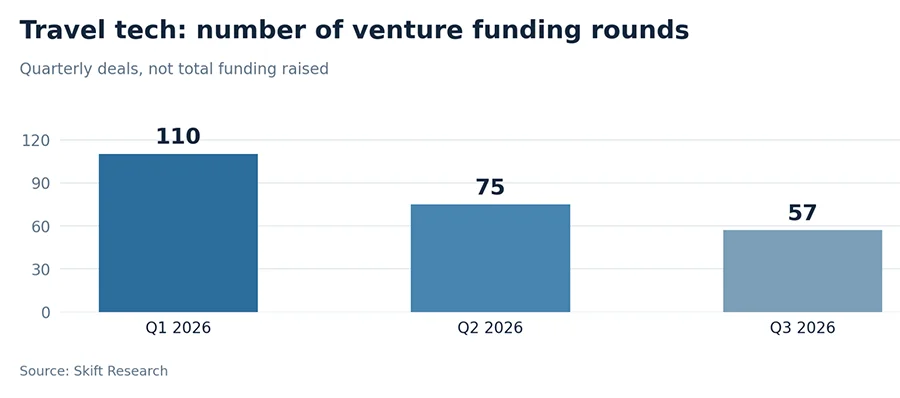
According to Skift Research, funding for travel startups declined throughout 2026. There were 110 venture rounds in the first quarter, 75 in the second and 57 in the third. The number of rounds fell by almost half over six months.
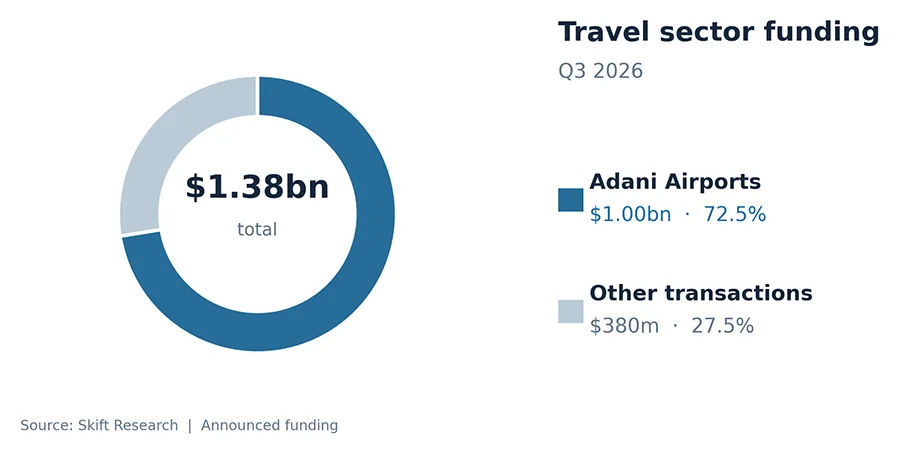
In the third quarter, Skift recorded $1.38 billion in funding for the travel sector. Of that amount, $1 billion related to a single Adani Airports announcement, with approximately $380 million linked to other transactions. This concentration explains why a large headline total does not necessarily signal a recovery in venture market activity.
Only 12 rounds were recorded in artificial intelligence, compared with 25 in the previous three months. Investors are looking at booking, guest communication and pricing tools that can influence hotels' costs and revenues. Booking Holdings announced plans to invest up to $100 million in the AI venture Vayo, while Duetto acquired FLYR's specialist business unit. These are different forms of capital deployment: the first remains a financing plan, while the second is an acquisition of an existing operation.
Georgia: resorts and airports
Tourism demand and hotel projects
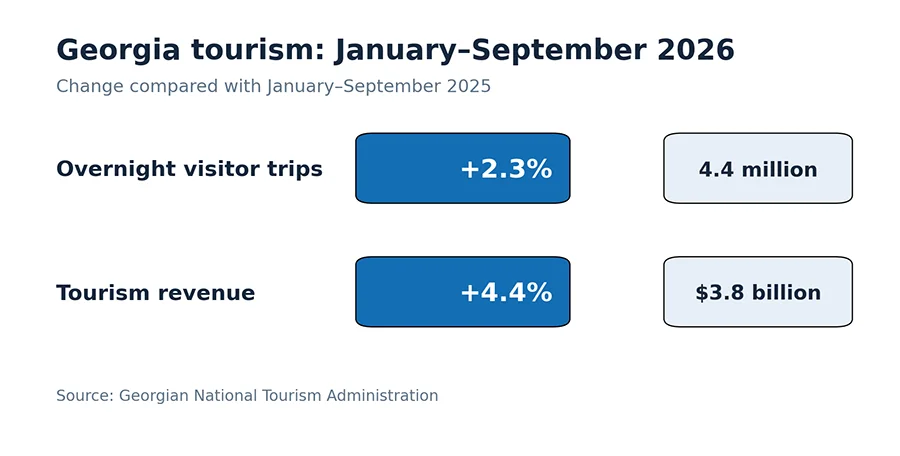
From January through September 2026, foreign visitors made 4.4 million overnight trips to Georgia, 2.3% more than during the same period of 2025. According to the Georgian National Tourism Administration, tourism revenue rose by 4.4% to $3.8 billion.
In Gonio, developer European Village is building Wyndham Grand Batumi Gonio, which brings together five hotel projects: Aqua, Family Club, Riviera, Villas and Sky Castle. The development includes hotel rooms, villas and townhouses. More than 100 amenities are planned across a 27,115 sq. m site, including restaurants, swimming pools and spas. International operator Aimbridge Hospitality has been engaged to manage some of the hotels.
International operators give resorts access to booking systems, loyalty programmes and service standards. This helps broaden the customer base and reduces reliance on individual sales channels. However, affiliation with a well-known chain does not in itself guarantee owners high profits.
According to TBC Capital, the average occupancy rate at branded hotels in Georgia was 65% in January–September 2026, three percentage points higher than in the same period of 2025. The average room rate rose by 14% to $154 per night.
Transport infrastructure
Georgia's airports are also receiving investment. In Tbilisi, TAV Airports plans to invest around $150 million to expand the terminal and increase annual capacity to 10 million passengers. A new runway and related infrastructure costing GEL 240 million will be built in Kutaisi. Batumi has a plan to enlarge the existing terminal and construct a new building. Separately, preparations are under way for a new international airport project in Vaziani; its cost estimate remains preliminary, and the timetable depends on design decisions.
Georgia's airports: investment and project details
|
Airport |
Investment |
Project and timetable |
|
Tbilisi |
More than $150m |
Terminal +19,500 sq. m; up to 10m passengers a year by 2028 |
|
Kutaisi |
GEL 240m |
New 3.5 km runway; construction under way |
|
Batumi |
About $5m |
Terminal +1,000 sq. m; capacity +22–25%; works under way |
|
Vaziani |
Approx. $1.3bn (estimate) |
New airport for up to 20m passengers a year; project preparation stage |
Expanded air connectivity could bring more visitors to both established hotels and new resort developments. However, projected airport capacity does not automatically translate into additional tourist trips: route networks, aircraft load factors and seasonality also matter.
What this means for investors
The global tourism investment market is developing unevenly in 2026. Hotel transaction volumes are rising in the United States and Asia-Pacific, while Europe shows more restrained activity. Interest in existing hotels remains strong: acquiring an operating property can provide income from an established business, while asset sales help companies reduce debt and reallocate capital.
In aviation, long-term decisions focus on fleet renewal and expanding carriers' capabilities. The decline in venture funding rounds points to tougher requirements concerning the commercial potential of new technologies.
International Investment analysts note that hotels remain one of the most attractive areas for investors. Properties operated under international brands are of particular interest. Established booking systems, loyalty programmes and brand recognition provide access to a broad customer base. Professional management supports stable occupancy, effective cost control and stronger profitability. Together, these factors reinforce the sector's appeal as a long-term investment.
FAQ: tourism investment in 2026
Where is tourism investment going in 2026?
Capital is flowing into hotels, aviation and travel technology: investors are buying operating properties, developing new resorts, ordering aircraft and financing digital services.
Why are investors buying existing hotels?
An operating business provides entry into a market without waiting for new construction. Buyers should assess debt, occupancy and refurbishment costs before making a purchase.
How does an international brand affect hotel profitability?
Booking systems and loyalty programmes help attract guests and maintain occupancy. Final profits also depend on operating expenses and the management agreement.
Planning to buy property abroad?
Discuss the country, budget and goals with a consultant.