







 Tbilisi Residential Real Estate Market: Prices, Rentals, and Investment Yields
 Investment in Albania: Growth and Risks
 Rule of Law: Fresh Data Shows Georgia Ahead of Albania, Moldova, and Ukraine
 Turkey Lowers Cap on Residential Rent Increases
 Tskhaltubo Needs a New Strategy to Attract Tourists as Visitor Numbers Decline
 Maldives Introduces Email Verification for Tourists
Number of Ukrainians Under Temporary Protection in the EU Falls
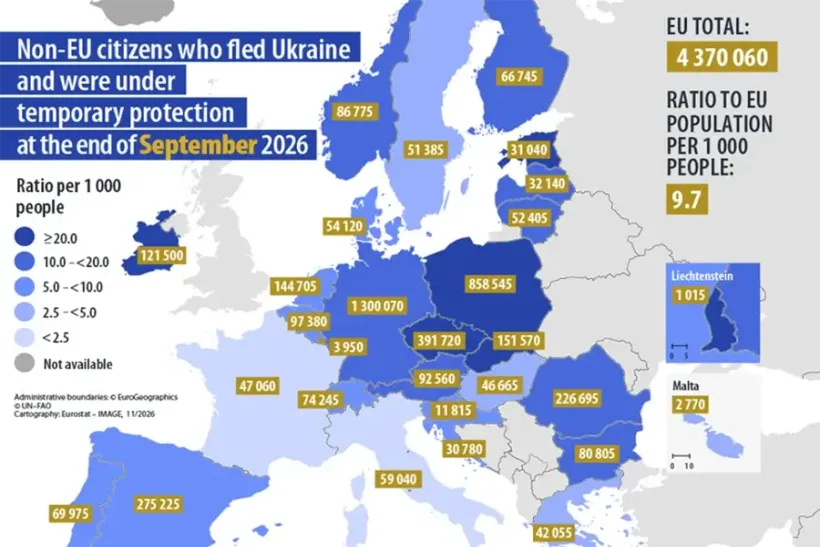
In September 2026, the number of Ukrainians under temporary protection in the EU fell by more than 61,000 to 4.37 million. The sharpest decline was recorded in Poland, where the change was largely linked to people switching to other residence permits. Meanwhile, the number of beneficiaries increased in the other 25 member states, according to Eurostat.
Poland: Reasons for the Sharp Decline
By the end of September, 858,545 Ukrainians held temporary protection in Poland — 80,850 (8.6%) fewer than a month earlier. The country accounted for 19.6% of all beneficiaries in the EU. It recorded the sharpest decline among member states.
The main reasons were the issuance of regular residence permits and the removal of outdated entries from government registers. Some Ukrainians changed the legal basis of their stay and remained in Poland, although they were no longer included in temporary protection statistics. The number of registrations removed for each reason was not specified.
Since May 4, 2026, Poland has offered a procedure for obtaining a three-year CUKR card. It is intended for temporary protection beneficiaries who meet the eligibility requirements. The document allows holders to work without an additional permit and to run a business. Applications are submitted online via the MOS portal. Once the card is issued, the previous status ends and the holder is no longer counted among temporary protection beneficiaries.
Germany, the Czech Republic and Other EU Countries
Germany has the EU’s largest population of Ukrainians under temporary protection. At the end of September, 1,300,070 beneficiaries were registered there, accounting for 29.7% of the EU total. The figure rose by 5,515 (0.4%) during the month, the largest increase in absolute terms.
The Czech Republic ranked third, with 391,720 people holding the status, or 9% of the EU total. The figure fell by 6,640 (1.7%) in September. However, the country led in the number of beneficiaries relative to its population, at 35.9 per 1,000 residents. Slovakia (28) and Cyprus (27.4) followed, compared with an EU average of 9.7.
In Romania, the figure rose by 3,900 (1.8%) in September, while Italy recorded an increase of 2,505 (4.4%). Other member states also reported growth, but this was not enough to offset the decline in the two main countries. As a result, the EU total decreased.
|
Country |
September 2026 |
Monthly change |
|
Germany |
1,300,070 |
+5,515 (+0.4%) |
|
Poland |
858,545 |
−80,850 (−8.6%) |
|
Czech Republic |
391,720 |
−6,640 (−1.7%) |
|
Romania |
226,695 |
+3,900 (+1.8%) |
|
Italy |
59,040 |
+2,505 (+4.4%) |
Who Receives Temporary Protection in the EU
At the end of September 2026, Ukrainian nationals accounted for 98.5% of all temporary protection beneficiaries in the European Union. The remaining 1.5% were nationals of other countries who had also fled Ukraine because of the war. The largest groups among them were citizens of Russia (11,785), Nigeria (4,710) and Azerbaijan (4,430).
Adult women were the largest group, making up 44.1% of all registered beneficiaries. More than half of them (51.4%) were aged 35–64. Minors accounted for 28%, while adult men represented 27.9%. Boys made up a slightly larger share than girls, at 14.8% versus 13.2% of the total.
Compared with August, the share of children and adolescents fell from 29.1% to 28%. Among adults, the pattern was reversed: the proportion of women rose from 43.6% to 44.1%, and that of men from 27.3% to 27.9%. The distribution thus shifted slightly towards older age groups over the month, although minors still represented more than a quarter of all registered beneficiaries.
|
Category |
August 2026 |
September 2026 |
|
Adult women |
43.6% |
44.1% |
|
Adult men |
27.3% |
27.9% |
|
Minors |
29.1% |
28.0% |
New Temporary Protection Decisions
In September 2026, EU countries issued 46,610 new decisions granting temporary protection, up 4,255, or 10%, from August. The figure rose in 17 member states and fell in ten. Romania (+2,045), Germany (+1,460) and Slovakia (+1,040) recorded the largest increases. The sharpest declines were in Poland (–1,570), Portugal (–645) and Finland (–405).
Across the third quarter, 144,910 positive decisions were issued — 4,415, or 3%, fewer than in April–June. The figures rose in 18 countries and fell in nine. The overall decrease reflected sharper reductions in the number of approvals in individual member states.
Since March 2022, approximately 7.3 million positive decisions granting temporary protection have been issued in the EU. There were 794,845 in 2024 and 683,645 (–14%) in 2025. The cumulative figure includes all grants over the period, rather than the number of active registrations on a particular date.
Temporary Protection Extended Until 2028
In July 2026, the Council of the EU agreed to extend temporary protection for refugees from Ukraine until March 4, 2028. The mechanism provides the right to reside and work, access to healthcare and social support, and education for children, without an individual asylum application process.
At the same time, EU countries agreed to take compliance with military obligations to Ukraine into account when assessing new applications. Applicants will be required to provide evidence that they meet the relevant requirements or are exempt. The changes do not apply to people already benefiting from temporary protection.
Back in September 2025, the Council of the EU adopted recommendations for a gradual transition to other types of residence permits. Ukrainians will be able to apply for national permits based on employment, business activity, education or family circumstances. Requirements are determined by each host country’s laws, and permanent residence is not granted automatically.
European authorities are also developing mechanisms to support voluntary returns and reintegration in Ukraine once conditions allow people to return safely. The recommendations include information support, exploratory visits and special assistance programmes.
Trends and Outlook
International Investment analysts note that the decline in the number of Ukrainians under temporary protection does not indicate a mass departure from the European Union. Much of the reduction stems from changes in Poland’s migration records, while figures continue to rise in most other countries. At the same time, the influx of new arrivals is gradually slowing, and the nature of their stay in Europe is changing.
EU countries are gradually tightening admission conditions and scaling back social assistance. Support for Ukrainian refugees is becoming more targeted, with priority given to vulnerable groups. Temporary protection was introduced as an emergency measure, but the fighting has continued for almost five years, putting greater strain on host-country budgets.
Major policy changes are unlikely before the conflict is resolved. The latest talks on Ukraine in Abu Dhabi ended without a breakthrough on key issues, although diplomatic contacts are continuing. With the prospects for a peace agreement still uncertain, the EU will have to maintain its protection mechanisms and adapt them to the prolonged stay of displaced people.
Even an end to the fighting is unlikely to bring about a mass return. Over the years, many Ukrainians have found jobs, learned the local language and settled in other countries, and some may prefer to stay. Future migration trends will depend on Ukraine’s reconstruction and opportunities for long-term residence in Europe.