







read also
 Vietnam Mortgage Surge Pushes Homes Out of Reach
 Lithuanian Apartment Prices Accelerate Across Major Cities
 London Flats Lose Value Ahead of Leasehold Reform
 Construction of the Batumi–Sarpi Highway Begins in Georgia
 Baltic Property Investment Accelerates in 2026
 Hong Kong and Singapore Renew Their Expat Rivalry
Housing Market and Prices in Israel: the Correction Will Continue in 2026
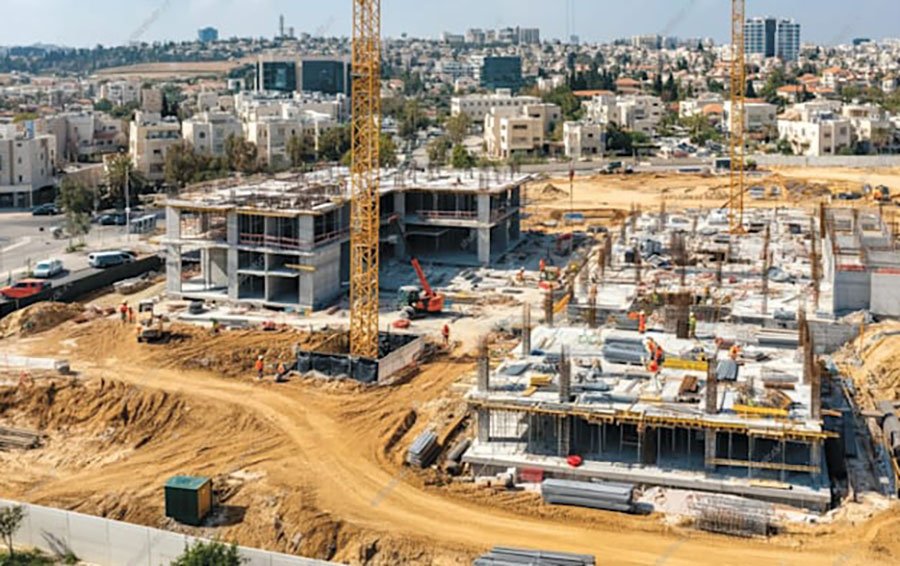
Photo: Globes
Israel’s residential real estate market in 2025 came under pressure from record-high supply, weakened demand, and tighter regulation. Prices have been falling for eight consecutive months, and analysts at Globes see no signs of a trend reversal, forecasting a further correction.
A turning point for Israel’s residential property market in 2025 was the Bank of Israel’s decision in March to restrict 20–80 and 10–90 deals, under which buyers paid a minimal down payment while the bulk of the price was settled upon completion. In previous years, these schemes had actively supported demand, primarily from first-time buyers, allowing them to enter transactions with minimal equity. After the restrictions were introduced, the market faced tighter financing conditions and transaction volumes began to decline. Demand became more cautious and more price-sensitive, allowing the real state of the market to emerge without artificial support from deferred payments and quasi-credit mechanisms.
September slowdown
Israel’s Ministry of Finance reported that in September 2025 a total of 6,925 apartments were purchased, including homes sold under government discount programs. This was 17% less than in September 2024 and 9% less than in August. Excluding subsidized transactions, the decline was even sharper: 6,048 apartments, representing a 19% year-on-year drop. Demand in the open market is falling faster than in the secondary housing segment, which remains weak but shows relatively greater resilience.
The most pronounced decline was recorded in the primary market. In September, developers sold 2,671 apartments, including subsidized units, which is 25% fewer than in September 2024 and 16% fewer than in August. Considering only open-market transactions, sales of new apartments fell to 1,794 units, a year-on-year decline of 35%. The situation was partly cushioned by large-scale purchases of projects intended for long-term rental.
The share of transactions at the project planning stage fell to 57%, down seven percentage points from the previous month and five points below the level of September 2024. The regional picture remains uneven: the sharpest decline in this indicator was recorded in the Netanya area, while in Tel Aviv, by contrast, the share of such transactions increased.
Against this backdrop, developers continued to expand financial incentives. After a temporary decline in August, September saw a renewed increase in the share of offers featuring payment deferrals, preferential financing schemes, and other bonuses. In five key regions, their share rose to 31%, up from 27% a month earlier. However, the expansion of financial incentives did not lead to a recovery in demand. In cities where such measures intensified most noticeably — including Netivot, Lod, Ramat Gan, Acre, and Kiryat Gat — the number of transactions continued to decline, and in some cases the drop was particularly steep.
Weak sales and developers’ responses
Amid weakening demand, supply continued to grow. According to the Central Bureau of Statistics, by October 2025 the number of unsold apartments reached 83,577 units. Despite a slight decrease compared with the previous month, this figure remains a record for the Israeli market and reflects the scale of the accumulated imbalance.
At the same time, there has been an increase in construction starts and building permits compared with 2024. This means that even as sales slow, the market enters 2026 with a substantial pipeline of new supply, complicating the absorption of already completed housing and increasing downward pressure on prices.
In these conditions, developers in 2025 began actively adapting their sales models. Instead of direct price cuts, the market saw a growing number of financial campaigns aimed at reducing the initial burden on buyers and spreading payments over time.
For example, Rotshtein Real Estate launched a campaign allowing buyers to defer mortgage payments for up to six years from the date of contract signing. Av-Gad introduced trade-in programs, enabling buyers to exchange an existing apartment for a new one, targeting those unwilling to enter the market without first securing the sale of their current property. Aura, in turn, introduced an “apartment with protection” model, allowing buyers to cancel the contract six months before moving in if market prices decline.
These measures did not lead to a noticeable reduction in the stock of unsold apartments. Financial campaigns helped sustain interest among certain buyer groups but did not alter the overall balance between supply and demand, which continued to shift in favor of sellers.
Prices and mortgages
The imbalance between supply and demand directly affected price dynamics. In November, the housing price index recorded its eighth consecutive monthly decline — the longest downward streak since March–October 2023. The cumulative decline over this period amounted to 2.6%, and nearly 4% year-on-year. A similar trend was observed in the new-build segment: prices of new apartments in the open market fell for the sixth consecutive month, losing 1.8%, or about 3.5% year-on-year.
The rise in the Bank of Israel’s key interest rate, which began in 2022, led to a significant increase in monthly mortgage payments. In 2025, the average household payment rose by more than 1,000 shekels ($312), noticeably undermining payment discipline. As a result, between August and October the volume of overdue mortgage debt exceeded 4 billion shekels ($1.24 billion), setting a new record. In response, buyers began reassessing their borrowing structures, moving away from index-linked fixed rates toward fixed, non-linked products in an effort to reduce inflation-related risks.
Outlook for 2026
Against the backdrop of current dynamics, analysts are forming cautious expectations for 2026. Meitav chief economist Alex Zabezhinsky notes that the combination of high construction volumes and record levels of unsold housing looks atypical. In his view, with excess supply persisting, developers will be forced to slow the pace of new project launches in order to gradually narrow the gap between supply and demand.
Phoenix chief economist Matan Shitrit holds a similar view, arguing that even the expected decline in interest rates is unlikely to significantly revive the housing market. Weak demand and elevated supply levels, in his assessment, create conditions for a further price decline of 6–8% over a one-year horizon.
Avi Yusupov, Deputy Chairman of the Israeli Mortgage Advisors Association, notes that as interest rates ease in 2026, demand will increasingly concentrate on fixed-rate, non-index-linked mortgage products, as well as loans tied to the prime rate. At the same time, he emphasizes that changes in borrowing structures alone do not imply a sharp expansion in demand, as households remain cautious amid high debt levels and broader economic uncertainty.
Analysts at International Investment add that for investors, Israel’s housing market remains challenging. Despite the ongoing price correction, property values remain high while rental yields are low. Combined with slowing economic activity, rising costs, and persistent geopolitical risks, this limits the sector’s attractiveness. Many investors, including those from Israel itself, have shifted their focus to other markets — notably Georgia, where entry thresholds are lower, conditions are more flexible, and returns are higher.