







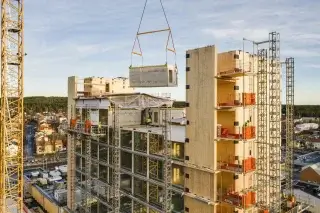
 Scandinavian Prefab Housing Market Seen Reaching $7.9 Billion
 Denmark Sets First-Half Tourism Record as Germans Lead
 Drought Dries Bärenschützklamm Waterfalls in Austria
 Thailand Industrial Property Faces Rising Vacancy Risk
 Apartment Prices in Estonia Differ by 51 Times
 European Property Investment Rises to €54 Billion
Asia-Pacific Property Investment Hits Record $92.5 Billion

Asia-Pacific commercial real estate investment reached a record $92.5 billion in the first half of 2026, rising 35% from a year earlier. Japan, Singapore and Australia generated a large share of the activity. The regional recovery creates a supportive investment backdrop for Thailand, but the domestic picture is mixed: foreign condominium transfers declined in the first quarter, while hotels, industrial property and data centres remain among the market’s most prominent capital themes.
Asia-Pacific property investment reaches a record
Commercial real estate investment across Asia Pacific totalled $45.5 billion in the second quarter of 2026, up 38% year on year. First-half volumes reached $92.5 billion, increasing 35% and marking the strongest first half on record, according to JLL data.
The definition is important. The $92.5 billion figure measures investment transactions in commercial real estate under the research firm’s methodology. It is not the combined value of every house and apartment bought across Asia Pacific and it is not a measure of foreign capital flowing directly into Thai residential property.
Japan recorded $23.8 billion of first-half transactions, up 12% year on year. Australia reached $14.7 billion, an increase of 68%. Singapore surged 238% to $18.2 billion, while Hong Kong rose 90% to $4.7 billion.
Singapore also illustrates the impact that a small number of very large transactions can have on regional figures. CICT’s approximately $3 billion acquisition of the Paragon shopping mall and IOI Properties’ approximately $1.9 billion purchase of Asia Square Tower 2 were two of the major deals completed during the second quarter.
Japan and Australia attract capital into different sectors
Japan saw investment increase across several sectors, with offices leading activity. Industrial assets also attracted value-add capital, while data centres benefited from demand linked to artificial intelligence infrastructure and data-sovereignty requirements.
Australia generated $8.9 billion of second-quarter transactions, 82% more than a year earlier. Four large portfolio deals helped produce the strongest second-quarter result since 2021, with property trusts, developers and private capital active in industrial assets.
The regional recovery is therefore selective rather than universal. Investors are returning to large transactions but continue to favour assets offering visible rental growth, reliable income or exposure to structural long-term demand.
Offices return as Asia-Pacific investors’ top choice
Investor intentions also point to a change in sector preferences. In a CBRE survey of more than 420 Asia-Pacific investors, 57% of respondents said they planned to increase acquisitions in 2026. Offices became the preferred property sector for the first time in six years, ahead of industrial and logistics property. The living sector ranked third and data centres fourth.
The change does not imply a uniform office recovery. Investors are focusing on modern, well-occupied buildings in locations with constrained supply. Australia, Japan and Singapore are among the markets where expectations for rental growth are supporting demand for higher-quality assets.
Thailand’s property market is moving selectively
Thailand’s position is more nuanced than the regional headline suggests. A February 2026 outlook for the Thai market identified hotels, industrial and logistics assets, data centres and higher-quality offices as some of the areas benefiting from structural demand. At the same time, investors have become more selective about land costs, income potential and individual locations.
Thai hotel investment reached THB26.4 billion in 2025, almost twice the average recorded over the preceding decade. More than 75% of that volume was concentrated in Bangkok. Investment is expected to normalise to around THB13 billion in 2026, indicating a slowdown from an unusually strong year rather than another doubling of activity.
Data centres represent a longer-term growth theme. Board of Investment-approved digital-industry investment exceeded THB746 billion in 2025. That figure covers the broader digital industry and should not be interpreted entirely as real estate investment. Around 360MW of data-centre capacity is planned in each of 2026 and 2027, increasing competition for sites with sufficient grid capacity, fibre connectivity and cooling infrastructure.
Foreign condominium transfers decline in Thailand
Residential data point in a different direction. Foreign buyers completed transfers of 3,241 condominium units in the first quarter of 2026, down 17.3% from a year earlier. Their combined value fell 17.9% to THB13.464 billion, while transferred floor area decreased 13.8% to 141,644 square metres.
Foreign buyers represented 13.6% of condominium transfers by unit count and 23.9% by value. Chinese nationals remained the largest group with 906 units, but their transfers fell 38.8% and their transaction value dropped 42.9% to THB3.493 billion. Russian buyers moved into second place, with transfers rising 33% to 383 units and their value increasing 68.7% to THB1.665 billion, according to Thailand’s Real Estate Information Center, part of the Government Housing Bank.
The regional investment record and Thailand’s foreign condominium market are therefore moving in different directions. This is not contradictory: the datasets cover different segments and different types of capital.
Chinese demand weakens while Russian buying rises
Chinese nationals remain Thailand’s largest foreign condominium buyer group, but weaker economic conditions and liquidity constraints have reduced activity. At the same time, demand is becoming more diversified.
Russian buyers posted one of the strongest increases during the first quarter. Indian demand also strengthened, with Indian buyers recording the highest average transaction value per unit among the major foreign groups.
This shift can be particularly relevant in resort markets such as Phuket, where international demand has a greater influence on project formats, unit sizes and pricing than in many domestic markets.
Transfer statistics, however, measure completed changes of ownership. They do not represent new reservations or presales and do not show current demand for unfinished projects.
Foreign condominium ownership is capped
Thailand allows foreign nationals to own condominium units directly, but foreign ownership within a registered condominium is capped. The aggregate foreign share may not exceed 49% of the total condominium area, and buyers need confirmation from the condominium juristic person that the foreign quota remains available, according to Thailand’s official government portal.
Land operates under a much more restrictive regime. Foreign nationals generally cannot purchase land on the same terms as Thai citizens. A narrow statutory exception permits up to one rai, or 1,600 square metres, for residential purposes subject to an investment of at least THB40 million and additional regulatory approval.
Villa and land price statistics therefore should not automatically be interpreted as describing assets that overseas buyers can acquire outright under the same rules that apply to condominium units.
The regional record does not guarantee Thai price growth
Higher Asia-Pacific transaction volumes can improve investor sentiment and capital availability, but there is no automatic mechanism linking the $92.5 billion regional record to the price of an individual condominium in Bangkok, Phuket or Pattaya.
Thai residential prices depend on local supply, purchasing power, tourism, land and construction costs, exchange rates, new development pipelines and ownership restrictions. Investment property is also affected by rental income, financing costs, occupancy and resale liquidity.
Forecasts claiming that the regional record alone will push Thai property values up by a specific percentage therefore require separate local evidence. The $92.5 billion figure itself does not support such a conclusion.
Record investment does not remove market risks
Interest rates, energy costs, currency volatility and geopolitical uncertainty continue to influence Asia-Pacific property transactions. Even as more capital returns to the market, buyers have become more demanding in underwriting assets and increasingly focus on sustainable income growth rather than relying solely on capital appreciation.
The risks differ by sector. Data centres depend heavily on power and infrastructure capacity. Hotels remain exposed to international tourism demand. Condominiums depend on pricing, foreign ownership quotas, rental performance and resale liquidity.
As International Investment experts report, the record $92.5 billion demonstrates a strong recovery in Asia-Pacific property investment activity, but it cannot be transferred directly to Thailand. Much of the regional increase is concentrated in the largest markets, while Thailand is showing divergent trends: foreign condominium transfers declined, hotel investment is expected to normalise after a very strong 2025, and the clearest structural expansion is occurring in digital, industrial and logistics infrastructure. For private investors, the regional record is useful as a measure of sentiment, but it does not replace due diligence on the individual property, ownership structure, purchase price and realistic income potential.
FAQ: Asia-Pacific and Thailand real estate in 2026
How much was invested in Asia-Pacific real estate in H1 2026?
Commercial real estate investment reached $92.5 billion, 35% more than a year earlier and the highest first-half volume on record.
Does the $92.5 billion figure include every residential purchase?
No. It measures investment transactions in commercial real estate under JLL’s methodology and is not the combined value of all residential purchases across the region.
Which markets accounted for much of the activity?
Japan recorded $23.8 billion, Singapore $18.2 billion, Australia $14.7 billion and Hong Kong $4.7 billion in the first half of 2026.
Does the APAC record mean Thailand is in a property boom?
No. Thailand is showing mixed conditions. Foreign condominium transfers fell 17.3% year on year in the first quarter even as several commercial property sectors continue to attract capital.
Which Thai property sectors are attracting investors?
Hotels, industrial and logistics property, data centres and selected high-quality offices are among the most prominent themes.
Can foreigners own condominiums in Thailand?
Yes. Foreigners can directly own units in registered condominiums, provided the aggregate foreign ownership share does not exceed 49% of the total condominium area and other legal requirements are met.
Can foreigners buy land in Thailand?
Direct foreign land ownership is generally heavily restricted. A narrow exception exists under specific investment and approval conditions.
Is Russian demand for Thai condominiums increasing?
Yes. In the first quarter of 2026, transfers to Russian buyers increased 33% by unit count and 68.7% by value from a year earlier.
Will the APAC investment record push Bangkok and Phuket prices higher?
Not automatically. Local prices depend on supply, demand, tourism, construction costs, exchange rates, financing and the characteristics of individual developments.