







 Covivio Hotels Revenue Grows 4.7% as European Markets Split
 Lithuanian Apartment Prices Accelerate Across Major Cities
 Georgia's Tourism Revenue Hits Record High
 Norway's Sovereign Fund Commits €1.5bn to European Warehouses
 Market Rout of October 2026: Can Branded Hotels Protect Capital?
 Residential Property Prices in Tbilisi Rise by 5.9% Year-on-Year
Tbilisi Apartment Sales Reach Highest Level Since 2022
Apartment sales in Tbilisi increased significantly in July 2026, while transactions on the secondary market reached their highest monthly level since 2022. Buyer activity was supported by improved market sentiment, the strengthening of the Georgian lari and lower interest rates, according to a Galt & Taggart study.
Dynamics of Residential Transactions in Tbilisi
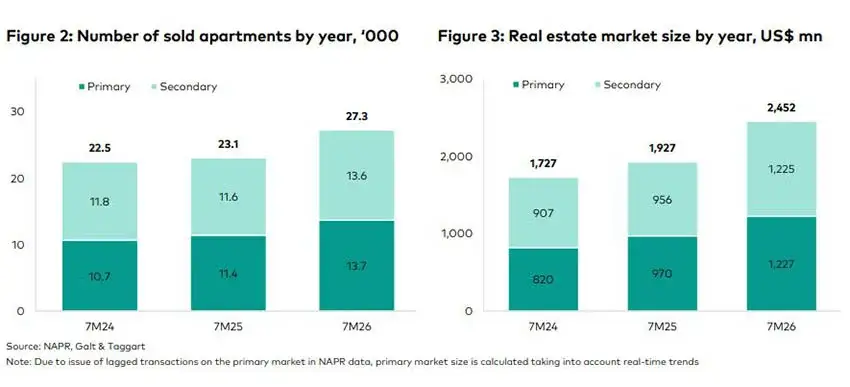
Overall data. In July 2026, 4,475 apartment transactions were registered in Tbilisi, according to data from the National Agency of Public Registry (NAPR). A total of 2,294 properties were sold on the secondary market, up 18.8% from 2025. This was the highest monthly figure since 2022. From January through July, the number of such transactions increased by 16.6%.
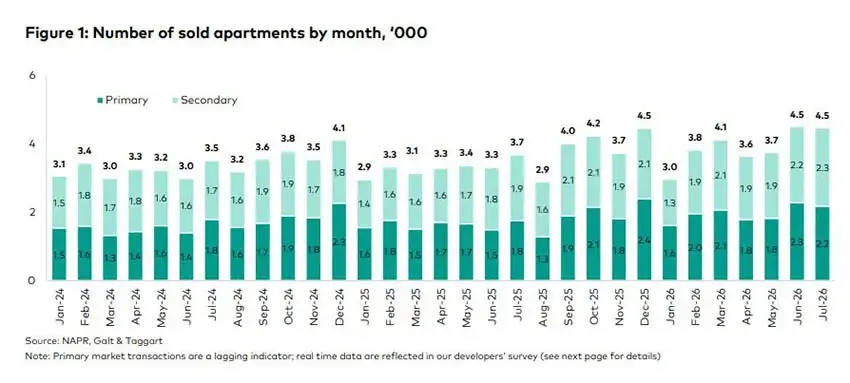
Primary market. In July, 2,181 transactions were registered, up 24.4%. Over the first seven months, the increase was 19.9%. Galt & Taggart notes that official statistics do not fully reflect the current situation because of delays between a property's sale and its registration in the registry. The analysts therefore also conduct regular surveys of developers.
Developer projects. In July, actual sales by systematic developers with more than 100 projects in Tbilisi increased by 14.8% year-on-year, while sales rose by 30.1% over the first seven months. Overall, 27,274 residential real estate transactions were registered in the capital from January through July, with the total value of properties sold reaching $2.5 billion, up 27.3%.
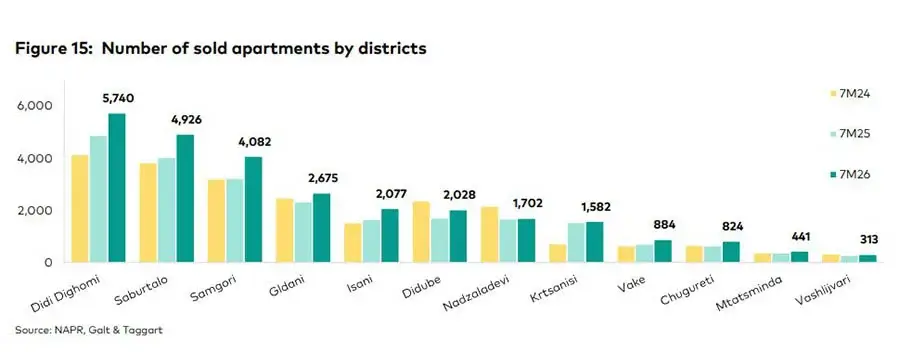
Sales by district. During the first seven months of 2026, the largest number of apartments were sold in Didi Dighomi — 5,740. Saburtalo followed with 4,926 sales and Samgori with 4,082. Sales exceeded 2,000 properties in Gldani, Isani and Didube. Vake recorded 884 transactions, Chughureti 824, while Mtatsminda had the fewest at 441.
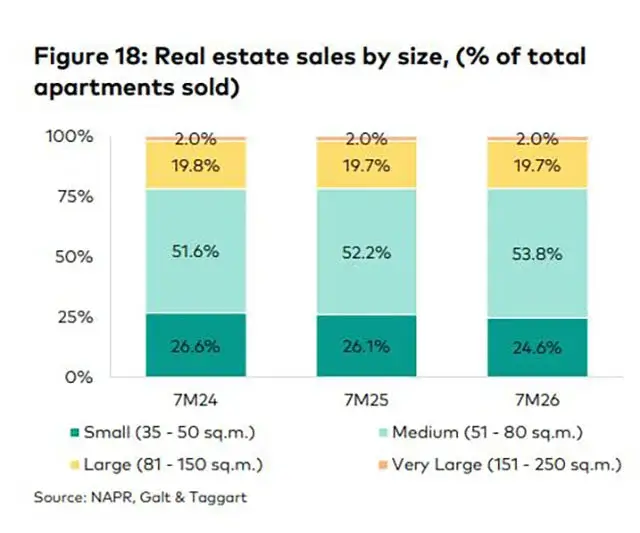
Popular housing in Tbilisi. The main demand is for apartments ranging from 51 to 80 sq. m. Their share increased from 51.6% during the first seven months of 2024 to 52.2% over the same period in 2025 and 53.8% in 2026. Transactions involving properties of 35–50 sq. m. declined from 26.6% to 24.6%. Larger apartments of 81–150 sq. m. maintained a stable share of around 19.7–19.8% of the market. Properties of 151–250 sq. m. accounted for 2% of sales.
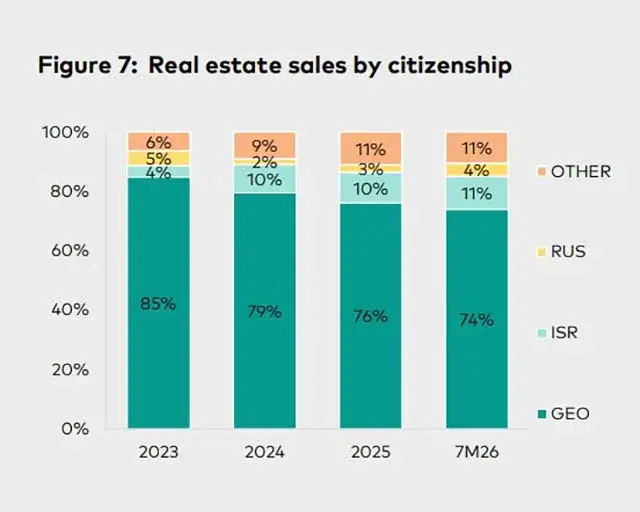
Foreign buyers in Tbilisi. Georgian citizens remain the largest buyer group, but their share is declining as interest from foreign buyers increases. In 2023, local buyers accounted for 85% of transactions, compared with 74% during the first seven months of 2026. Israeli buyers showed the strongest growth, with their share increasing from 4% to 11%, making them the largest group among foreign buyers. Transactions involving Russian citizens fell to 2% in 2024 but increased to 4% in January–July 2026. Sales to buyers from other countries increased from 6% to 11%.
Construction Permits in Tbilisi
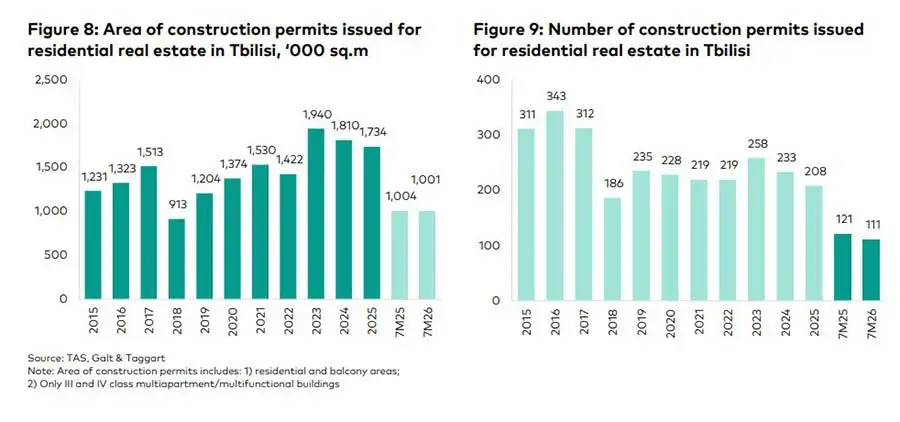
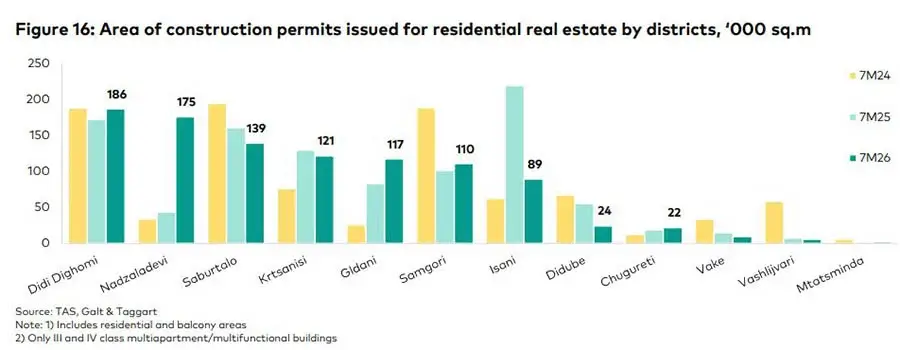
Over the past decade, the number of new residential projects in Tbilisi has declined, but their average scale has increased. In 2015–2017, more than 310–340 permits were issued annually. In 2023, the total permitted area reached a record 1.94 million sq. m., with 258 permits. The figure stood at 1.81 million sq. m. in 2024. In 2025, the number of permits fell to 208, while the total area declined to 1.73 million sq. m.
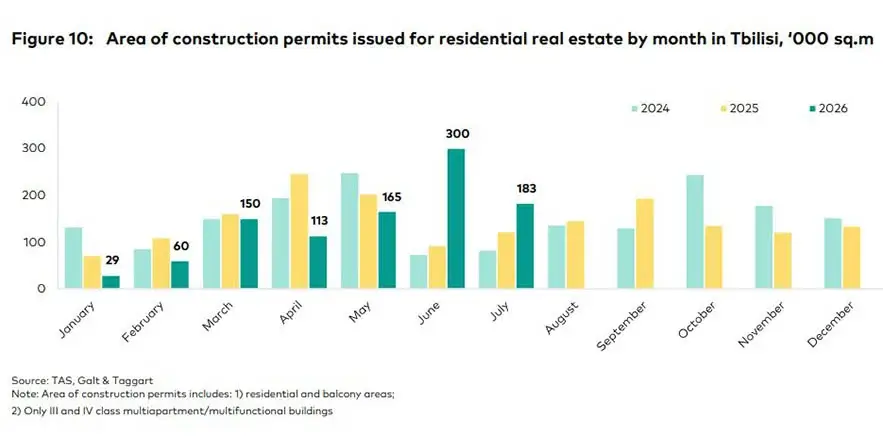
From January through July 2026, construction was approved for 1.001 million sq. m. of residential property in Tbilisi, with 111 permits issued. Activity remained relatively low during the first two months: 29,000 sq. m. in January and 60,000 sq. m. in February. A sharp increase followed in June, when the figure reached 300,000 sq. m.
In July, construction permits were issued for 17 projects in Tbilisi. The permitted area increased by 50.3% to 182,789 sq. m. Over the first seven months, the result was almost unchanged from the previous year: 1.001 million sq. m. compared with 1.004 million sq. m.
Didi Dighomi leads by district, with 186,000 sq. m. The Nadzaladevi district recorded a sharp increase in development activity, moving into second place with 175,000 sq. m. During the first seven months of 2024, permits in this area covered only 32,000 sq. m. In Isani, which was the absolute leader in 2025, the figure declined from 218,000 to 89,000 sq. m. New construction remains limited in central districts such as Vake (8,000 sq. m.) and Mtatsminda (1,000 sq. m.) because of the density of existing development.
How Much Does Housing Cost in Tbilisi?
Average price. The average price per square meter on Tbilisi's primary market increased by 0.7% in July compared with June, reaching $1,426. On the secondary market, including new buildings constructed under permits issued since 2013, the figure rose by 2% month-on-month to $1,372.
Segments. During the first seven months of 2024, the budget segment, priced at up to $1,100 per sq. m., accounted for 68.8% of all sales. Over the same period in 2026, its share fell to 49.5%, dropping below half of the market for the first time. The mid-market segment, priced at $1,101–2,000 per sq. m., expanded significantly, with its share rising from 27.1% to 42.9%. The premium segment, priced at $2,001–3,000 per sq. m., increased its share from 3.3% to 6%. The ultra-premium segment, with prices above $3,000 per sq. m., also expanded, from 0.7% to 1.6%.
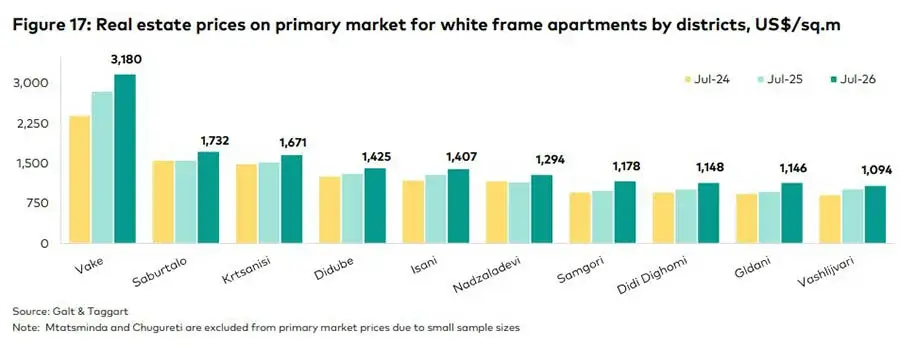
Districts. Vake remains the most expensive location in the premium segment. In July 2024, the average price of an apartment in white-frame condition was $2,390 per sq. m., rising to $3,180 by July 2026. In the business segment, the highest prices were recorded in Saburtalo and Krtsanisi at $1,732 and $1,671 per sq. m., respectively. In Didube, the price reached $1,425, while in Isani it was $1,407 per sq. m. In the affordable housing stock, prices stood at $1,094 per sq. m. in Vashlijvari, $1,146 in Gldani, $1,148 in Didi Dighomi and $1,178 in Samgori. Even in the budget segment, prices have exceeded $1,000 per sq. m.
Rental Housing in Tbilisi: Rates and Yields
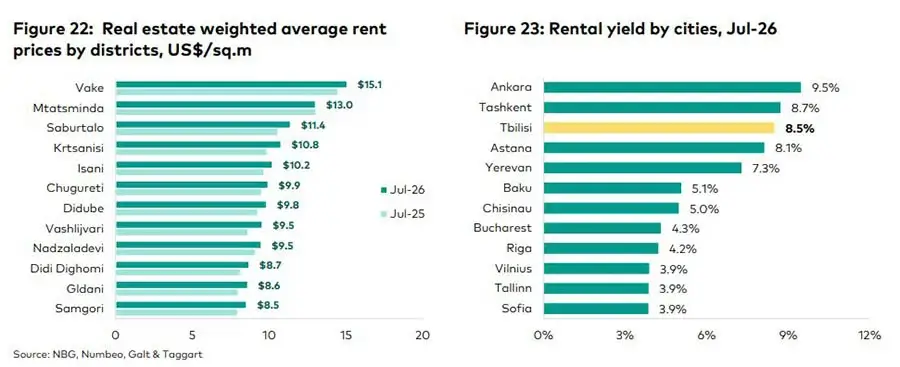
Average rental prices in Tbilisi remained broadly stable from July 2025 to July 2026. The highest rates were recorded in the premium segment. In Vake, the average rent was $15.1 per sq. m., while in Mtatsminda it was $13.
In the mid-market segment, Saburtalo led at $11.4 per sq. m., followed by Krtsanisi at $10.8 and Isani at $10.2. These were followed by Chughureti at $9.9, Didube at $9.8, and Vashlijvari and Nadzaladevi at $9.5 per sq. m. each. In the affordable housing stock, the lowest rental rates were recorded in Samgori at $8.5, Gldani at $8.6 and Didi Dighomi at $8.7 per sq. m.
In July 2026, the average rental yield in Tbilisi was 8.5%, excluding promotion, maintenance and tax expenses. Among the regional cities included in the comparison, the figure was higher only in Ankara at 9.5% and Tashkent at 8.7%. In Astana, the yield was 8.1%, in Yerevan 7.3% and in Baku 5.1%. Rental yields were significantly lower in the European capitals included in the comparison: 3.9% in Vilnius, Tallinn and Sofia, 4.3% in Bucharest and 5% in Chisinau.
What This Means for Investors
Analysts at International Investment note that Tbilisi's residential real estate market retains potential for further expansion, but the structure of demand is gradually changing. Buyers are moving into higher-priced segments, while developers are focusing on larger projects. At the same time, the significant volume of new supply limits the potential for a sharp increase in apartment prices in the near term.
Two opposing factors will continue to influence housing prices. Limited supply in central districts will support prices, while large volumes of new construction in Didi Dighomi, Nadzaladevi and other locations will increase competition between projects and restrain price growth.
Investors should take into account rising housing prices and largely stable rental rates. This could extend the payback period for properties. In addition, the 8.5% figure represents gross rental yield. After taxes, maintenance and promotion costs, as well as vacancy periods, the actual return will be lower.
Hotel projects are creating additional competition for residential real estate. Investments in hotels can in some cases provide higher and more stable returns, particularly in the premium segment and branded hotels. As apartment prices rise, this factor is likely to become increasingly important when investors choose between residential and hotel real estate.