







read also
 Fines for Illegal Rentals in Spain Reach €800,000
 Australia’s Spring Auctions Rise but Remain Well Below 2025
 Number of Foreigners Holding Turkish Residence Permits Exceeds 1.27 Million
 Demand from Russian Tourists for Holidays in Georgia Rises by 20–25%
 Montenegro Property Buying Costs in 2026
 Four in Ten Companies Would Not Choose Slovakia
Two high-speed trains collide in Spain, 39 killed
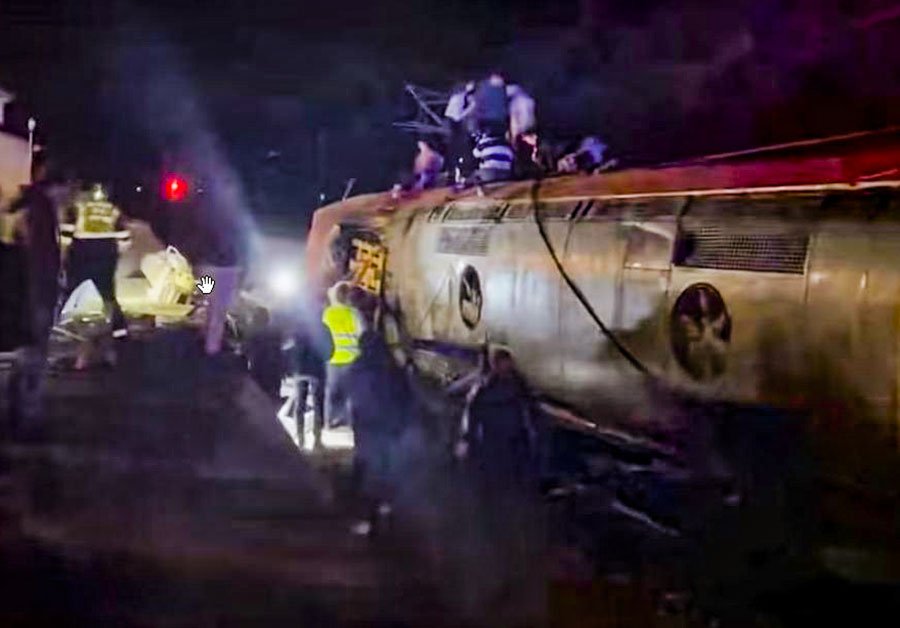
Photo: Reuters
A major railway disaster has occurred in southern Spain, about 360 km south of Madrid. Two high-speed trains collided after one of them derailed. Thirty-nine people were killed and dozens were injured, reports the Associated Press. Rescue operations are ongoing, and authorities do not rule out that the death toll may rise.
The accident occurred at around 7:45 p.m. local time near the town of Adamuz in the province of Córdoba. The rear carriages of a high-speed Iryo train travelling on the Malaga–Madrid route derailed and ended up on the adjacent track, where they collided with an oncoming Renfe train heading to Huelva. The impact sent the Renfe train down a railway embankment about four metres high; the most severe consequences were suffered by passengers in the front carriages. Earlier reports spoke of 21 fatalities and 75 people taken to hospital, 15 of them in serious condition. As search-and-rescue operations continued, the death toll rose to 39.
Around 400 passengers were travelling on the trains, most of them Spaniards returning after the weekend. Passengers from the Iryo train were evacuated within a few hours, while access to the Renfe carriages was significantly hampered by severe structural deformation: some passengers were trapped inside, forcing rescuers to use heavy machinery, notes Reuters.
Salvador Jiménez, a journalist with Spanish broadcaster RTVE who was on board one of the derailed trains, said the incident felt like an earthquake. According to him, many passengers climbed out through shattered windows, while others broke the glass using emergency hammers. Adamuz Mayor Rafael Moreno, who was among the first to arrive at the scene, described what he saw as a “horrific scene,” noting that body parts were found at a considerable distance from the collision site.
Emergency services worked through the night. The Spanish Red Cross set up an assistance centre in Adamuz for passengers and their relatives, authorities organised a temporary reception centre, and local residents brought food and blankets. Officials say the death toll could still rise as search operations continue.
The cause of the accident has not yet been established. Spain’s Transport Minister Óscar Puente said the derailment appeared “extremely strange” given that the crash occurred on a straight stretch of track that had been upgraded in May last year. The trains involved were relatively new. An investigation is under way, and rail services between Madrid and Andalusia have been temporarily suspended.
Spain has the largest high-speed rail network in Europe for trains travelling at speeds above 250 km/h, with a total length exceeding 3,100 km. According to the European Union, this mode of transport is popular in the country and is considered safe. Renfe said that more than 25 million passengers used its high-speed trains in 2024.
The deadliest railway accident in Spain in the 21st century occurred in 2013, when 80 people were killed after a train derailed in the north-west of the country. The investigation concluded that the train was travelling at 179 km/h on a section of track with a speed limit of 80 km/h when it left the rails.
Analysts at International Investment note that the January 18, 2026 disaster has dealt a serious blow to the reputation of Spain’s high-speed rail network, long regarded as one of the most reliable in Europe. The outcome of the investigation will be important not only for establishing the cause of the accident, but also for revising safety standards on the country’s key routes.