







 Tbilisi Residential Real Estate Market: Prices, Rentals, and Investment Yields
 Rule of Law: Fresh Data Shows Georgia Ahead of Albania, Moldova, and Ukraine
 Turkey Lowers Cap on Residential Rent Increases
 Tskhaltubo Needs a New Strategy to Attract Tourists as Visitor Numbers Decline
 Maldives Introduces Email Verification for Tourists
 Scammers Target Tourist Parks Across Australia
First-Time Visits Decline as Repeat Trips Rise: What Do the Figures Reveal?

According to the National Statistics Office of Georgia, the average monthly number of visits to Georgia remained virtually unchanged during the first nine months of 2026. However, significant shifts occurred within the inbound tourism structure. Specifically, the number of repeat visits increased, while first-time arrivals dropped. As a result, visitor growth in Q3 2026 was driven entirely by an uptick in repeat trips.
Q3 2026: Growth in Visits Driven by Repeat Arrivals
According to data published by the National Statistics Office of Georgia (Geostat) on 30 October 2026, the average monthly number of visits by non-residents aged 15 and older reached 866.1 thousand in Q3 of this year. This represents a 3.3% increase compared to the same period in 2025; however, behind this overall positive dynamic lie two contrasting trends.
Specifically, the average monthly number of first-time visits to Georgia decreased from 224.1 thousand to 201.4 thousand, representing a 10.1% decline. Conversely, repeat visits climbed from 614.7 thousand to 664.7 thousand, registering an 8.1% year-on-year increase.
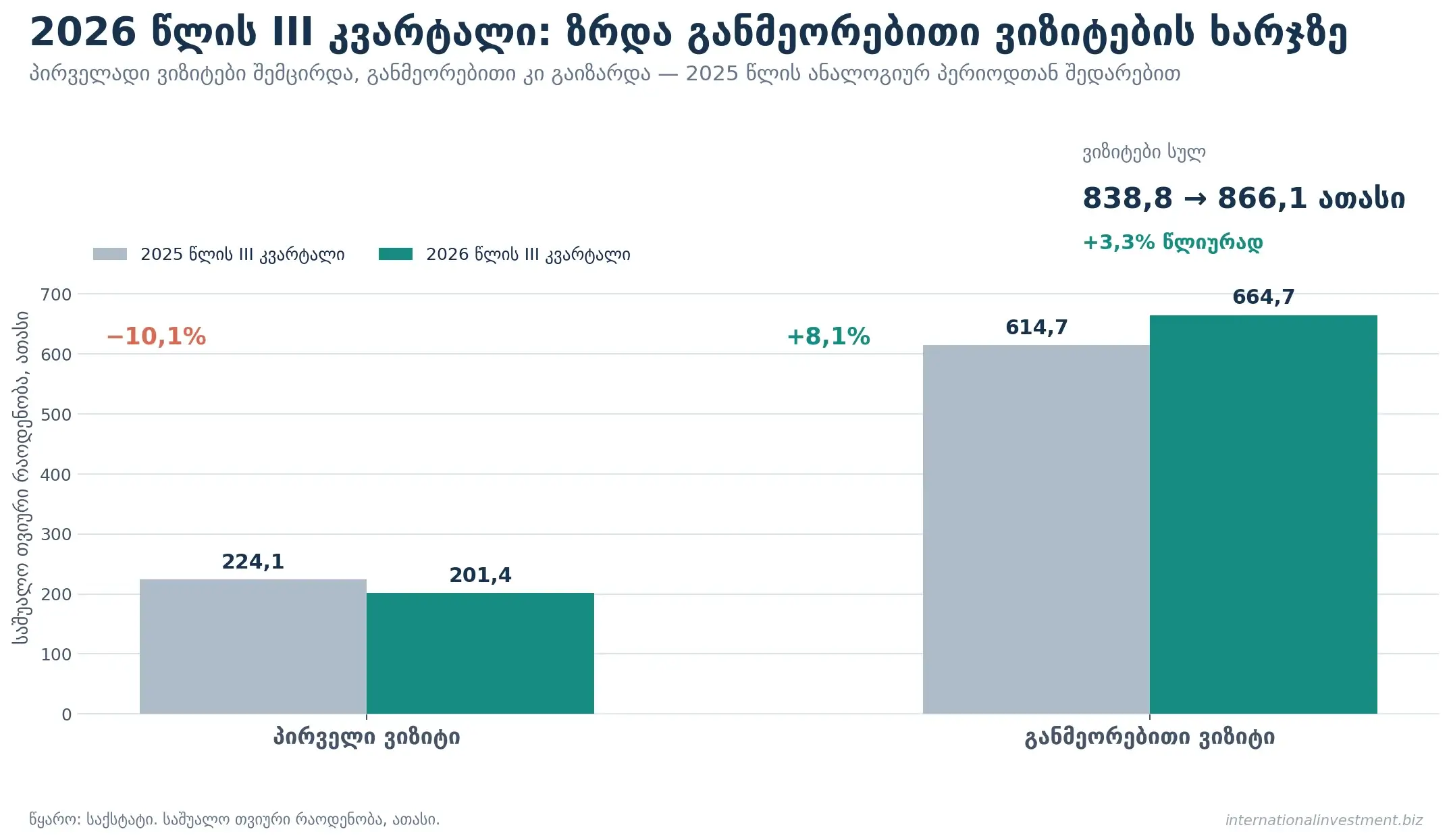
As a result, in Q3 2026, repeat trips accounted for roughly 76.7% of all visits, whereas the share of first-time travellers stood at just 23.3%. A year earlier, this breakdown was 73.3% and 26.7%, respectively.
This shift indicates that repeat demand for Georgia as a tourist destination continues to grow, yet no substantial progress is evident in attracting new inbound visitors.
First Nine Months: Overall Figure Stable, but Visit Structure Is Shifting
This trend is highlighted even more distinctly by data covering January through September 2026.
In particular, the average monthly number of first-time visits to Georgia fell from 133.9 thousand to 120.2 thousand (a 10.3% drop). Meanwhile, repeat trips rose from 457.9 thousand to 472.4 thousand, up by 3.2%.
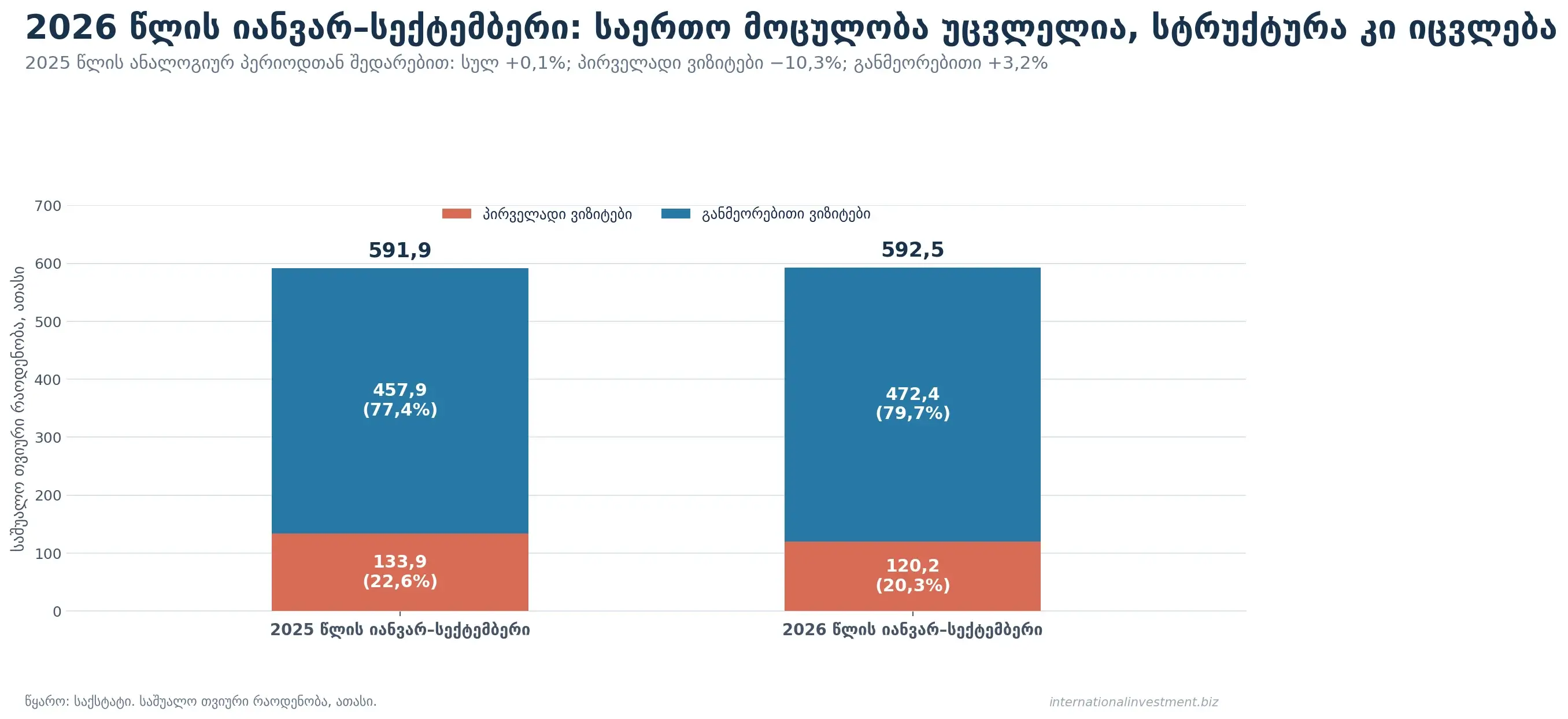
This adjustment also influenced the annual structure of visits. Specifically, in January–September 2025, first-time arrivals accounted for 22.6% of visits, whereas during the same period in 2026, their share slipped to 20.3%. Consequently, the share of repeat visits rose from 77.4% to 79.7%, an increase of 2.3 percentage points.
Looking at quarterly figures, it is noteworthy that first-time visits dropped by 20.7% in Q2 and by 10.1% in Q3. At the same time, repeat visits remained virtually unchanged in the second quarter before expanding by 8.1% in the third quarter.
Overall, this indicates that the summer expansion in total visits stemmed not from capturing new source markets, but from the recurrent activity of the established visitor base.
Comparison with 2019: Repeat Visits Recovered, First-Time Numbers Still Lagging
Comparing current figures with the pre-pandemic period offers further insights into the recovery pattern of Georgia's tourism sector.
Specifically, in Q3 2026, average monthly visits stood at 866.1 thousand, which is 5.6% below the 917.7 thousand recorded in the same period of 2019. However, the trajectory differs across individual segments. In Q3 2026, repeat visits reached 664.7 thousand, surpassing the 2019 figure (636.7 thousand) by 4.4%, whereas first-time visits amounted to 201.4 thousand, lagging 28.4% behind the pre-pandemic benchmark (281.1 thousand).
A similar picture emerges when comparing the first nine months. The number of first-time visits fell 35.8% short, whereas repeat visits have practically recovered, trailing 2019 levels by just 1.1%.
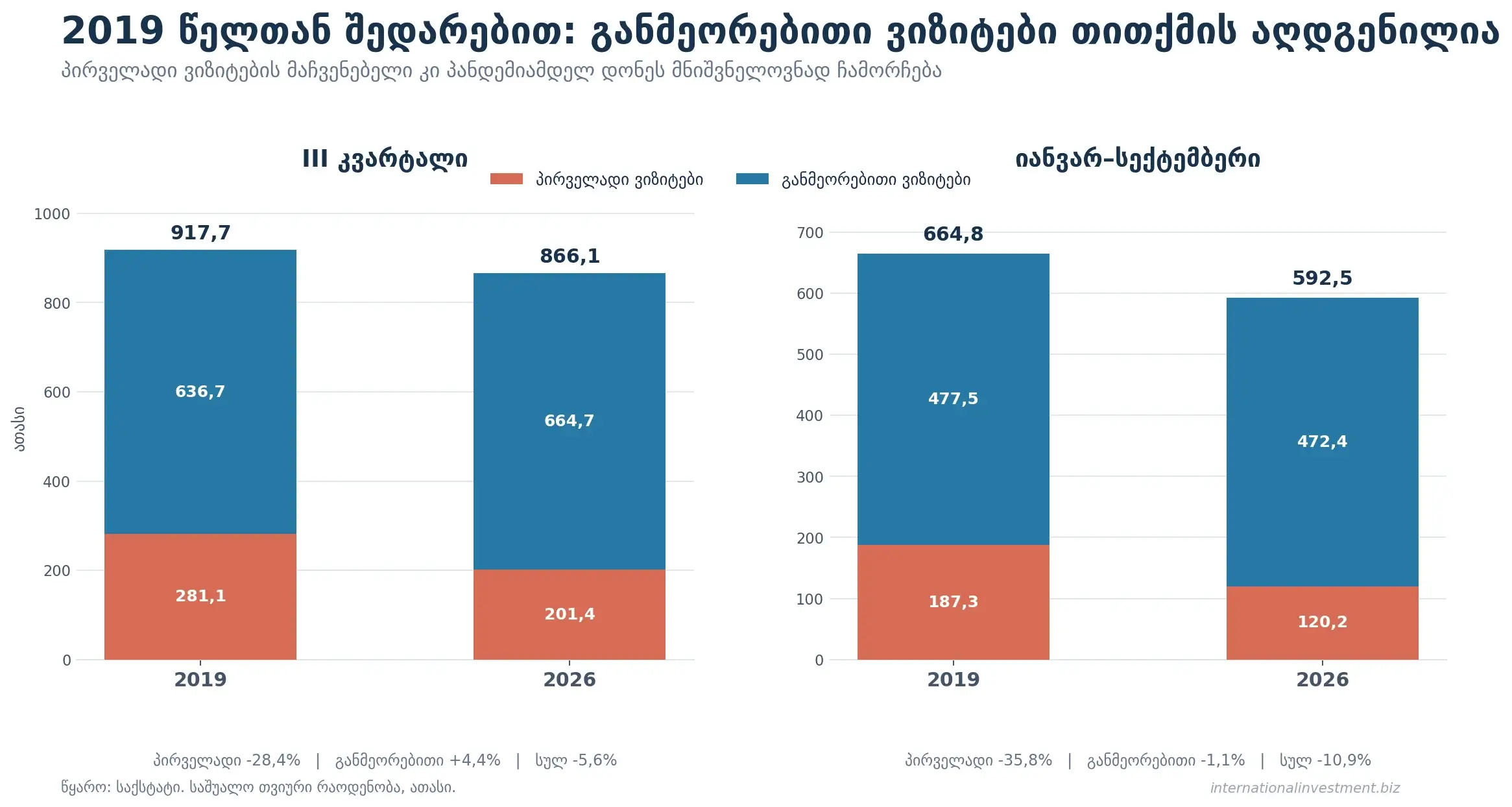
Thus, the main deficit relative to pre-pandemic volumes is driven precisely by the shrinking influx of first-time travellers. In the repeat travel segment, the market has almost fully rebounded.
Annual Trends: Pre-Pandemic Expansion and Post-Pandemic Structural Shift
Long-term trends show that prior to the pandemic, growth in non-resident visits to Georgia was primarily driven by attracting new visitors.
In 2015, average monthly visits were 438.0 thousand. This metric grew to 449.4 thousand in 2016, 540.2 thousand in 2017, 600.3 thousand in 2018, and reached 643.8 thousand in 2019. Consequently, between 2015 and 2019, the average monthly volume of visits climbed by 47%.
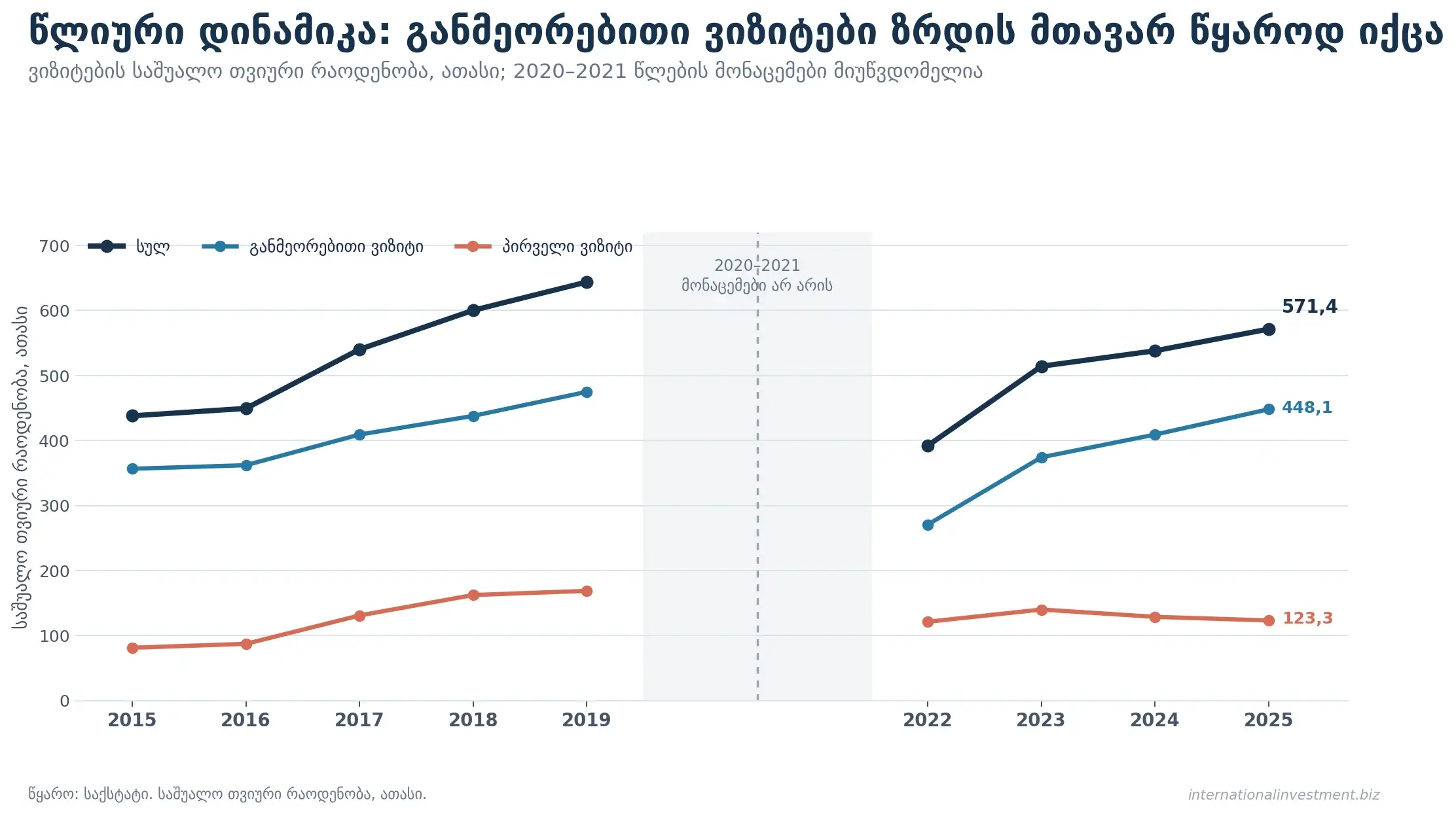
Regarding the composition of trips, over the same period first-time visits to Georgia surged from 81.4 thousand to 168.9 thousand, representing a 107.5% increase. Repeat journeys grew from 356.6 thousand to 475.0 thousand, or by 33.2%.
These metrics demonstrate that before the pandemic, attracting new visitors was a key catalyst for expanding incoming travel to Georgia. For example, in 2015, the share of first-time visits was 18.6%, rising to 27.1% by 2018.
The post-pandemic period reflects a different dynamic. Most notably, total growth in 2025 was fueled solely by the rise in repeat journeys. In particular, their monthly average rose from 409.1 thousand in 2024 to 448.1 thousand in 2025 (+9.5%). At the same time, first-time visits contracted from 128.9 thousand to 123.3 thousand (-4.3%).
Thus, despite the overall increase in visits in 2025, the volume of travelers visiting the country for the first time continued to drop.
This dynamic is also confirmed by comparing 2022–2025 data. Across this period, the average monthly volume of repeat visits surged by 65.5%, while first-time visits expanded by merely 1.7%.
Furthermore, following the pandemic, the proportion of repeat trips consistently grew. Specifically, while first-time visits represented 30.9% of all trips in 2022, this share decreased to 27.2% in 2023, 24.0% in 2024, and 21.6% in 2025.
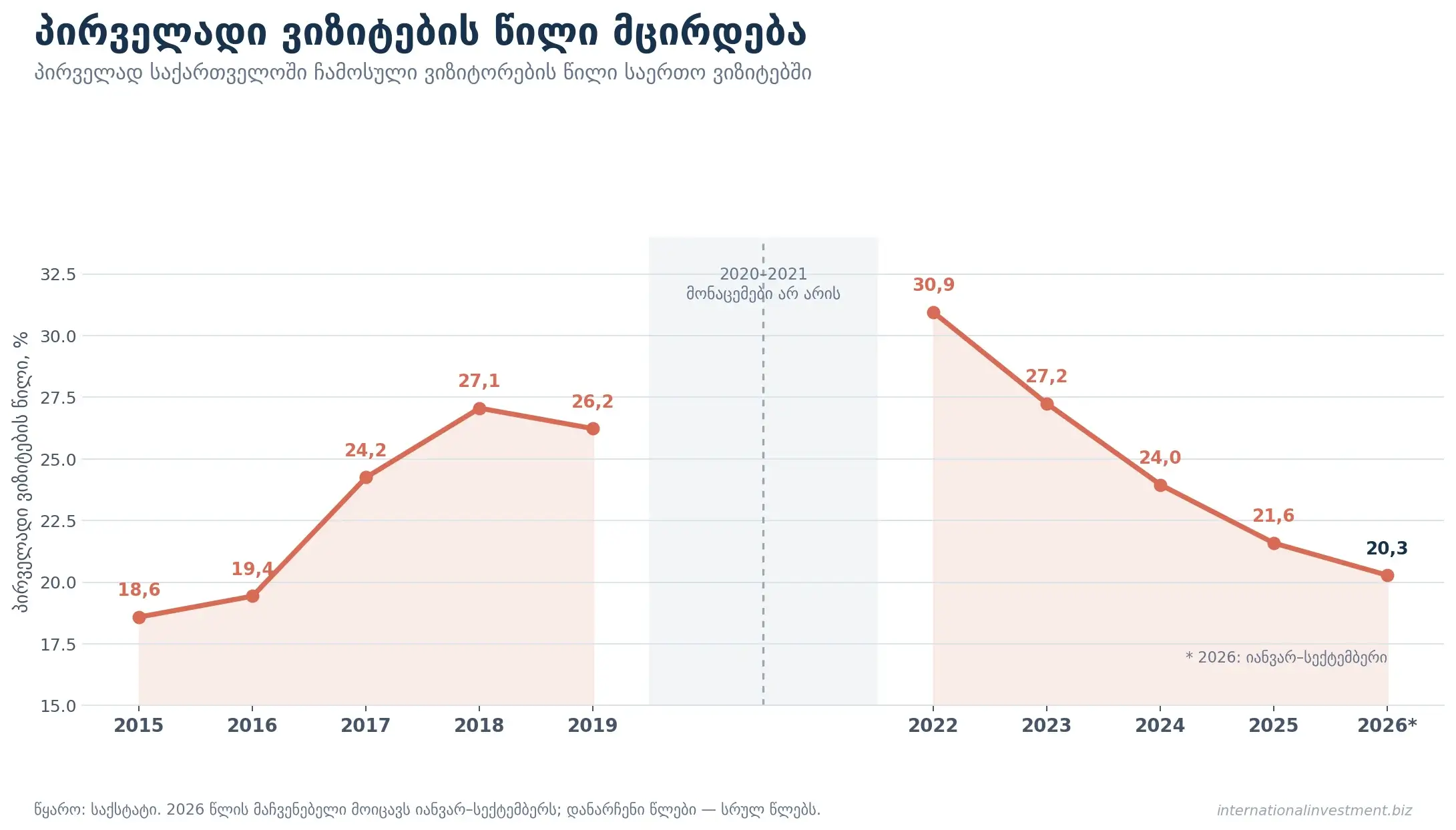
This reallocation highlights that the quantitative recovery of Georgia's tourism market in the post-pandemic era has relied on repeat travel rather than an influx of new guests.
What Does This Trend Mean for the Tourism Sector?
The statistical findings demonstrate that Georgia's tourism market is achieving quantitative growth, but the underlying structure of this growth is shifting. A strong proportion of return visitors reflects loyalty toward Georgia as a familiar and appealing destination to revisit. However, the drop in first-time arrivals exposes ongoing difficulties in engaging new audiences.
For the tourism industry, this development holds vital implications both for marketing strategies and investment choices. Relying exclusively on retaining loyal visitors will not suffice to achieve further market expansion. It will be essential to penetrate new target markets, diversify travel products, reduce seasonality, and introduce offerings that inspire travelers to discover Georgia for the first time.
On the whole, 2026 data draws a clear distinction between aggregate visitor numbers and their growth drivers: Georgia reliably retains and expands its repeat visitor base, but attracting first-time guests remains a major challenge.