







 UK Grid Charges Could Rise 25% for Offices
 ART Riverfront Hotel Opens in Tbilisi with $68 Million Investment
 One in Three Renters in Spain Lives Below the Poverty Line
 Dubai Home Prices Fall for the First Time in Several Years
 Five Danish Hotels With 928 Rooms Change Hands
 Prague and Warsaw Lead CEE Office Recovery
Vienna Hotel Nights Rise as August Revenue Falls

Vienna recorded 1.825 million visitor nights in September 2026, a 4% increase from a year earlier. The latest published accommodation revenue figure, however, relates to August: €109.17 million, 5% below August 2025. The city's tourism update dated 22 October presents these two data series for different months. September's increase in guest nights therefore cannot be used to infer September hotel turnover, which had not yet been reported in the release.
September stays rise while room occupancy holds steady
Accommodation operators recorded 14.932 million nights in January–September, 4% more than a year earlier. September itself also grew 4%, yet average hotel room occupancy held at approximately 74%, broadly unchanged from September 2025. Bed occupancy edged up from 57.1% to 57.4%. Rising guest nights therefore did not translate into a comparably large increase in the share of rooms occupied.
Supply has been expanding alongside demand. Vienna offered roughly 86,200 hotel beds in September, about 2,800 more than a year before. When both the number of available beds and the amount of accommodation sold increase, total overnight stays can rise while occupancy remains stable.
August revenue falls despite almost steady guest nights
Vienna's accommodation businesses reported €109.168 million in net accommodation turnover for August 2026, down 5% year on year. The earlier August tourist bulletin put guest nights at 1.907 million, down only 0.2% from the previous August. These metrics refer to the same month but measure different things: nights stayed and money earned from accommodation. The divergence warrants investigation into rates and market mix, but does not prove a single cause by itself.
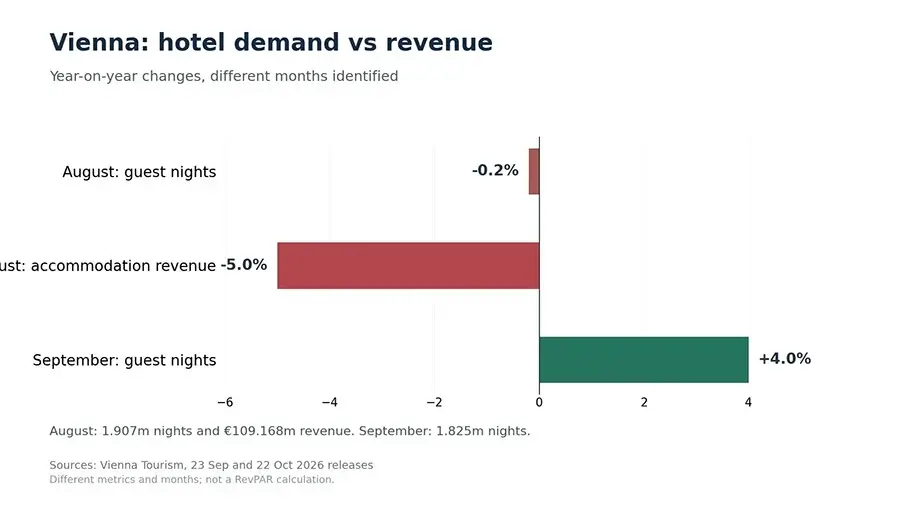
Year-on-year changes for Vienna: August nights −0.2%, August accommodation turnover −5.0%; September nights +4.0%. Months and measures are kept distinct. Sources: Vienna Tourism's 23 September and 22 October releases. ALT EN: comparison of changes in nights and hotel turnover for selected months.
The earlier August overnight count was published on 23 September. Accommodation turnover for January–August reached €867.173 million, up 1% year on year. That eight-month revenue figure should not be divided mechanically by the nine-month total of 14.932 million guest nights; the series cover different periods. Calculating RevPAR requires comparable room revenue and room availability data rather than total visitor nights alone.
Source markets diverge despite aggregate growth
Germany was Vienna's largest source of September guest nights at 354,000, up 4% year on year, followed by domestic travellers at 312,000 (+6%). The US generated 149,000 nights (+9%), Italy 66,000 (+5%) and the UK 65,000 (−11%). China rose 23% to 40,000 nights. These differences can affect booking channels, length of stay and spending patterns even when the total nights indicator moves only moderately.
A shift in the visitor mix is relevant to hotel operations, but country-of-origin nights are not direct evidence of per-room profit. International Investment's previous Austria short-term rental review showed that Vienna dominates by number of listings while Alpine locations can produce more estimated income per listing. That is a separate methodology and should not be confused with the municipal figures for the full commercial accommodation market.
Higher capacity creates a tougher investment test
Across the first nine months, Vienna's average room occupancy was around 67%, compared with about 68% a year earlier. The city can therefore welcome more overnight visitors while an individual hotel experiences competition from additional rooms. An owner's result depends on room pricing, operating agreements, labour, renovation spending and financing, not solely on a destination's headline arrivals.
Vienna has also adopted a phased change to its accommodation tax, from 3.2% to 5% in July 2026 and a planned further rise to 8% in July 2027. The measure changes part of the fiscal environment for guests and accommodation providers; it should not be identified as the sole cause of August's revenue decline without further evidence.
International Investment's existing European hotel market comparison documented Austria's expanding branded hotel capacity. The new Vienna figures add an operating perspective: growth in total visitor nights is compatible with stable or weaker occupancy rates and does not assure stronger revenue per room. Property investors should evaluate individual hotel performance and the actual terms of management or lease agreements.
Frequently Asked Questions (FAQ)
How many nights did visitors spend in Vienna in September 2026? The city reported 1.825 million, up 4% from September 2025.
Did Vienna hotels earn more in August? Net accommodation turnover fell 5% year on year to €109.168 million in August 2026.
What was Vienna's hotel occupancy rate in September? Approximately 74%, broadly unchanged from a year earlier.
Does growth in visitor nights guarantee better hotel returns? No. Pricing, operating costs, room supply and property financing also determine profitability.