







 Gemofest: “Your Personal Guide to Discovering Georgian People and Georgian Cuisine” — Wanderlust
 Azora Raises €2.05bn for Southern European Property
 American Tour Operators Visit Georgia
 Hotels Return to Investors’ Priority List
 Tbilisi Hotel Market Enters a New Phase: Rising Demand, Global Capital, and Higher Costs
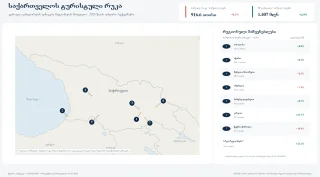 Tourist Visits to Kakheti Increase by 21.7%
AI in Hospitality: Practical Applications and Future Prospects

What risks can the use of artificial intelligence in the hospitality business entail and
how can sustainable development and planning of AI be ensured in the future? AI mentor, systems architect, and founder of the AI Technopark Otar Kvirikashvili discussed this in an interview with http://internationalinvestment.biz/-.
— What does the implementation of artificial intelligence in the hospitality business actually mean?
— In reality, it means creating a unified operating system where, instead of fragmented bookings, inventory, finances, and marketing, everything comes together in a single workspace.
— How does this system operate in real time?
— In real time, the system monitors both external factors—such as flight schedules, weather, and events planned across the city—and the "inner workings", anticipating demand shifts weeks ahead of management and understanding how to adjust prices to maximize profit. Simultaneously, it analyzes the habits of each guest to offer services tailored precisely to their preferences at the right moment, while internally hedging against financial losses—ranging from power savings on unoccupied floors to flawless inventory forecasting and staff scheduling.
— What is the ultimate outcome of this entire process?
— Ultimately, artificial intelligence turns a hotel into a living organism that presents the owner with a complete view of the business on a single screen, while freeing the team from daily chaos to focus on what matters most: genuine, human interaction with guests.
— How should the sustainable development of artificial intelligence proceed in the future so that businesses remain satisfied with the results?
— Sustainable development will begin once chaotic experiments cease and the automation of business processes merely for the sake of fashion or blind imitation of competitors comes to an end; when businesses transition to thoughtful, long-term planning. In the future (though this future could arrive in just a couple of months, and in fact has essentially already arrived), success will not come to a company that simply buys a trendy piece of software.
— Taking these factors into account, what should sound planning be grounded in to achieve effective results?
— Sound planning rests on three main pillars. The first is a hybrid model that clearly delineates what technology handles and what humans handle. Routine operations, analytics, and resource management are fully assumed by the system, while final decision-making and guest relations remain with humans. The second direction is staff reskilling. Sustainable development is impossible if the team fears losing their jobs to technology. Companies must train their personnel to manage these systems so that a manager or receptionist is not replaced by a machine, but becomes far more capable and productive. And the third is ethical standards and environmental sustainability. Systems must be engineered so that, on the one hand, guest privacy is strictly protected, and on the other, technology genuinely minimizes environmental impact, whether through precise energy usage or the reduction of food waste. Ultimately, the winner in this process will be whoever leverages technology to enhance human capabilities rather than replace them.