







 Madrid to Build €1 Billion City of Health Complex
 Australian Property Market: Fastest Downturn in 40 Years
 Buying Land in Argentina: Restrictions for Foreigners
 Albania Limits Residential Development in Resort Complexes
 10,883 Apartments Sold in Batumi in 2026 — Galt & Taggart
 Hilton and Scandic Plan New Hotels Across Nordics
Belgian Industrial Property Draws €537m of Capital

Belgian industrial property attracted €537 million of investment by the end of the third quarter of 2026, accounting for 29% of the country's overall real estate investment volume. JLL's market dynamics update, published on 22 October, also reported a 20-basis-point outward movement in prime logistics yields to 5.10% along the Brussels–Antwerp corridor. The figures illustrate the distinction between continued investor demand and the price investors are willing to pay for a given income stream.
Industrial assets account for nearly a third of investment
The €537 million figure reflects capital invested in industrial properties during the reporting period through Q3. JLL characterises overall volumes as lower following an exceptionally strong year for the sector, but continues to describe investor appetite as resilient. The 29% share compares industrial property with total Belgian real estate investment, rather than measuring industrial space leased by occupiers or the cost of construction.
Domestic capital remains the prevailing source of investment according to the research. The publicly available summary does not quantify its exact share or provide a city-by-city breakdown of the €537 million, so it would be misleading to attribute an invented portion of transactions to Brussels, Antwerp or international funds. More granular conclusions would require the underlying transaction-level report.
Prime logistics yields widen to 5.10%
JLL reports that the benchmark prime logistics yield along the Brussels–Antwerp corridor moved out by 20 basis points to 5.10%. The prime semi-industrial yield remained steady at 6.2%. These two property categories are not identical: semi-industrial assets can serve manufacturing and mixed-use activities, while modern distribution warehouses have their own tenant and technical requirements.
An outward movement in yield means investors demand more income relative to the capital value, all else equal. It can therefore signal pressure on asset prices even when occupier demand remains solid. However, a market-wide valuation benchmark cannot demonstrate that every logistics warehouse has fallen in price by the same amount, nor does it represent a guaranteed investor return after financing and maintenance.
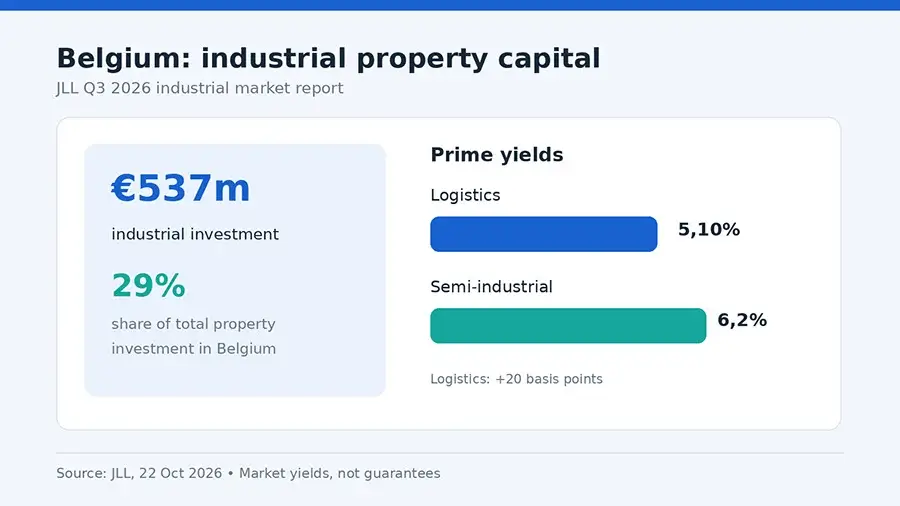
Belgian industrial capital investment €537m, a 29% share of total property investment. Prime logistics yield 5.10% in the Brussels–Antwerp corridor versus 6.2% for semi-industrial property. Source: JLL, 22 October 2026. ALT EN: comparative investment share and prime property yield indicators.
Why the Brussels–Antwerp corridor matters
The connection between Belgium's capital and its principal port region supports demand for distribution infrastructure. The published JLL summary, however, contains no new data on warehouse vacancy, speculative development or rental rates in the two cities. Investment demand should not be used as a proxy for proven occupancy growth. Individual site selection still depends on motorway access, utility capacity, expansion options and the quality of existing leases.
International Investment's previous Belgium and Luxembourg investment review described growing interest in logistics and residential assets among market participants. The latest JLL figures add a more specific picture of actual industrial investment activity and valuation yields in 2026. It is essential not to directly compare survey preferences from 2025 with transaction shares in 2026 as if they measured the same thing.
Transactions can rise as asset values reprice
Investor demand and higher required yields can coexist. Institutional buyers may remain interested in well-leased warehouses while insisting on a lower entry valuation to compensate for borrowing costs and future capital expenditure. The public report does not state actual lending spreads or discounts achieved on transactions, so these remain valuation considerations rather than reported deal terms.
International Investment's wider European logistics outlook has shown how capital is becoming more selective about building quality and infrastructure readiness. Belgium's updated investment share and yield levels are consistent with that need for discrimination, but they do not establish that prices have recovered for all industrial properties.
What investors should monitor next
Future market updates will show whether prime yield levels stabilise as borrowing conditions evolve and whether transaction volumes broaden to more assets and locations. If yields continue to rise while rental income remains unchanged, sellers may face tougher price negotiations. The JLL summary does not quantify a full-year forecast or a precise timeline for a reversal.
At the asset level, investors should examine lease duration, tenant concentration, structural condition, energy efficiency, transport links and refurbishment obligations. The reported 5.10% prime yield is a useful market reference but cannot replace property-specific cash-flow analysis.
Frequently Asked Questions (FAQ)
How much was invested in Belgian industrial property? JLL reports €537 million through Q3 2026.
What share of real estate investment did the sector represent? Industrial properties accounted for 29% of the Belgian total.
What is the prime logistics yield in Belgium? JLL puts the Brussels–Antwerp corridor benchmark at 5.10%, following a 20-basis-point outward move.
Does a 5.10% benchmark guarantee an investor's return? No. It is a market valuation yield, not an after-cost return for a particular property.