






 China Eastern Airlines to Boost Shanghai – Tbilisi Flight Frequency to Five Times Weekly from 2027
 Belgian Industrial Property Draws €537m of Capital
 Madrid to Build €1 Billion City of Health Complex
 Australian Property Market: Fastest Downturn in 40 Years
 Buying Land in Argentina: Restrictions for Foreigners
 Albania Limits Residential Development in Resort Complexes
Georgia's Hotel Market: Batumi Room Rates Surge as Tbilisi Occupancy Climbs

Georgia's hotel market in the third quarter of 2026 was characterized by improving metrics. According to the Galt & Taggart study Tourism Market Watch - 3Q26 Overview, between July and September, both hotel occupancy and the average daily room rate increased in Tbilisi as well as in Batumi. However, growth rates and market dynamics differed across the two main tourist hubs. Specifically, price growth was more intensive in Batumi, while Tbilisi saw notable improvements in occupancy rates.
These figures indicate that the recovery of demand across the hospitality sector is accompanied by rising average service costs. Nevertheless, seasonality and regional variations must be taken into account when evaluating the investment appeal of the market.
Supply of accommodation facilities is growing, with the market concentrated in two main hubs
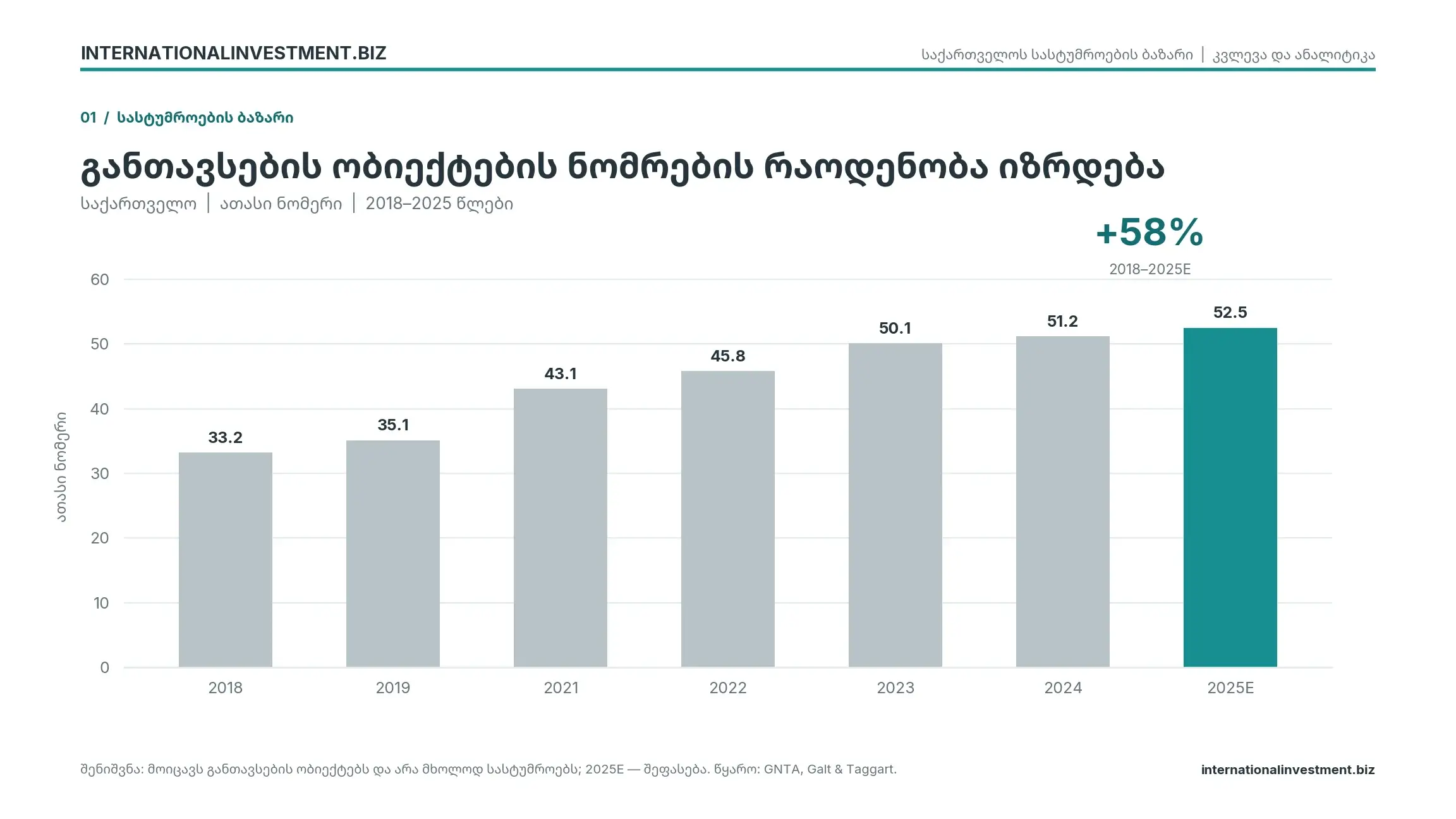
The number of rooms in Georgia's accommodation facilities has increased considerably over recent years. According to Galt & Taggart, the country had roughly 33.2 thousand rooms in 2018, rising to 50.1 thousand in 2023, and reaching 51.2 thousand in 2024. As for 2025, the total number of rooms in Georgian accommodation properties reached 52.5 thousand, which exceeds the 2018 figure by about 58% and the 2024 level by 2.5%.
The regional distribution of supply shows that a substantial share of the market is concentrated in two key hubs. According to estimates for 2025, 29.6% of the accommodation room supply was located in Adjara and an identical 29.6% in Tbilisi. Consequently, these two regions account for 59.2% of all rooms in the country.
As for the remaining regions, their share is comparatively modest: Samtskhe-Javakheti accounts for 7.5%, Kakheti for 7%, Imereti for 6.7%, and other regions combined for 19.6%.
This structure demonstrates that the primary capacity of Georgia's accommodation sector remains concentrated in the capital and Adjara. At the same time, the equal shares of Tbilisi and Adjara underscore the significance of both destinations—one as a tourist magnet and the other as a business hub.
It should also be noted that the supply data applies to the entire category of accommodation facilities as a whole and should not be viewed exclusively as room inventory in traditional hotels.
Batumi leads in price growth, while Tbilisi demonstrates improved occupancy
One of the main trends of the third quarter of 2026 was the simultaneous increase in hotel occupancy and average daily room rates.
In particular, during the third quarter, the average occupancy of the sampled hotels in Tbilisi stood at 79%, compared to 75% for the same period in 2025. Accordingly, year-on-year occupancy gained 4 percentage points.
Over the same period, the average daily rate (ADR) reached 94 US dollars compared to 87 dollars in the third quarter of the previous year. Thus, the increase amounted to approximately 8%.
As for Batumi, hotel occupancy in the third quarter reached 84%, which is 2 percentage points above last year's 82%.
At the same time, the average daily rate (ADR) reached 135 dollars, compared to 119 dollars during the same period in 2025. Consequently, the average daily room rate grew by approximately 13.4% year-on-year.
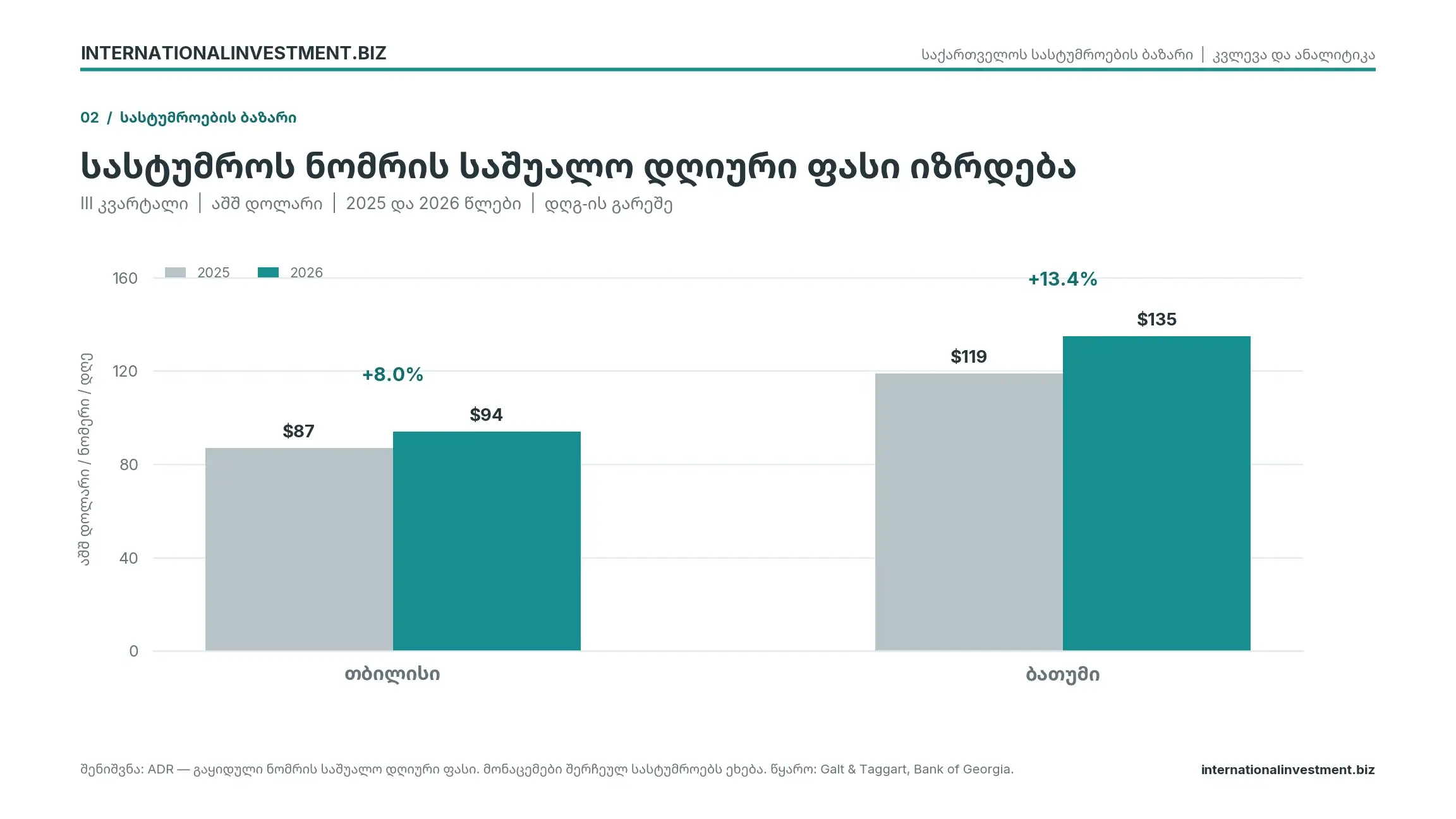
Therefore, the price growth rate in Batumi outpaced that of Tbilisi by roughly 5.4 percentage points. In addition, the average daily rate in Batumi hotels was 41 dollars higher than in Tbilisi, or approximately 43.6% higher.
This disparity goes beyond absolute price levels. Batumi also registered higher occupancy, reflecting the relatively strong seasonal position of the coastal hotel market during the third quarter.
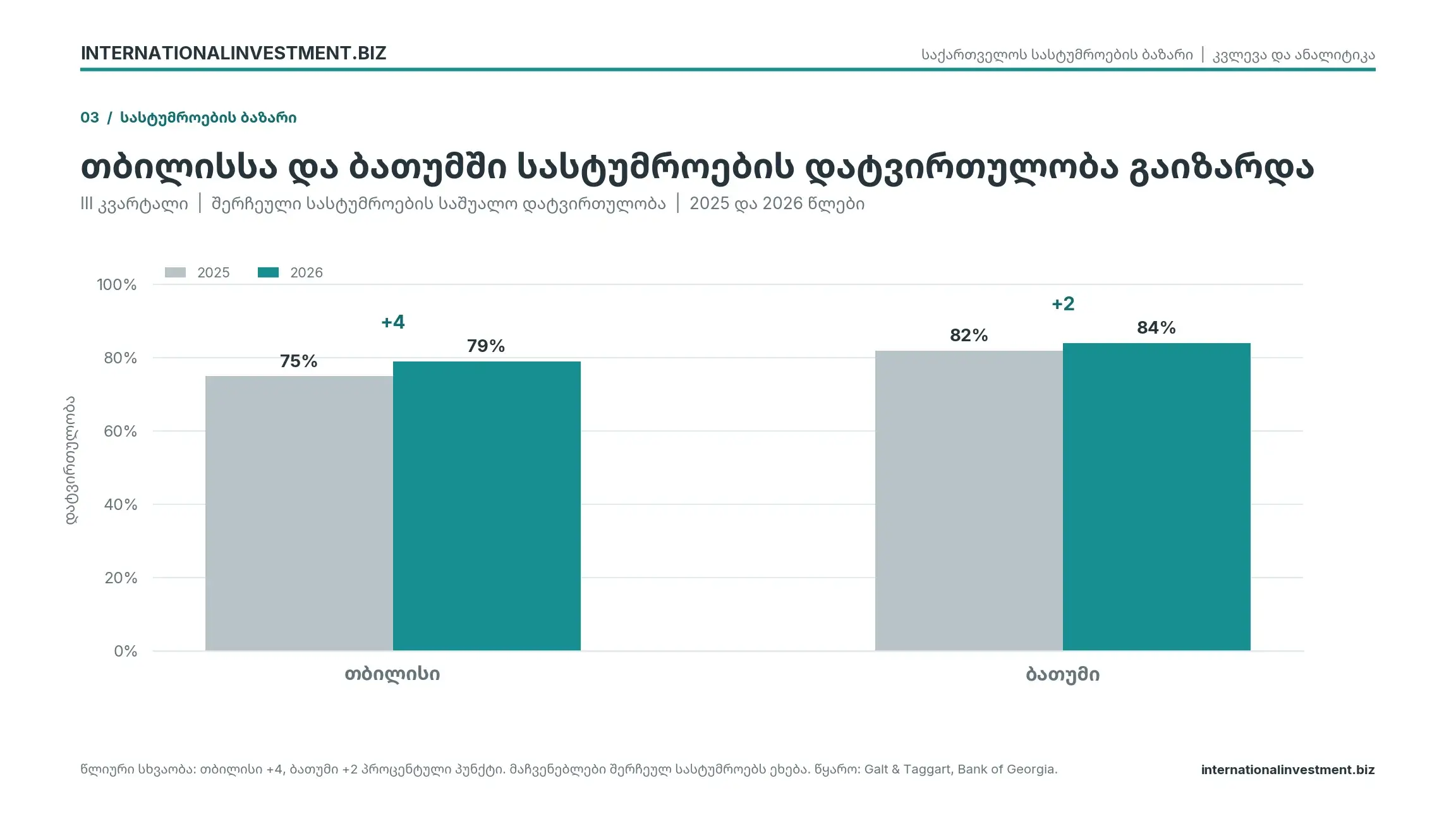
It is also worth noting that the ADR figures in the report are presented exclusive of VAT.
Seasonality is the main challenge for Batumi's hotel market
Seasonality analysis is crucial when evaluating the hotel market. Monthly data for 2026 presented by Galt & Taggart indicates that hotel occupancy dynamics in Batumi and Tbilisi differ markedly.
In Batumi, occupancy surges during the summer season. Specifically, according to 2026 data, occupancy in the sampled hotels was 25% in March, rose to 44% in April, 62% in May, and 72% in June.
Regarding subsequent months, the figure reached 85% in July, peaked at 90% in August, but then dropped to 77% in September.
A similar pattern was observed in room pricing. The ADR of Batumi hotels stood at around 149 dollars in August, falling to 118 dollars in September.
These figures clearly demonstrate that the summer season exerts an immense influence on hotel yield in Batumi. Peak occupancy and maximum room rates are achieved during the hotels' most active operational period. Once the high season ends, both indicators decline.
Remarkably, seasonal dynamics in Tbilisi follow a different course. In March 2026, hotel occupancy was 35%, climbed to 69% in May, 74% in June, 78% in July, 79% in August, and reached 81% in September.
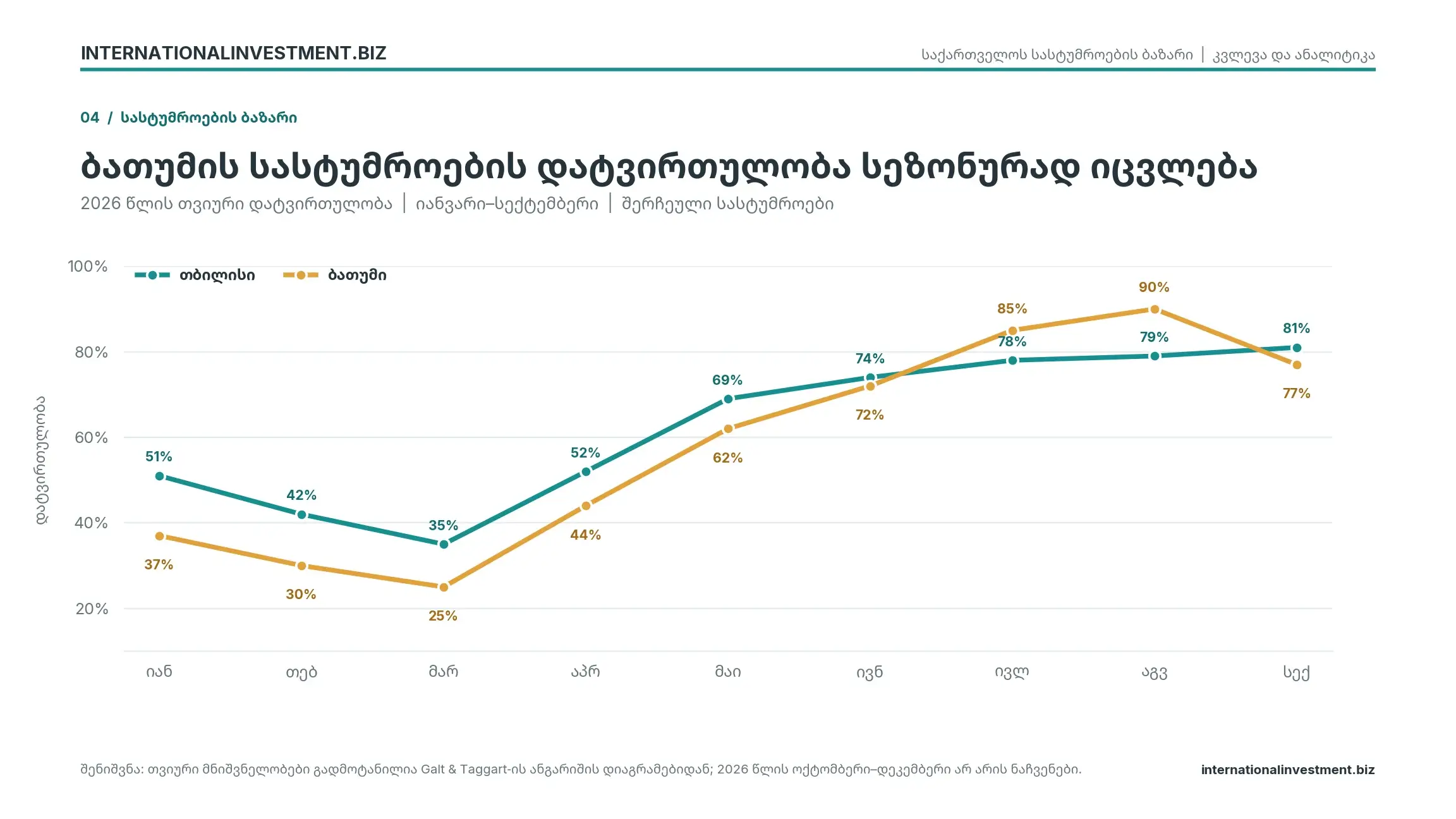
As a result, hotel occupancy in Tbilisi grew consistently throughout the summer and maintained a high level in September. In contrast to Batumi, no sharp seasonal drop was recorded by the end of the third quarter.
This difference highlights the distinct business models of hotels in the two cities: a substantial portion of Batumi's revenue depends on the intensive summer peak, whereas Tbilisi demonstrates far more stable occupancy trends.
Price growth indicates increased hotel yield
Occupancy alone is not sufficient when evaluating the outlook for the hotel business. The realized room rate is just as critical, since profitability depends both on the number of rooms sold and the revenue generated per room.
In the third quarter of 2026, both indicators improved in Batumi and Tbilisi, albeit at different paces.
In Batumi, a 13.4% increase in ADR occurred alongside a 2 percentage point increase in occupancy. In Tbilisi, ADR rose by approximately 8%, while occupancy improved by 4 percentage points.
This combination points to improved operational metrics across the hotel sector in both cities. Batumi deserves special attention due to its faster price growth.
However, rising prices do not automatically translate into net profit growth at the same pace. The bottom line is affected by operating costs, payroll, utilities, marketing, maintenance, financing costs, and other factors.
Consequently, the concurrent rise in ADR and occupancy serves as a positive indicator for the industry, yet sound investment decisions require assessing supplementary financial metrics.
Investment prospects: Batumi attracts with high seasonal revenue, Tbilisi with steadier demand
Analysis of Galt & Taggart data shows that the hotel markets of Batumi and Tbilisi offer distinct investment opportunities and risks.
In Batumi's case, the primary advantage lies in high occupancy and comparatively high room rates during the summer season. The climb in Q3 2026 ADR to 135 dollars from 119 dollars a year earlier indicates strong pricing potential in the sector.
However, this advantage is paired with substantial seasonal risk. Occupancy of 90% in August and 77% in September means hotel performance can heavily rely on just a few intensive months. Accordingly, when evaluating an investment project in Batumi, it is crucial to realistically model off-season occupancy, cash flows, and operating expenses.
As for Tbilisi, smoother seasonal dynamics, a 79% third-quarter occupancy rate, and an ADR of 94 dollars unlock different opportunities for the market. For investors, value lies not only in peak performance but also in the ability to sustain demand across diverse periods throughout the year.
The simultaneous growth of occupancy and prices in both cities creates a favorable environment for the hospitality sector. Nonetheless, the financial attractiveness of new hotel projects will depend on location, asset class, operational efficiency, and an accurate assessment of the competitive landscape.
Conclusion: growth persists, but accounting for seasonality remains crucial for successful investments
Third-quarter 2026 figures from Galt & Taggart point to improving operational trends across Georgia's hotel market. In Tbilisi, hotel occupancy is expanding, while in Batumi, average daily room rates are climbing at an accelerated pace.
At the same time, regional market concentration and pronounced seasonality in Batumi emphasize that investment decisions in the hospitality sector should not be made solely on the back of peak-season figures.
Going forward, stimulating demand outside the summer season and increasing annual average hotel occupancy will play a decisive role for Batumi. For Tbilisi, maintaining current demand levels and securing sustainable room rate growth remain paramount.
Overall, the results of the third quarter of 2026 reaffirm the positive trajectory of Georgia's hotel market. Long-term investment success, however, will depend not just on increasing room rates, but on generating stable year-round demand and running an efficient operating model.
Source: Galt & Taggart — Tourism Market Watch, 3Q26 Overview, October 22, 2026. Source for hotel occupancy and pricing data: Galt & Taggart, Bank of Georgia. Source for accommodation supply and regional distribution data: GNTA, Galt & Taggart.
Methodological note: hotel occupancy and ADR metrics refer to a sample of hotels rather than the entire statistical population of hotels nationwide. Regional distribution of accommodation capacity encompasses a broader category. The 2025 supply figure is an estimate.