read also
 Vietnam Mortgage Surge Pushes Homes Out of Reach
 Lithuanian Apartment Prices Accelerate Across Major Cities
 London Flats Lose Value Ahead of Leasehold Reform
 Construction of the Batumi–Sarpi Highway Begins in Georgia
 Baltic Property Investment Accelerates in 2026
 Hong Kong and Singapore Renew Their Expat Rivalry
Belarusian Cuisine Enters the World’s Top 100: TasteAtlas Ranking
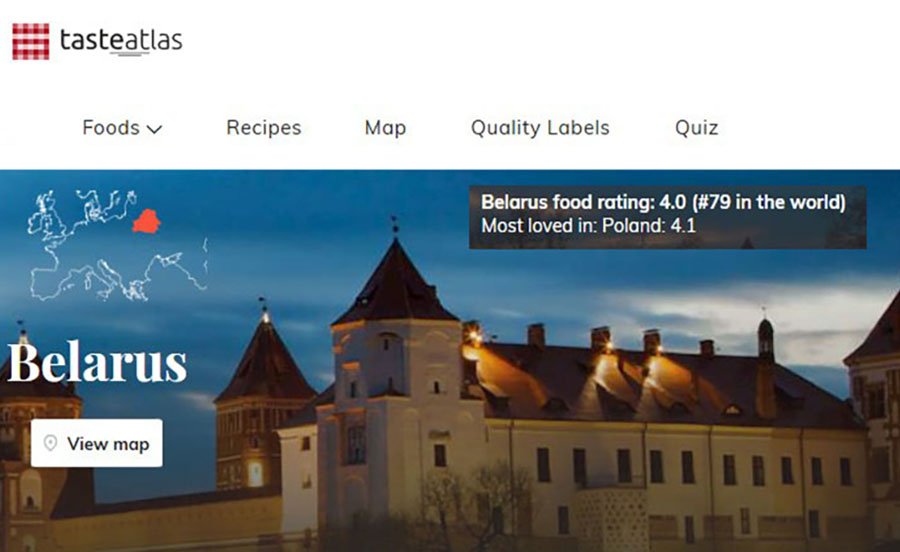
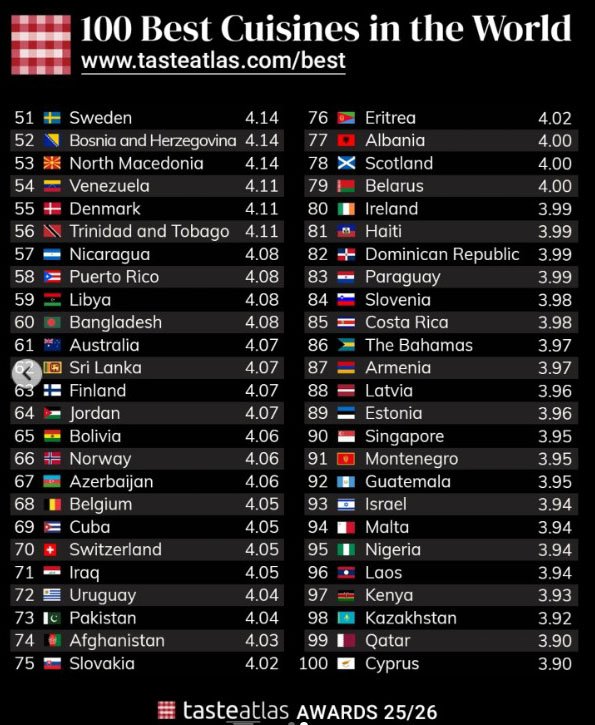
Belarusian cuisine has entered the global top 100 for the first time, ranking 79th in the worldwide TasteAtlas list, reports Charter’97. The national gastronomy received a score of 4 out of 5, reflecting growing international interest in the country’s traditional dishes and local flavors.
In 2025, more than 590,000 valid ratings were submitted for nearly 19,000 dishes and food products in TasteAtlas’ “100 Best Cuisines in the World” ranking, according to the platform. The gap between the leaders is minimal: the difference between first and tenth place in the top 10 is less than two-tenths of a point.
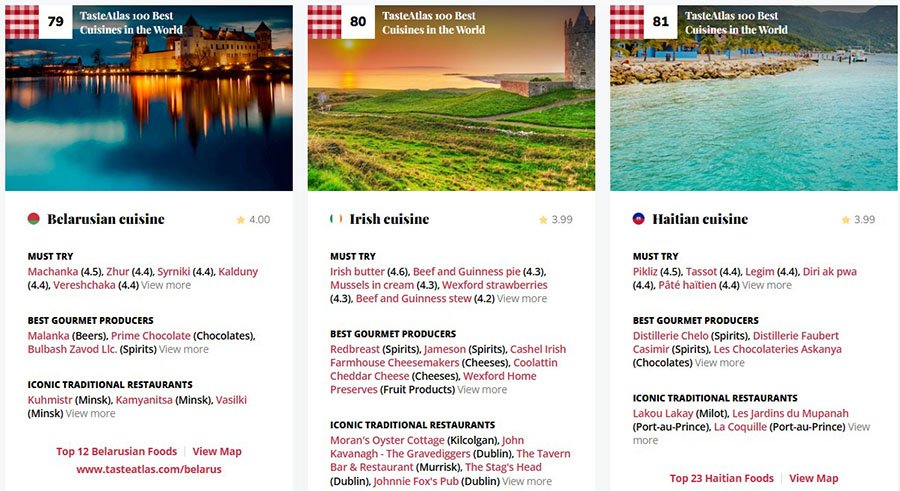
Among the most notable Belarusian dishes, users highlighted machanka, zhur, syrniki, kalduny, and vereshchaka. At the same time, one of the country’s most recognizable dishes — draniki — did not make the list of recommended foods, which came as a surprise.
TasteAtlas also points to venues where authentic Belarusian cuisine can be sampled. Among the recommended establishments are the restaurants “Kukhmistr,” “Kamyanitsa,” and the “Vasilki” chain, which, according to the portal, most accurately reflect the country’s national culinary traditions.
Belarus is ranked alongside Slovakia (75th), Eritrea (76th), Albania (77th), and Scotland (78th). Below it are Ireland (80th), Haiti (81st), the Dominican Republic (82nd), and Paraguay (83rd). This clustering underscores that this segment of the ranking includes cuisines that are consistently well perceived by international audiences but remain less represented in the global restaurant landscape compared with the list’s leaders.
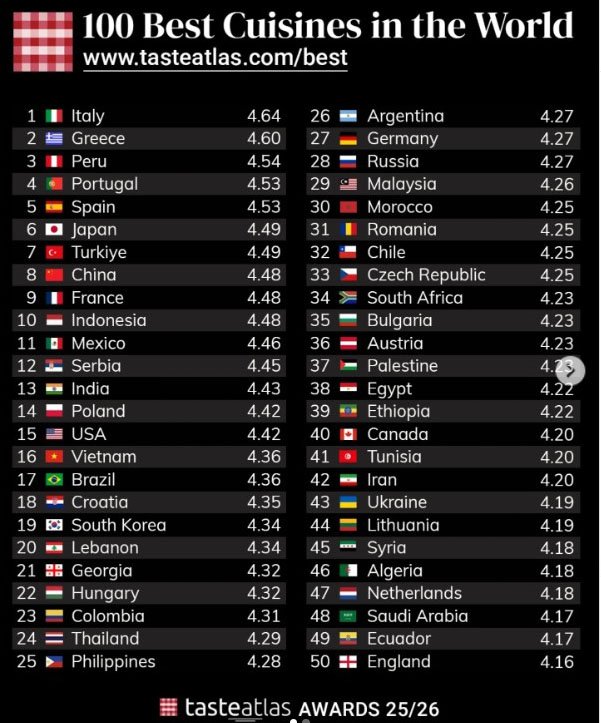
Italy topped the ranking with a score of 4.64. Among its signature dishes and products, TasteAtlas highlights Neapolitan pizza, Parmigiano Reggiano cheese, prosciutto, traditional pasta varieties, and regional cheeses. Greece ranks second (4.60), with moussaka, souvlaki, spanakopita, and fava from Santorini among its most recognizable dishes. Peru is third (4.54), noted for pollo a la brasa, ají criollo, ocopa sauce, and traditional desserts.
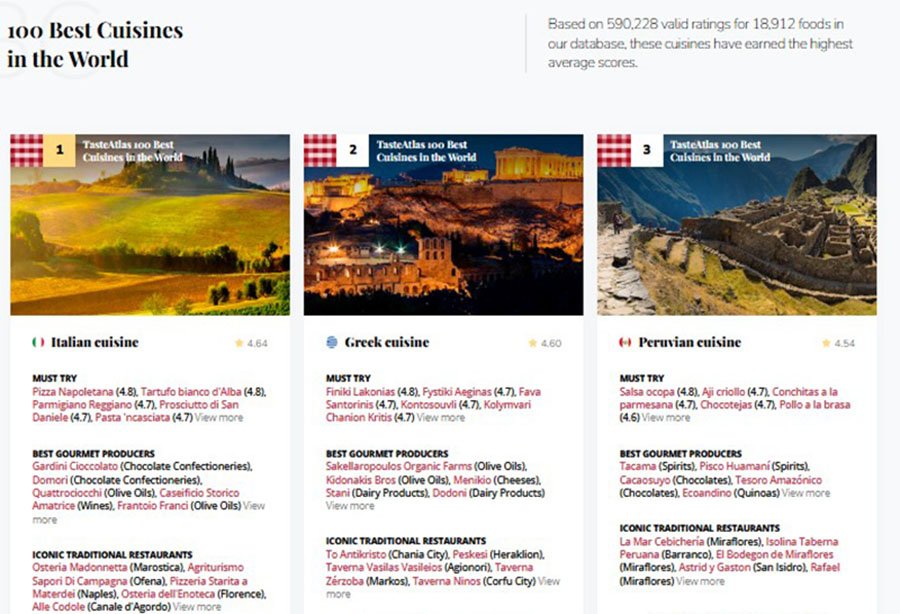
The TOP 10 also includes:
Portugal — pastéis de nata, bacalhau (salted cod) dishes, regional meat products, and olive oil;
Spain — jamón ibérico, Spanish tortilla, paella, and smoked paprika pimentón de la Vera;
Japan — sushi, nigiri, ramen, wagyu dishes, and donburi;
Turkey — kebabs, meze, baklava, the traditional Turkish breakfast kahvaltı, and döner;
China — dim sum, dumplings, Lanzhou noodles, hot pot, and mapo tofu;
France — baguette, croissants, cheeses, ratatouille, and classic meat dishes;
Indonesia — rendang, nasi goreng, satay, soto, and Padang cuisine dishes.
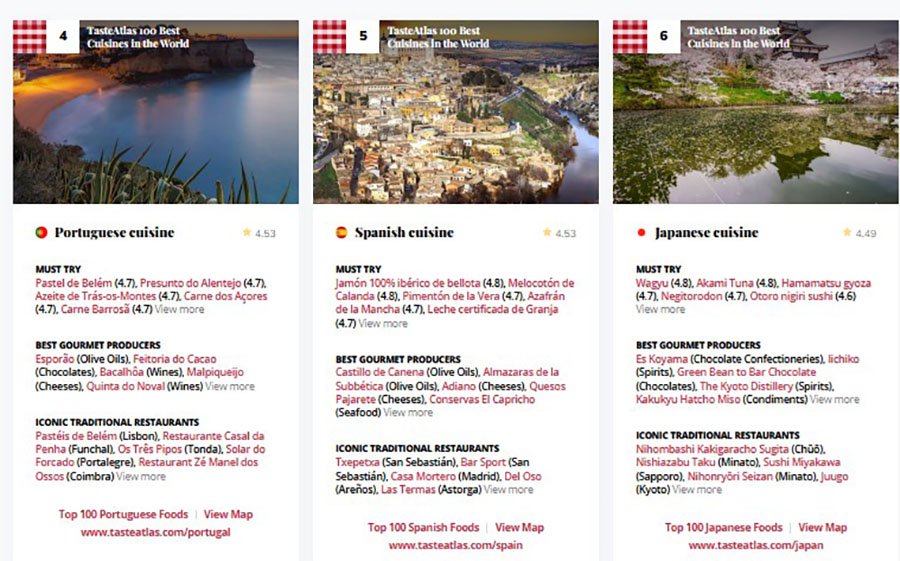
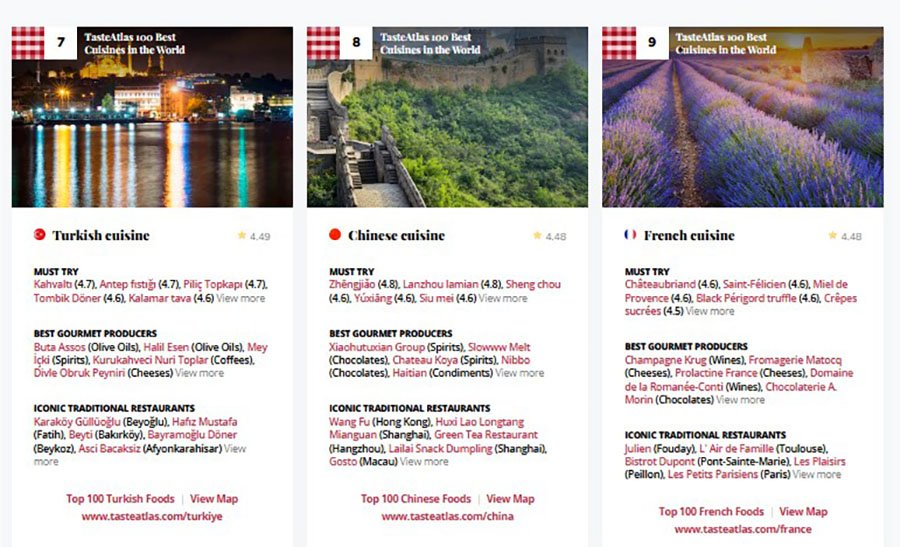
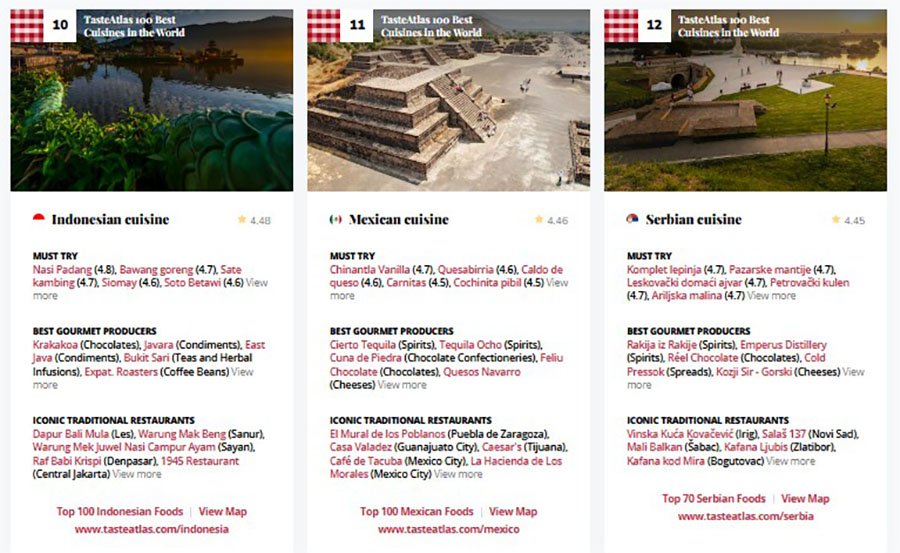
The TasteAtlas results point to the sustained dominance of European countries in the world’s top 100 national cuisines, particularly those of the Mediterranean. Italian and Greek cuisines occupy the top two positions, while Spain and Portugal are in the top five. This distribution is linked not only to taste preferences but also to the long-term effects of tourism, a well-developed restaurant environment, and systems of protected products with geographical indications, which have ensured high international visibility for these cuisines.
At the same time, the ranking reflects growing interest in gastronomies beyond the Western European tradition. Peruvian cuisine ranks third, becoming the highest-placed representative from Latin America. In Asia, Japan stands out in sixth place, while China and Indonesia round out the top ten. This indicates a widening geographic scope of the ranking and sustained demand for non-European cuisines that have already established themselves in the international restaurant scene.
The upper part of the list is typically occupied by cuisines that are easily reproduced outside their countries of origin. Their dishes are accessible to a broad audience, require little adaptation, and have long been integrated into global tourism and restaurant circulation. This explains the proximity of Mediterranean traditions, highly standardized Japanese gastronomy, and Peruvian cuisine, which has been actively promoted on the global culinary stage.
The ranking format has its limitations. It is based on user ratings and largely reflects the experiences of tourists and residents of major cities rather than the everyday cuisine of smaller regions. Differences between regional traditions within large countries — such as China, India, or the United States — are not fully captured in a single aggregate score, while cuisines less represented in international tourist flows receive fewer votes regardless of their gastronomic quality.
Overall, TasteAtlas constructs a hierarchy of national cuisines based on user perception, reflecting the current distribution of attention and interest among global audiences. The ranking shows which culinary traditions are most visible on the international stage today and highlights the role food plays in shaping cultural presence and soft power.