







 Belgian Industrial Property Draws €537m of Capital
 Madrid to Build €1 Billion City of Health Complex
 Buying Land in Argentina: Restrictions for Foreigners
 Albania Limits Residential Development in Resort Complexes
 10,883 Apartments Sold in Batumi in 2026 — Galt & Taggart
 Hilton and Scandic Plan New Hotels Across Nordics
Australian Property Market: Fastest Downturn in 40 Years
Australia’s property market is experiencing its fastest price decline in 40 years. Home values have been falling for seven consecutive months, with the downturn now reaching cities that previously led the growth. Yet buyers are in no hurry to take advantage of lower prices: high mortgage costs are largely offsetting the potential savings.
Trends in Australian House Prices
Across Australia’s state capitals, property values have fallen by 8.1% in seven months. Prices have not dropped this quickly in at least 40 years. During the 2022–2023 downturn, the decline over a comparable period was 7%. The current fall, however, has not yet broken the record for the deepest overall downturn: between 2017 and 2019, housing values lost 8.2% from peak to trough. That decline unfolded over almost two years, while a similar fall has now taken just a few months.
Buyer activity has weakened considerably. According to Cotality, sales from August to October 2026 were down 23% compared with the same period in 2025. Properties are taking longer to sell: finding a buyer now takes an average of 39 days, the longest since August 2020. Sellers are increasingly accepting discounts, averaging 4.7% below the original asking price. Even at auctions, where vendors hope buyers will compete, fewer than half of the properties offered find new owners.
Where Property Prices Are Falling Fastest
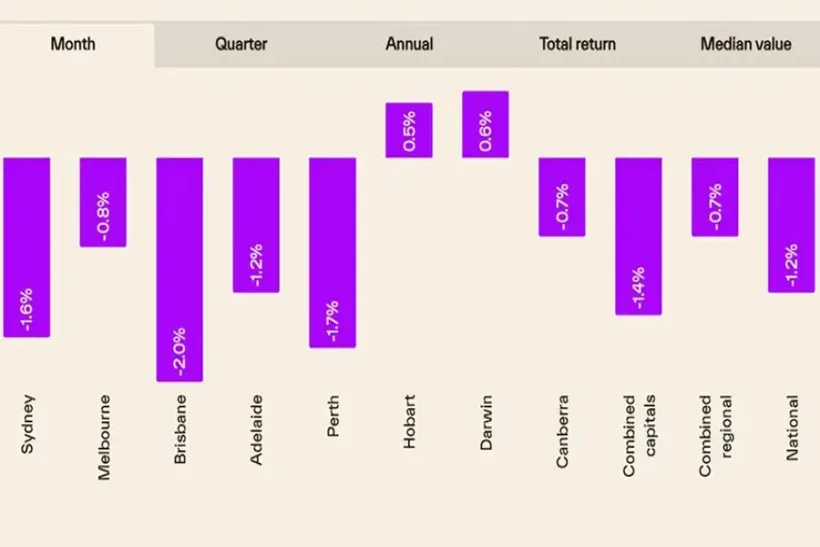
Brisbane recorded the sharpest decline in October, with property values down 2% over the month and 6.1% over three months. In Perth, the respective falls were 1.7% and 5.7%. Both cities were among the leaders in price growth until recently but are now among the hardest hit by the downturn. In Sydney, prices fell 1.6% in a month and stood 1.5% below their October 2021 level. Melbourne faces an even tougher situation, with housing values down 7.3% over five years.
According to Domain, house prices in Australia fell across every state capital in the third quarter for the first time in 15 years. Apartments proved more resilient, declining by an average of 3.5%, compared with 4.7% for detached houses. More affordable properties continue to attract buyers despite high mortgage rates.
Median House and Apartment Prices in Australian Cities, Q3 2026
|
City |
Houses, AUD |
Change, % |
Apartments, AUD |
Change, % |
|
Sydney |
1,661,167 |
−4.7 |
820,890 |
−3.0 |
|
Melbourne |
1,014,335 |
−3.3 |
563,199 |
−3.7 |
|
Brisbane |
1,152,122 |
−5.4 |
783,357 |
−3.0 |
|
Perth |
1,115,227 |
−7.4 |
659,561 |
−6.5 |
|
Adelaide |
1,095,429 |
−3.0 |
584,389 |
−3.8 |
|
Canberra |
1,025,084 |
−2.6 |
485,276 |
−4.2 |
|
Hobart |
790,155 |
−3.0 |
584,127 |
−2.7 |
|
Darwin |
752,478 |
−2.6 |
454,732 |
+2.2 |
Why Buyers Are Leaving the Market
On 3 November, Australia’s cash rate rose to 4.85%, its highest level since late 2008. The Reserve Bank raised it for the fifth time in 2026 in an effort to contain inflation. Tighter lending conditions have become one of the main reasons for weaker housing demand.
Cotality estimates that monthly mortgage repayments in Australia have increased significantly. For example, a borrower with a loan of AUD 742,000 now pays approximately AUD 600 more each month than in January. A household on an average income can also borrow AUD 88,000 less than at the beginning of the year. Even falling house prices have not offset the deterioration in borrowing conditions.
Rising living costs and changes to tax policy affecting investors are adding to the pressure. Investor activity has declined since the May budget was presented. Prospective buyers are postponing purchases in the hope of further price reductions, while sellers have to make concessions to secure a sale.
Housing Affordability in Australia
Falling prices have done little to improve housing affordability in Australia. According to Domain, houses in the major cities have become an average of AUD 81,000, or 6.2%, cheaper than at their previous peaks. Yet estimated monthly mortgage repayments have fallen by just AUD 10. Higher interest rates have virtually wiped out the benefit for buyers.
Monthly Mortgage Repayments in Australian Cities, AUD
|
City |
At price peak |
September 2026 |
Change |
|
Sydney |
8,195 |
8,211 |
+0.2% |
|
Melbourne |
4,938 |
5,014 |
+1.5% |
|
Brisbane |
5,926 |
5,695 |
−3.9% |
|
Adelaide |
5,495 |
5,415 |
−1.5% |
|
Perth |
5,628 |
5,513 |
−2.1% |
|
Canberra |
4,971 |
5,067 |
+1.9% |
|
Hobart |
3,964 |
3,906 |
−1.5% |
|
Darwin |
3,759 |
3,720 |
−1.0% |
|
All capitals |
6,073 |
6,063 |
−0.2% |
Source: Domain. Estimated repayments are compared at each city’s peak house prices and in Q3 2026.
The situation is particularly difficult in Sydney, Melbourne and Canberra, where servicing a home loan has become more expensive despite falling property values. For repayments in the major cities to be 10% below their previous peaks, house prices would have to fall by another 9.8%. This is a calculation based on third-quarter lending conditions, not a forecast of further market declines.
Outlook for Australia's Property Market in 2027
Australia’s property market is likely to remain under pressure in the coming months. Cotality forecasts further price declines and fewer transactions. Analysts link a recovery in demand to an easing of monetary policy, although interest rate cuts are not expected before the second half of 2027. A shortage of new housing construction may limit the scale of the downturn, but high borrowing costs continue to hold back buyers.
According to analysts at International Investment, current conditions are most favorable for buyers with their own funds. They have more room to negotiate prices, especially when a seller is keen to close a deal quickly. Investors relying on loans need to assess rental yields and debt-servicing costs more carefully. Investment prospects will also depend on the individual city, local demand and the potential for long-term capital appreciation.
Frequently Asked Questions
Why are property prices falling in Australia?
High mortgage rates have reduced purchasing power and demand for housing.
How much have Australian property prices fallen in 2026?
By October, Cotality’s national index was 6.7% below its March peak, while values across the state capitals had fallen by 8.1% over seven months.
Which Australian cities are seeing the steepest price declines?
Brisbane (−2% over the month) and Perth (−1.7%) led the declines in October. Sydney recorded a 1.6% drop.
Has housing become more affordable for buyers?
Hardly. Higher mortgage costs have largely erased the benefits of lower property prices.
What can the market expect in 2027?
Cotality sees scope for further price declines. A recovery in demand will depend heavily on future interest rate decisions.