











Aviation fuel crisis: 2 million seats and 12,000 flights cut
Cirium
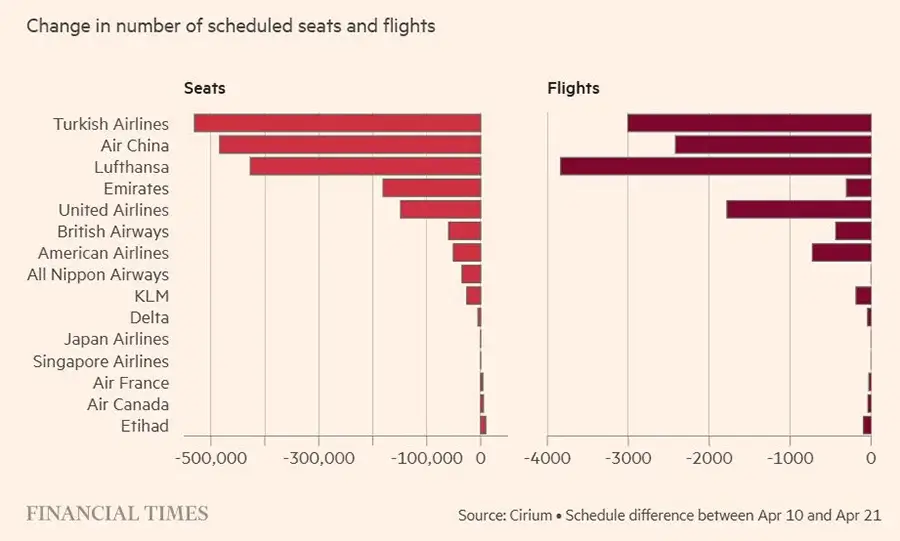
Airlines are being forced to sharply cut capacity due to the fuel crisis. Over the past weeks, 2 million seats and around 12,000 flights have been removed from May schedules, the Financial Times reports, citing data from Cirium. These developments have been driven by the war in the Middle East, which continues to destabilize international air transport.
Contraction of the global aviation market
In May, the global airline market recorded a decline in total seat capacity from 132 million to 130 million, reflecting not isolated adjustments but a systemic contraction of route networks and a broader reassessment of global aviation structures. Against this backdrop, passenger flows are being redistributed between regions, alongside a shift in the balance between transit and direct routes.
Additional pressure is emerging from a sharp change in demand geography. According to Eurocontrol, passenger traffic between Europe and the Middle East fell by 54% year-on-year in the week of April 6–12, despite overall capacity growth and preparations for the seasonal peak.
Network restructuring and airline responses
Lufthansa has announced the reduction of around 20,000 flights and the gradual retirement of part of its less efficient fleet, aiming to cut fuel consumption by approximately 40,000 tonnes during the summer period. British Airways, China Airlines, and ANA are also adjusting route networks and reallocating capacity across long-haul destinations.
United Airlines has announced a reduction of around 5% in flights in the second and third quarters of 2026. Fuel costs now exceed 20% of the company’s operating expenses, and management has warned of potential annual losses of up to $11 billion if current price trends continue.
Delta Air Lines has reduced its network by approximately 3.5% in the second quarter, while KLM plans to cut around 80 flights to and from Schiphol. Air France-KLM has also restricted expansion of services to Singapore and Tokyo at the request of Asian hub airports.
Carriers in the Gulf region — Emirates, Etihad Airways, and Qatar Airways — are revising their May schedules, including cancellations of selected flights. Air China ranked second in terms of seat reductions, including domestic services between Chengdu and Beijing.
Fuel prices and disruption of logistics
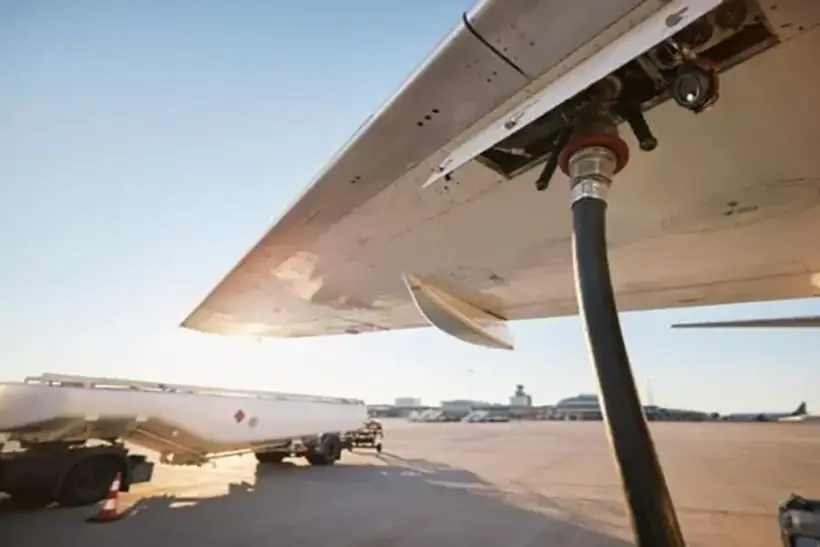
Since the beginning of the conflict in the Middle East, jet fuel prices have doubled, sharply increasing operating costs and forcing a reassessment of the economics of several routes, particularly long-haul services. The closure of airports in Gulf countries, which previously handled around one-third of Europe–Asia flights, has disrupted established transit chains and redirected passenger flows toward alternative hubs.
The Gulf region and East Asia are among the most exposed areas due to their reliance on fuel supplies through the Strait of Hormuz, where risks of disruption remain amid geopolitical tensions. Aviation analyst John Strickland noted that the situation now presents not only price volatility risks but also the possibility of physical fuel shortages, fundamentally changing the nature of industry risk.
In some countries, restrictions on jet fuel use are already being introduced. Vietnam has begun partial regulation of aviation kerosene supplies, while officials at Incheon Airport in Seoul say that “price and demand” have become key factors in managing air transport operations.
Structural deficit and long-term outlook
According to the International Energy Agency, global jet fuel demand in 2025 averaged around 7.8 million barrels per day, of which approximately 2 million barrels per day were international supplies, highlighting the sector’s heavy reliance on external fuel trade. Exports from Gulf countries accounted for around 400,000 barrels per day, or roughly one-fifth of global trade, making the region a critical supply source for global aviation.
The reduction of these flows has already created a structural imbalance, which the IEA expects to intensify as oil refining output declines. In 2026, global refining capacity may fall by around 1 million barrels per day, leading to an additional reduction in jet fuel supply of about 200,000 barrels per day compared with pre-crisis levels. The peak deficit is expected in the second quarter, when up to 500,000 barrels per day could be removed from the market, increasing pressure on the global aviation system.
Air France-KLM CEO Ben Smith said the changes have already created a significant imbalance between supply and demand in the global travel market. Analysts at International Investment note that the aviation industry is effectively shifting toward a structurally constrained model, where limited fuel supply increasingly determines the configuration of global routes and overall connectivity. This deepens the sector’s dependence on energy market conditions and turns short-term supply fluctuations into a structural planning factor.