







 Yerevan Real Estate: Rising Prices and the Risk of Overheating
 Cipriani Batumi: Italian Luxury Hospitality Brand Enters Georgia
 Vietnam Real Estate: The Price Boom Gives Way to a Slowdown
 How Much Does Real Estate Cost in Batumi?
 Vienna Hotel Nights Rise as August Revenue Falls
 Investments, New Terminal, and Passenger Growth: Batumi Airport Plans Major Expansion
Foreign Tourists Stay Longer in Georgia: 2026 Trends
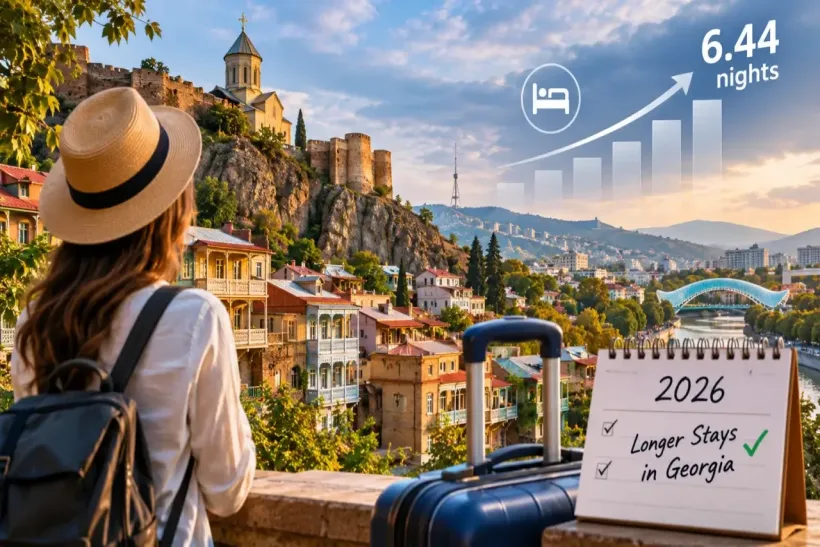
In the first three quarters of 2026, the average number of nights spent by foreign visitors per trip to Georgia increased compared to the same period last year. However, the growth rate has gradually slowed. In the third quarter, the figure reached 6.44 nights, which is 2.2% higher than in the same period of 2025.
2026: Visit Duration Grows, but Growth Rate Slows Down
According to the National Statistics Office of Georgia (Geostat), in the first three quarters of 2026, the average number of nights spent by foreign visitors per trip to Georgia exceeded the figures of the corresponding periods of last year.
The highest annual growth was recorded in the first quarter. In January–March, the average length of a single trip was 5.87 nights, compared to 5.50 nights in the same period of 2025. Accordingly, growth stood at 6.8%.
In the second quarter, the average dropped to 5.48 nights, yet was still 3.5% higher compared to the same period of last year. In April–June 2025, the average number of nights spent per trip was 5.30.
In the third quarter, the figure rose again to reach 6.44 nights. Annual growth was 2.2% — in July–September 2025, foreign visitors spent an average of 6.31 nights per visit in Georgia.
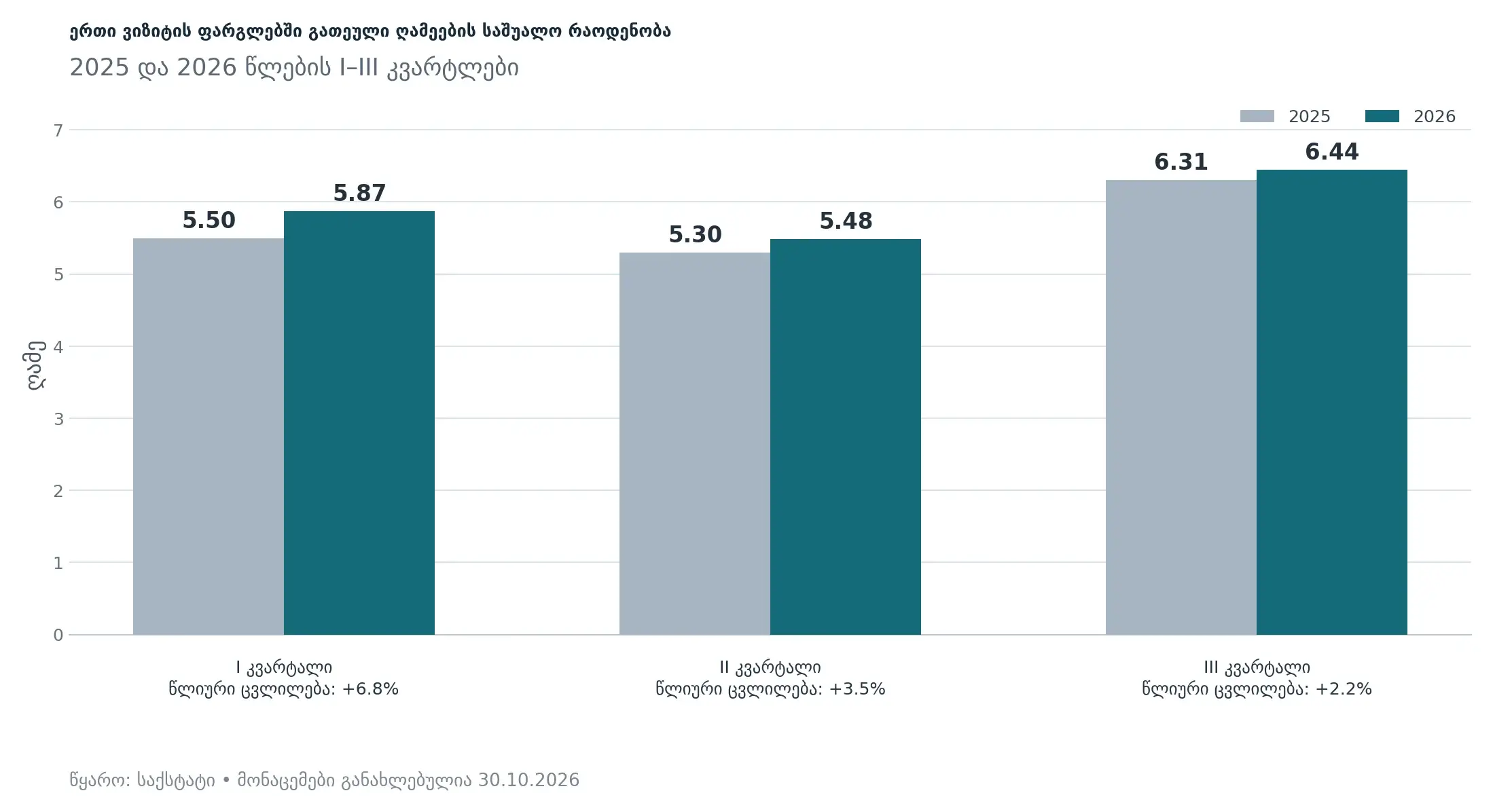
The data shows that in 2026 the average trip length increased across all three quarters, yet the pace of year-on-year growth slowed consecutively. Consequently, the current trend is upward, but its intensity has eased compared to the first quarter.
Summer Season Traditionally Marked by the Longest Stays
Quarterly dynamics also highlight the seasonal pattern of tourist activity in Georgia. In the third quarter of 2026, the average duration of a single trip exceeded the second quarter's figure by 17.5%.
The 6.44 nights recorded in July–September became the peak result for the first three quarters of the year, echoing a seasonal pattern observed in previous years. Specifically, in 2024 and 2025, the highest average duration was also registered in the third quarter.
At the same time, the Q3 2026 result is higher than the corresponding periods of the past three years. In Q3 2024, it was 6.18 nights, and in 2025 — 6.31 nights. Nevertheless, despite the growth, it remains below the Q3 2022 level, which reached 6.76 nights.
Accounting for seasonality is crucial when planning tourist infrastructure and hospitality accommodation. An increase in the average length of stay may indicate shifts in demand structure; however, for a comprehensive assessment of business performance, it is equally essential to analyze visitor flow dynamics, room occupancy, and average expenditure per trip.
Longer Stays and Lower Spending: A Contradictory Economic Picture
An increase in the average duration of trips does not automatically translate into higher revenue for the tourism sector or increased spending per visitor.
This is confirmed by Geostat data, according to which international visitor trips totaled about 2.6 million in the third quarter of 2026, up 3.3% compared to the same period last year. Over the same timeframe, the number of overnight tourist trips increased by 4.7%. However, total spending during visits in the third quarter amounted to 5.7 billion GEL, representing an annual decrease of 8.2%. The average expenditure per trip declined by 11.1% to 2 194.4 GEL.
This divergence is of particular importance for hotels and the hospitality real estate market. Foreign guests staying more nights in the country generates demand for longer accommodation, yet driving revenue growth solely through trip length is impossible. The key drivers remain visitor spending structure, accommodation type, pricing, and seasonal occupancy. Consequently, when evaluating tourism investments, stay duration must be analyzed alongside other economic indicators.
Annual Trend: Moderate Recovery Following the 2022 Peak
Annual figures provide a clearer overview. Specifically, between 2015 and 2019, the average number of nights spent in Georgia per trip was predominantly characterized by growth. In 2015, the figure stood at 3.37 nights, rising to 3.85 in 2016, 4.17 in 2017, and reaching 4.19 nights in 2018. A slight decline occurred in 2019, with the average duration falling to 4.11 nights.
During the initial post-pandemic years, the indicator surged. In 2022, the average number of nights per trip hit 6.25, the highest figure among available annual records. Subsequently, in 2023, the average duration declined to 5.40 nights (a 13.6% drop compared to 2022). Over the following two years, growth resumed: the metric reached 5.54 nights in 2024 and 5.63 nights in 2025.
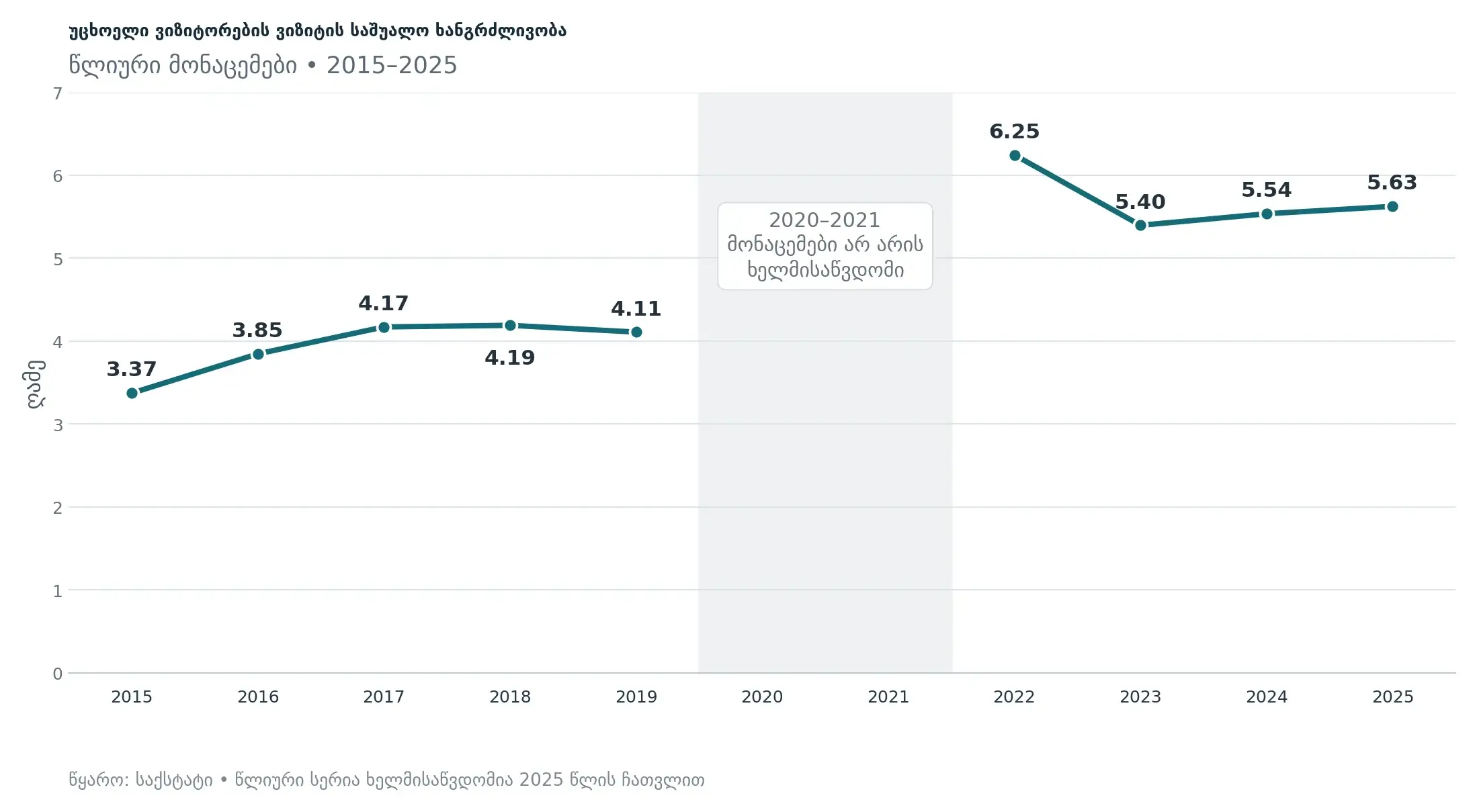
As the chart illustrates, the 2025 result exceeds the 2019 figure by 36.9%. At the same time, it is roughly 9.9% below the peak level of 2022, while compared to 2015, the average number of nights per trip has risen by 66.8%. Thus, annual data highlights two primary phases: relatively consistent growth in 2015–2019, followed by a post-2022 spike correction in 2023, which then transitioned into a moderate recovery throughout 2024–2025.
In Which Direction Is Tourism Demand Transforming?
The results of the first three quarters of 2026 demonstrate that the average stay duration of foreign visitors in Georgia maintains an upward trajectory. However, the decelerating annual growth rate and decreasing average expenditure per visit suggest that assessing the tourism market based solely on tourist arrivals or length of stay is insufficient. For the development of tourism and hospitality businesses, as well as for evaluating real estate investment potential, the primary factor is no longer just visitor volume, but the effective conversion of time spent in the country into economic activity.
Long-term data confirms that foreign visitors' average length of stay has increased significantly compared to pre-pandemic periods. The 2026 findings indicate the continuation of this trend; however, assessing its sustainability requires tracking full-year annual results and subsequent dynamics.